
Most failed estimates fall victim to “cost-plus” thinking without a strategic ceiling. When you calculate your costs and add a random “buffer” amount, you are practicing accidental pricing. This approach fails to account for indirect overhead—the silent killers like equipment depreciation, software licenses, and administrative salaries. A defined target profit margin acts as a financial filter, ensuring that every project contributes its fair share to the company’s long-term viability rather than just covering the immediate bills.
When Target Profit Margin Is NOT Considered in Estimates
When estimates are generated without defining a clear profit margin,
Businesses unknowingly operate at a survival level instead of a growth mode.
What looks like revenue slowly turns into hidden losses.
- Estimates look competitive but lack real profitability.
- Projects show profit initially but collapse after expenses.
- There is no buffer for delays, rework, or scope changes.
- Cash flow pressure becomes a constant problem.
- Teams work harder, but the business does not grow.
- The founder stays busy but earns less over time 😵
- Long-term stability becomes impossible.
Challenges Faced When Target Profit Margin Is Ignored
False Profit Visibility
Estimates appear profitable, but once overhead, taxes, and operational costs are considered
are paid, there is little or no real profit left.
Constant Cash Flow Pressure
Revenue enters the business but exits just as quickly.
Without a profit margin, businesses struggle to build reserves.
Underpricing Becomes Normal
Winning projects with thin pricing conditions clients to expect
low prices, which tend to lock the business into a race to the bottom.
No Safety Buffer
Any mistake, delay, or change request instantly converts
the project into a loss-making engagement, which is not good for the businesses.
Founder Dependency Increases
Founders compensate for low margins by doing sales.
management, and operations themselves, blocking scalability.
Team Burnout & Quality Decline
Low margins force unrealistic timelines and workloads.
reducing quality and increasing employee turnover.
Growth Plans Stall
Without profit, there is no hiring, no marketing,
no systems and no innovation, only survival.
Pricing Loses Credibility
Frequent revisions, discounts, and inconsistent pricing
damage client trust and long-term reputation.
Stress-Driven Decisions
Short-term financial pressure forces acceptance of
bad clients, off-scope work, and risky projects.
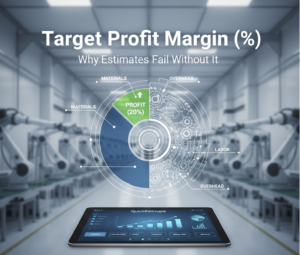
Don’t leave your growth to chance—integrating a target profit margin into your digital estimates ensures every project covers overhead and drives scalability.
Important Insight
Profit is not a leftover amount. It must be planned into every estimate,
or the business will slowly bleed financially.
How Skipping Profit Margin Damages Estimates Over Time
- Projects start strong but end with financial stress.
- Business owners personally absorb losses.
- Good clients leave, bad clients stay.
- Pricing trust erodes over time.
Why Target Profit Margin Is Critical for Long-Term Survival
Without a planned profit margin, even one delayed payment or
Unexpected costs can push a business into serious trouble.
If your estimate does not include profit, you are working for free—with risk.
How to Fix Estimates That Ignore Target Profit Margin
Step 1: Calculate the Total Project Cost First
- Direct labor
- Materials and tools
- Subcontractors
- Overhead allocation
This is your true cost base.
Step 2: Define Your Target Profit Margin (%)
- Low-risk projects: 10–15%
- Standard projects: 15–25%
- High-risk or complex projects: 25–40%
Separate Cost and Profit Clearly
- Project cost ✔
- Overhead ✔
- Risk buffer ✔
- Profit margin ✔
Use Standardized Estimation Rules
- Profit is applied consistently
- No emotional pricing
- No last-minute discounts
- No hidden losses