
Ignoring the company’s running costs in estimates is one of the biggest reasons
Businesses struggle despite winning projects. When monthly expenses such as salaries,
rent, software, and administration are not included, profits disappear after delivery.
Over time, this leads to cash flow stress, team burnout, and long-term business risk.
When Company Running Costs Are NOT Considered in Estimates
When a business generates estimates without accounting for its complete operating expenses,
Achieving sustainable profit becomes nearly impossible. This often results in disputes with
clients and internal pressure on teams.
- Estimates start looking artificially generated and cheap.
- At the start, projects show profit on paper but result in real financial loss.
- The company’s cash flow slowly begins to choke.
- There is always team pressure, and burnout increases.
- Your business growth becomes impossible.
- The founder works more but earns very little. 😵
- All of this creates long-term risk that can lead to a business shutdown.
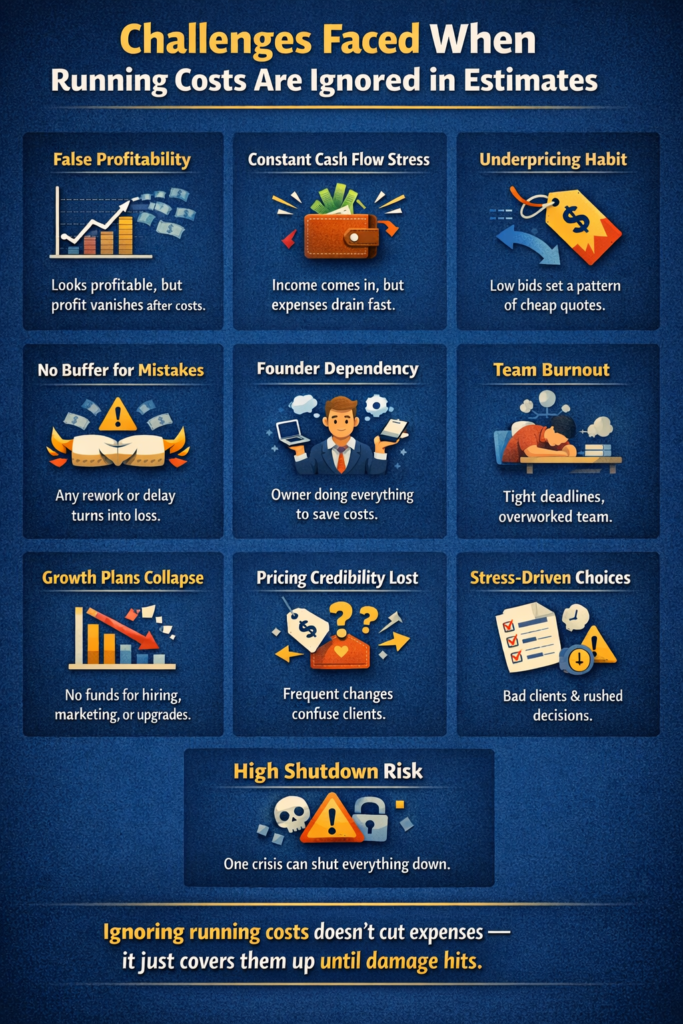
Challenges Faced When Company Running Costs Are Ignored in Estimates
False Profitability
Projects appear profitable at first, but once salaries, rent, tools,
utilities, and administrative expenses are paid, the profit disappears.
Constant Cash Flow Stress
The Revenue enters the business but disappears quickly due to fixed monthly costs.
leading to delayed payments, borrowing, and rushed project decisions.
Underpricing Becomes a Habit
Winning projects with low estimates tends to keep businesses underpriced
In future bids for any projects, trapping businesses in a race to the bottom.
No Buffer for Mistakes
If there is any rework, delay, or scope creep in any projects, it instantly converts the project into a loss.
Founder Dependency Increases
Founders start handling everything like sales, project management, admin, and support to reduce costs, which leads to a bottleneck for business growth.
Team Burnout & Quality Drop
Low estimates create imaginary timelines and excessive workloads, directly impacting delivery quality and employee morale.
Growth Plans Collapse
Without margin, there is no hiring, no marketing, no process improvement,
and no innovation—only survival.
Pricing Loses Credibility
Frequent discounts, revisions, and price changes confuse clients
and damage long-term trust.
Stress-Driven Decisions
Short-term cash needs force businesses to accept bad clients. off-scope projects and poorly planned work.
Important Insight
Company running costs are a monthly commitment, not one-time expenses. Ignoring them in estimates leads to long-term failure.
How Skipping Company Running Costs Affects Estimates Over Time
- Projects start profitable but end up in losses.
- Owners personally bear business expenses.
- Bad clients are replaced with good ones.
- Pricing credibility and trust loss.
Why You Must Include Running Costs to Avoid Long-Term Risk
A single delayed payment, unexpected expense, or emergency can push the
business toward closure when running costs are ignored.
If an estimate doesn’t pay your company’s monthly bills, it’s not an estimate, it’s a gamble.
How to Fix Estimates That Ignore Company Running Costs
Step 1: Calculate Your True Monthly Running Cost
- Salaries and contractor payouts
- Office rent and utilities
- Software tools and licenses
- Internet, hosting, and cloud services
- Admin, HR, and accounting
- Founder salary (non-negotiable)
- Marketing and sales costs
This is your survival number.
Convert Monthly Cost into Hourly Overhead
- Monthly running cost: $30,000
- Billable hours per month: 1,200
Overhead per hour = $25
Separate Estimates into Clear Cost Buckets
- Direct labor
- Materials and tools
- Overhead (running cost share)
- Risk buffer
- Profit margin
Add a Contingency Buffer
- Small projects: 5–10%
- Medium projects: 10–15%
- Complex projects: 15–25%
Standardize Your Estimation Process
- Running costs included ✔
- Overhead applied ✔
- Buffer added ✔
- Profit margin clear ✔