
Why Estimation Mistakes Are So Common
People often treat estimating like a quick guess project, but this is not the case; it is considered a careful workflow that helps you create estimates step by step.
- Estimates are prepared under tight deadlines
- Assumptions are rarely well documented
- Past estimates are reused without any kind of validation
- Review and approval steps are not consistent
The Most Common Estimation Mistakes
1. Depending heavily on Past completed Projects
It’s very risky to think your new project scope will have the same requirements as you had in your past projects. Even little changes in your scope of work and the labor hours can lead to very different results.
2. Ignoring Assumptions and Exclusions
A lot of estimates don’t spell out the exact boundaries of the estimate. If those assumptions are not well written down, people lead with different ideas during the execution of the agreed work, leading to disagreements or unexpected costs between parties.
3. Underestimating the Risk and Uncertainty of project completion
Creating an estimate based only on standard conditions is like going for a picnic without checking if the weather is good or stormy. Even with perfect math, you’ll end up flat-footed when the real world kicks in.
4. Skipping Review and Validation
If no one else checks an estimate, there’s a much higher chance of mistakes. A quick review can stop expensive errors, but it’s often the first thing skipped when time is tight.
5. Treating Estimation as a One-Time Task
Estimates are usually seen as a one-time event; for example, you bid, get approval, and the project is kicked off, rather than an ongoing clean process. Once locked in budgets/contracts, revisiting feels like accepting failure or reopening the negotiations on discussed matters again.
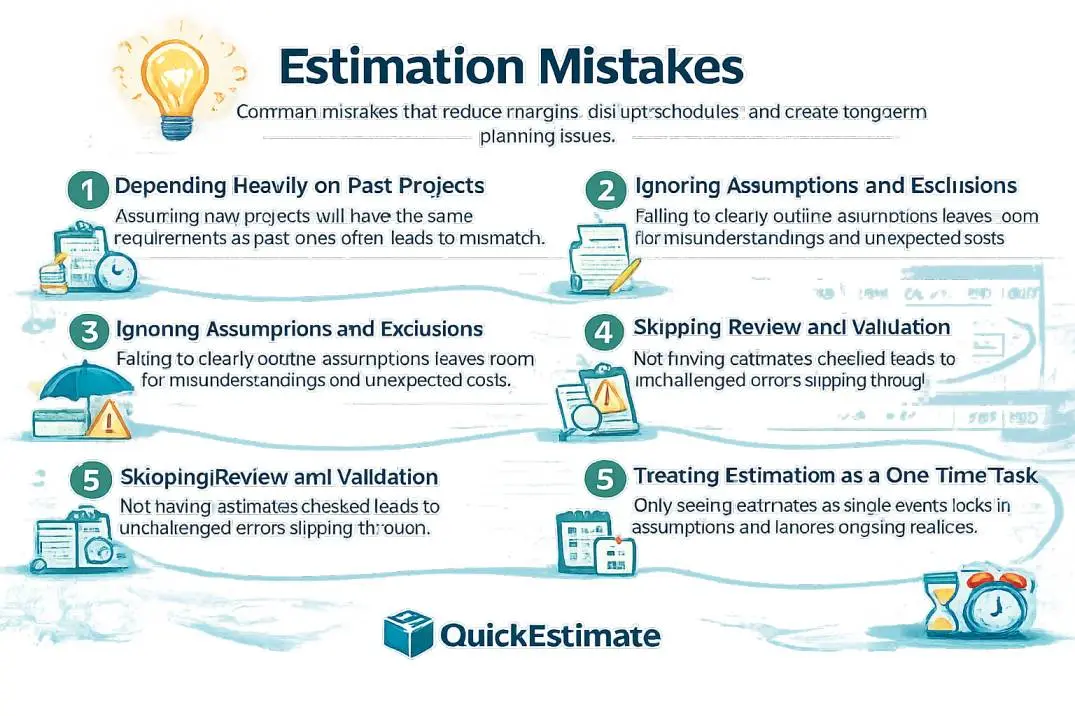
Common estimation mistakes quietly reduce margins and disrupt project planning when left unchecked.
Important Insight
The danger of estimation errors is invisible at first. They slowly reduce decision quality until problems become obvious during execution, leaving you with fewer and more expensive options.
The Impact of Repeated Estimation Mistakes
Over time, recurring estimation mistakes lead to:
- Chronic overbudgeting
- Delivery timelines are missed.
- Reduced trust in estimates
- The future accuracy of the estimate becomes difficult
- Increased team frustration and rework
- Making rushed decisions under pressure
The larger the project volume, the more damaging these patterns become.
Why Better Tools Alone Don’t Fix Estimation Mistakes
If processes are informal, assumptions hidden, or updates skipped, a shiny new tool just gives you the digital version of your same bad decisions. Teams end up with “garbage in, garbage out,” but with fancier dashboards.
Without a defined estimation workflow,
Leads to the same mistakes simply moving from one estimator tool to another.
How Teams Reduce Estimation Mistakes
- Estimation steps and inputs are standardized.
- Assumptions and scope boundaries are documented.
- Introduction of repeated reviews at all approval stages.
- Estimates are evaluated against actual outcomes.
The goal is not to create perfect estimates.
but continuously improving and reducing the risk of a broken estimate.
Read the Estimation Problems Guide