
 Reed Jason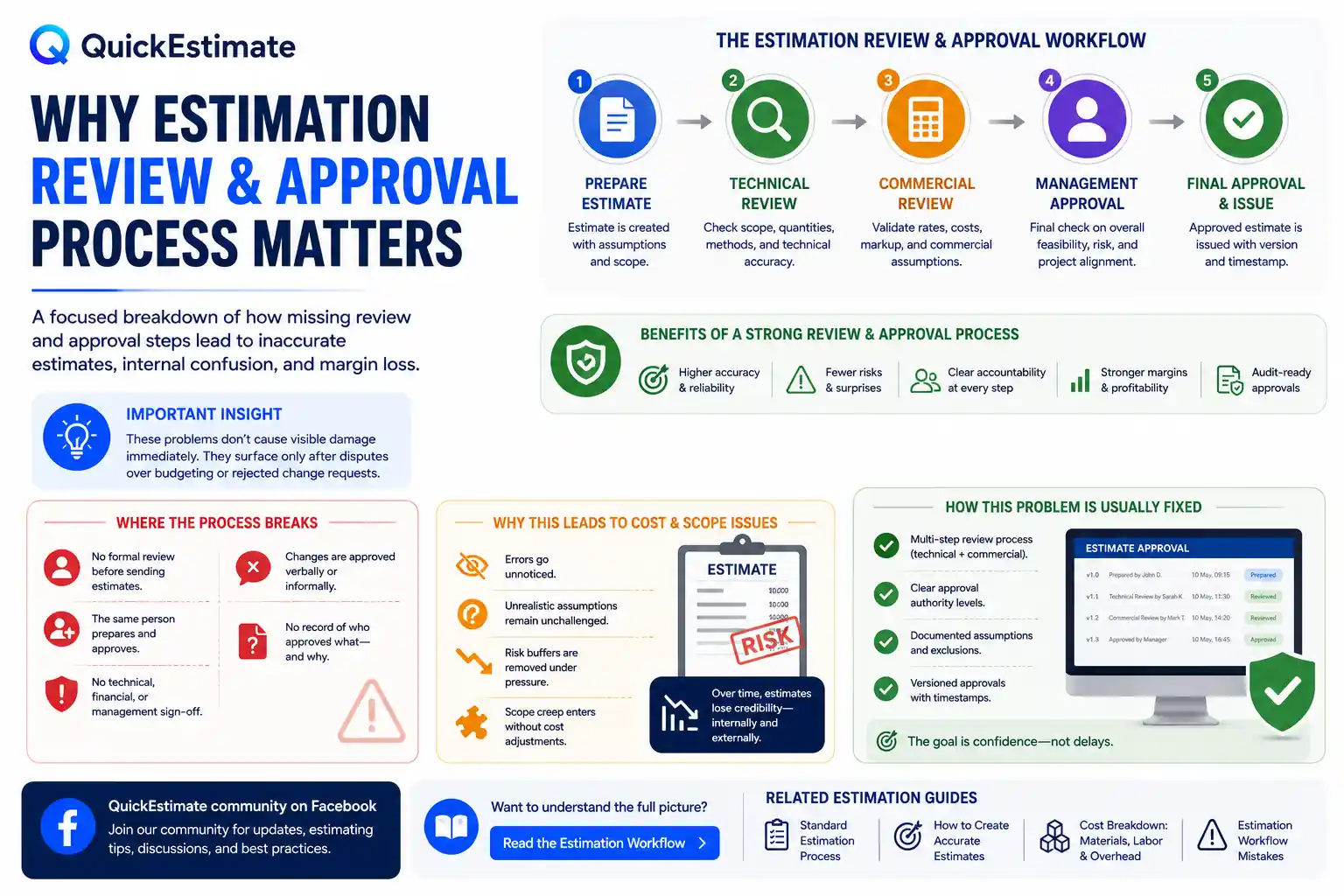
These estimation workflow challenges are covered in depth in the complete
Estimation Workflow →
In many organizations, estimates are created and shared too quickly — without structured review or approval processes in place.
What often feels like operational speed quietly introduces risk, weakens accountability, and creates hidden financial exposure across projects.
Where the Review & Approval Process Breaks
The biggest weakness in many estimation workflows is not effort — it is lack of structured accountability and approval visibility.
- No formal review before estimates are shared
- The same person prepares and approves estimates
- No technical, financial, or management sign-off
- Changes are approved informally or verbally
- No record of who approved what — and why
Review and approval problems usually remain hidden until budgeting disputes, rejected change requests, or unexpected project costs appear during execution.
Why Accountability Matters
Estimation workflows become unreliable when responsibility is unclear. Without defined review stages and approval ownership, assumptions and risks often move forward without validation.
Reliable estimates require visibility into who prepared, reviewed, validated, and approved the estimate before execution begins.
Why Missing Reviews Create Cost & Scope Problems
Without a structured review and approval process, estimates become vulnerable to hidden errors, unrealistic assumptions, and uncontrolled scope changes.
| Missing Process | Operational Result |
|---|---|
| No independent review | Errors remain unnoticed |
| No challenge to assumptions | Unrealistic planning decisions |
| Risk buffers removed under pressure | Reduced project protection |
| Scope changes approved informally | Scope creep without cost adjustment |
| No documented approvals | Internal confusion and disputes |
Over time, missing review discipline weakens confidence in estimates both internally and externally.
How Estimate Credibility Slowly Declines
Estimation credibility is not usually lost through one major mistake. It declines gradually as repeated workflow gaps create inconsistent outcomes, budget overruns, approval confusion, and unreliable forecasting.
Informal approvals and weak review discipline often create long-term operational distrust that becomes difficult to repair later.
How Teams Improve Review & Approval Reliability
Teams that improve estimate reliability focus on introducing structured review visibility and clear approval ownership throughout the workflow.
- Introduce multi-step technical and commercial reviews
- Define approval authority levels clearly
- Document assumptions and exclusions consistently
- Track approvals using timestamps and version history
- Create accountability before estimates are shared externally
The goal of review and approval workflows is confidence and consistency — not unnecessary delays or operational complexity.
Frequently Asked Questions
Structured reviews help identify hidden errors, unrealistic assumptions, scope gaps, and financial risks before estimates are approved or shared externally.
Without independent validation, mistakes, incorrect assumptions, and pricing risks are more likely to pass through unnoticed.
Documented approvals create accountability, improve visibility, reduce disputes, and help teams understand why estimating decisions were made.
Growing teams improve reliability by introducing formal reviews, approval authority structures, version tracking, and clear documentation standards.