
 Reed Jason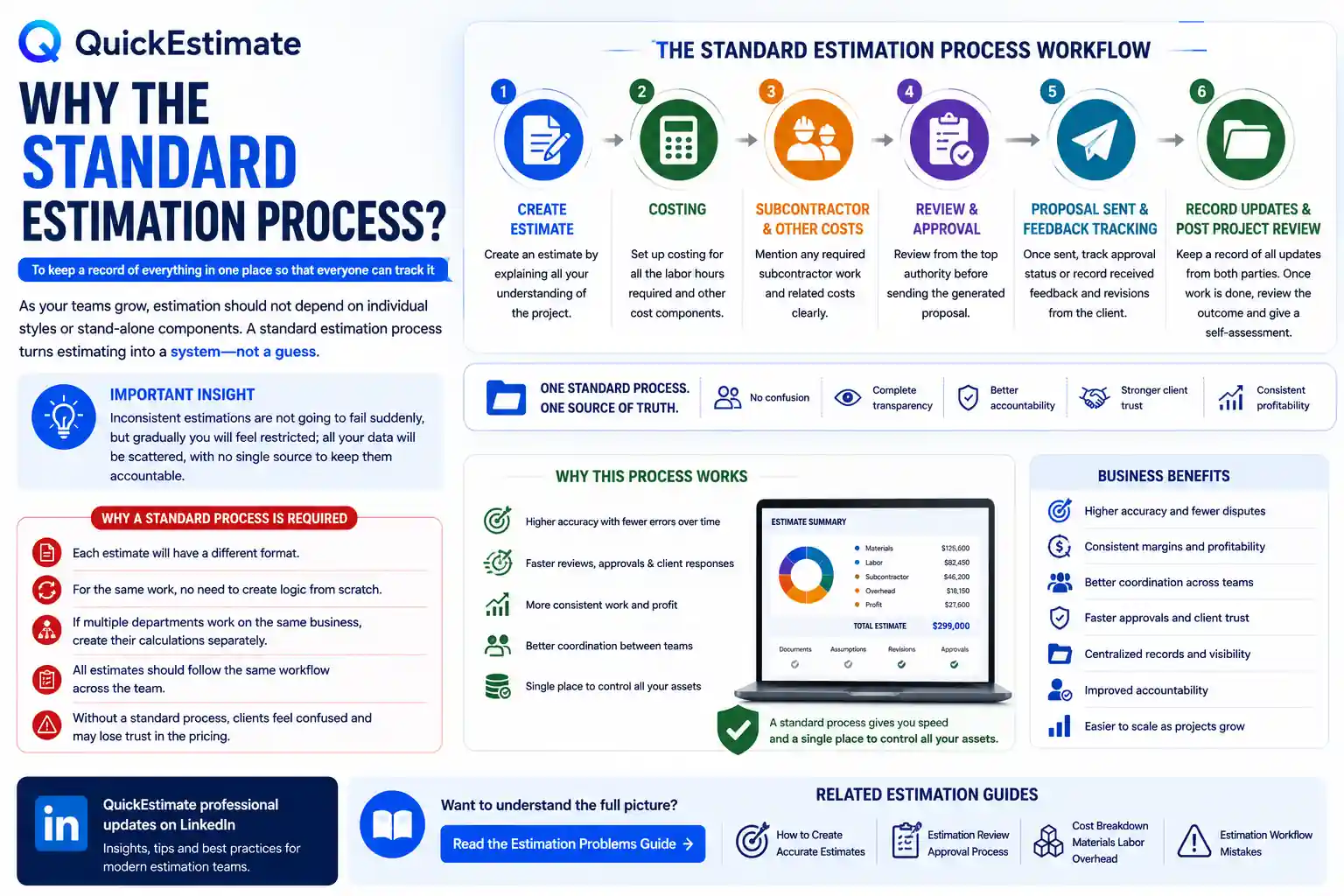
These workflow challenges are covered in depth in the complete
Estimation Problems Guide →
As teams grow, estimation should no longer depend on individual styles, disconnected spreadsheets, or personal estimating habits. A standard estimation process transforms estimating into a repeatable system instead of a guessing exercise.
Without a consistent workflow, multiple people generating estimates for the same project often produce different assumptions, pricing methods, and project understanding — creating confusion internally and reducing trust externally.
Why a Standard Estimation Process Is Required
The largest estimation problem for growing organizations is usually not lack of skill — it is inconsistency between people, departments, workflows, and project assumptions.
- Each estimate follows a different structure
- Estimators recreate logic repeatedly from scratch
- Departments calculate costs differently
- No shared workflow exists across the team
- Estimate records become fragmented and difficult to track
Inconsistent estimating usually does not fail immediately. Over time, data becomes scattered, accountability weakens, and operational control becomes increasingly difficult.
Why Inconsistency Creates Operational Risk
Informal estimating workflows create confusion between teams because every estimator interprets scope, pricing, assumptions, and project risks differently.
Reliable estimates come from shared systems and consistent workflows — not individual estimating styles.
Without a standard process, organizations struggle to maintain alignment between estimating, finance, operations, subcontractors, approvals, and project delivery.
What a Standard Estimation Process Should Include
A structured estimation process creates one clear workflow followed consistently across projects and teams.
Define the project scope clearly
Document assumptions, requirements, exclusions, and project understanding before calculations begin.
Build structured labor and cost calculations
Separate labor hours, material costs, subcontractor work, overhead, and pricing categories clearly.
Review before proposal approval
Introduce technical, financial, and management reviews before estimates are shared externally.
Track approvals and feedback
Record approval status, client feedback, revisions, and project communication history.
Review outcomes after project completion
Compare estimate accuracy, project delivery, and actual performance for continuous improvement.
Why Standardized Estimation Works
Organizations that follow consistent estimating workflows create stronger operational control, clearer accountability, and better long-term project reliability.
| Standardized Workflow | Operational Result |
|---|---|
| Shared workflow process | Higher estimate consistency |
| Centralized project records | Better accountability and tracking |
| Structured review stages | Fewer hidden estimating errors |
| Documented approvals and updates | Improved operational visibility |
| Post-project evaluation | Continuous estimation improvement |
Business Benefits of Standard Estimation
Teams using structured estimation systems gain better operational consistency and stronger control across projects and departments.
- Higher long-term estimating accuracy
- Faster reviews and approvals
- More consistent margins and profitability
- Better coordination between teams
- Centralized recordkeeping and visibility
- Reduced confusion and duplicated effort
- Improved accountability across stakeholders
- Easier scaling as project complexity increases
A standard estimation process creates both speed and operational control by keeping every estimate, update, approval, and workflow stage connected in one structured system.
Frequently Asked Questions
Standardized workflows improve consistency, accountability, visibility, and coordination across teams as project volume and operational complexity increase.
Different estimating approaches create inconsistent pricing, conflicting assumptions, operational confusion, and reduced client trust.
Centralized records improve accountability, simplify workflow visibility, reduce duplicated effort, and create one reliable source of project information.
Standard workflows reduce inconsistency, improve reviews, strengthen approvals, document assumptions clearly, and help teams continuously improve estimating accuracy over time.