
 Reed Jason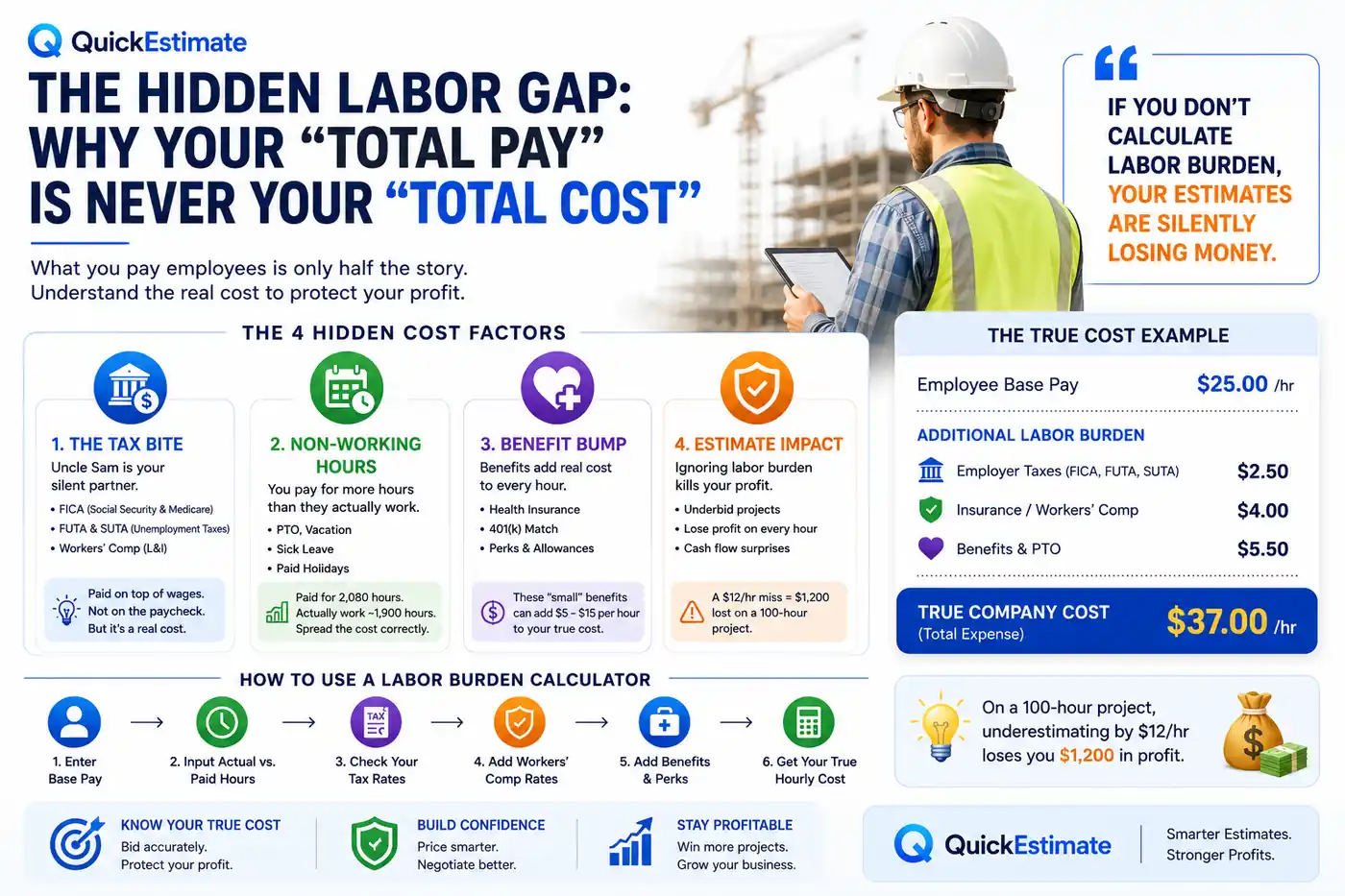
These labor costing problems are covered in depth in the complete
Estimation Problems Guide →
In business, what you pay employees is only part of the real story. The hidden labor gap appears when businesses calculate labor costs using only hourly wages while ignoring taxes, insurance, paid time off, and employee benefits.
A labor burden calculator helps reveal the true hourly company cost behind every employee. Without it, project estimates quietly lose profit long before work is completed.
1. Beyond the Paycheck: The “Tax Bite”
When you hire an employee in the United States, labor costs extend far beyond the paycheck itself. Employers are responsible for mandatory payroll taxes and insurance expenses that increase the true hourly cost of labor significantly.
Employer payroll taxes are paid in addition to employee wages. These expenses do not appear on the employee’s paycheck, but they directly impact your project profitability.
Common labor burden expenses include:
- FICA taxes (Social Security and Medicare contributions)
- Federal Unemployment Tax (FUTA)
- State Unemployment Tax (SUTA)
- Workers’ Compensation Insurance
- Industry-specific labor insurance costs
Workers’ compensation costs can vary dramatically depending on state regulations and job risk levels. In construction and manufacturing industries, labor burden percentages are often much higher because of insurance exposure.
A single high-risk project can wipe out expected profit margins if workers’ compensation and employer taxes are not included in the estimate accurately.
2. The “Non-Working” Hours Problem
Labor burden calculations become more complicated when paid time off, holidays, and sick leave are considered. Businesses often pay employees for more hours than they actually spend producing work.
A full-time employee may be paid for 2,080 hours annually, but after vacation, holidays, and PTO are removed, actual productive hours may be significantly lower.
Paid time off costs must be redistributed across actual productive hours. Otherwise, labor rates used in estimates become artificially low.
Total paid annual hours
Most full-time employees are paid for approximately 2,080 hours annually.
Subtract PTO and holidays
Vacation days, paid holidays, and sick leave reduce the actual productive working hours available.
Calculate real productive hourly cost
Remaining productive hours carry the full burden of wages, taxes, benefits, and overhead expenses.
3. The “Benefit Bump”
Competitive businesses often provide employee benefits beyond hourly wages. While these costs may appear manageable monthly, they significantly increase the real hourly company cost of labor.
| Benefit Type | How It Impacts Labor Cost | Result |
|---|---|---|
| Health Insurance | Monthly employer-paid premiums | Higher labor burden |
| 401(k) Match | Additional payroll percentage | Increased hourly cost |
| Uniforms & Equipment | Ongoing employee support expenses | Additional hidden overhead |
| Structured burden calculation | All labor costs accounted for accurately | Protected project margins |
Depending on the business and industry, benefits and labor burden costs can add an additional $5 to $15 per hour above base pay.
4. Why Labor Burden Matters for Estimates
Labor burden directly affects whether estimates remain profitable after projects begin. Estimating labor using only base hourly pay creates hidden losses on every productive hour worked.
A worker paid $25/hour may actually cost the company $37/hour after taxes, insurance, PTO, and benefits are included. Ignoring this difference creates silent profit loss on every project.
Example labor burden breakdown:
- Base Pay: $25/hr
- Employer Taxes: +$2.50/hr
- Insurance & Workers’ Comp: +$4.00/hr
- Benefits & PTO: +$5.50/hr
- True Company Cost: $37/hr
On a 100-hour project, underestimating labor by $12/hour results in $1,200 of lost profit before overhead or material costs are even considered.
5. How to Use a Labor Burden Calculator
A labor burden calculator helps businesses determine the true hourly company cost of employees so estimates remain accurate and profitable.
To calculate labor burden accurately:
- Enter the employee’s base hourly pay
- Input actual productive hours versus paid hours
- Include employer payroll taxes and insurance costs
- Add workers’ compensation rates
- Include health insurance and retirement contributions
- Factor in PTO, holidays, and sick leave
Review labor burden calculations regularly because insurance rates, tax rates, and benefit costs change over time.
The Bottom Line
Understanding your true labor cost is not only about accounting accuracy — it directly impacts pricing confidence, profitability, and long-term business sustainability.
When businesses know the real company cost of every labor hour, they can price projects more accurately, negotiate with confidence, and protect profit margins consistently.
If labor burden is not calculated properly, estimates silently lose money on every project.
Frequently Asked Questions
Labor burden is the total additional cost of employing a worker beyond hourly wages, including taxes, insurance, PTO, benefits, and other employer-paid expenses.
Accurate labor burden calculations prevent underpricing projects and help businesses protect profitability by understanding the real hourly company cost of employees.
Labor burden typically includes employer payroll taxes, workers’ compensation insurance, unemployment taxes, PTO, health insurance, retirement contributions, and other employee benefits.
Labor burden rates should be reviewed at least annually or whenever tax rates, insurance costs, wages, or employee benefits change significantly.