
 Reed Jason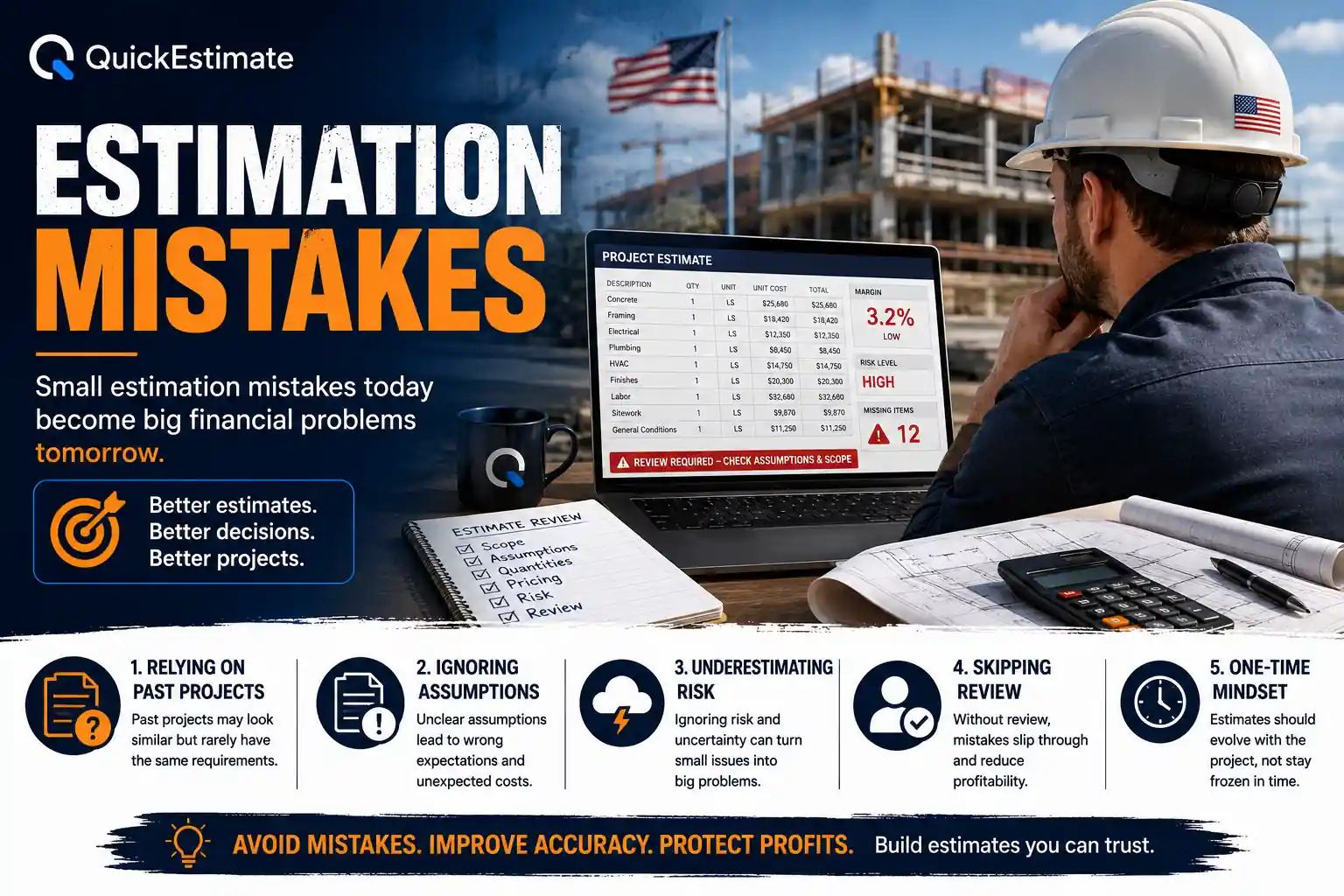
These challenges are covered in depth in the complete
Estimation Problems Guide →
Estimation mistakes rarely appear as dramatic failures in the beginning. Instead, they quietly reduce margins, create planning uncertainty, disrupt schedules, and gradually weaken confidence in project decisions over time.
These problems often emerge when organizations depend heavily on manual spreadsheets, inconsistent estimating methods, rushed takeoffs, or undocumented assumptions between teams and departments.
Why Estimation Mistakes Are So Common
Estimating is often treated like a quick calculation exercise, but reliable estimation is actually a structured workflow that requires review, assumptions, documentation, validation, and continuous refinement.
- Estimates are prepared under tight deadlines
- Assumptions are rarely documented clearly
- Old estimates are reused without validation
- Review and approval steps are inconsistent
The most dangerous estimation mistakes are usually not one-time failures. They are repeated patterns that quietly grow larger across projects over time.
1. Depending Too Heavily on Past Projects
Reusing previous project estimates without validating the current project scope creates significant risk. Even small changes in labor hours, materials, site conditions, or project complexity can produce very different outcomes.
Historical estimates should be used as references, not copied directly without validating current scope, assumptions, and pricing conditions.
2. Ignoring Assumptions and Exclusions
Many estimates fail to clearly define the assumptions, limitations, exclusions, and scope boundaries involved in the project. When assumptions are hidden or unclear, teams and clients often operate with different expectations.
This commonly leads to disagreements, unexpected costs, rework, and confusion during project execution.
3. Underestimating Risk and Uncertainty
Building estimates based only on ideal conditions creates fragile project plans. Real-world projects contain uncertainty related to labor availability, site conditions, weather, scheduling delays, price fluctuations, and external dependencies.
Even mathematically accurate estimates can fail when uncertainty and operational risk are ignored during planning.
4. Skipping Review and Validation
Estimates that are never reviewed by another person carry significantly higher risk. Independent review often catches missing items, duplicate costs, incorrect assumptions, or pricing inconsistencies before estimates reach clients or internal approvals.
- Missing scope items remain unnoticed
- Pricing inconsistencies pass through
- Formula or calculation errors go unchecked
- Risk assumptions are not challenged
5. Treating Estimation as a One-Time Task
Many organizations treat estimation as a single event: estimate, approve, and move on. However, estimation is more effective when treated as a continuous process connected to actual project outcomes and future improvements.
Once budgets or contracts are finalized, teams often avoid revisiting estimates because it feels uncomfortable or politically difficult to reopen discussions.
The Impact of Repeated Estimation Mistakes
The financial and operational effects of repeated estimating mistakes usually appear gradually, making them difficult to notice early.
| Repeated Problem | Long-Term Impact |
|---|---|
| Incorrect assumptions | Chronic overbudgeting |
| Poor validation | Missed delivery timelines |
| No workflow consistency | Reduced trust in estimates |
| Rushed estimating decisions | Higher team frustration and rework |
| No performance evaluation | Future estimate accuracy becomes difficult |
Why Better Tools Alone Don’t Fix Estimation Mistakes
New software alone does not automatically improve estimation quality. If assumptions remain hidden, processes informal, and reviews inconsistent, the same mistakes simply move from spreadsheets into new tools.
Better estimates come from better workflows, documentation, visibility, and review discipline — not just more advanced dashboards.
How Teams Reduce Estimation Mistakes
Organizations reduce estimating risks by standardizing workflows and improving visibility across every stage of the estimation process.
- Standardize estimation steps and inputs
- Document assumptions and exclusions clearly
- Introduce structured review and approval stages
- Compare estimates against actual project outcomes
- Continuously improve estimating accuracy over time
Frequently Asked Questions
Most estimating mistakes appear gradually through reduced margins, missed schedules, and repeated operational inefficiencies rather than obvious immediate failures.
In most cases, recurring estimation mistakes are caused by weak workflows, inconsistent standards, unclear assumptions, and lack of review processes rather than individual intent.
Validation helps catch missing scope items, pricing inconsistencies, incorrect assumptions, and hidden risks before projects move into execution.
No system completely eliminates estimation risk. However, structured workflows, visibility, approvals, and continuous evaluation significantly reduce repeated mistakes over time.