
 Reed Jason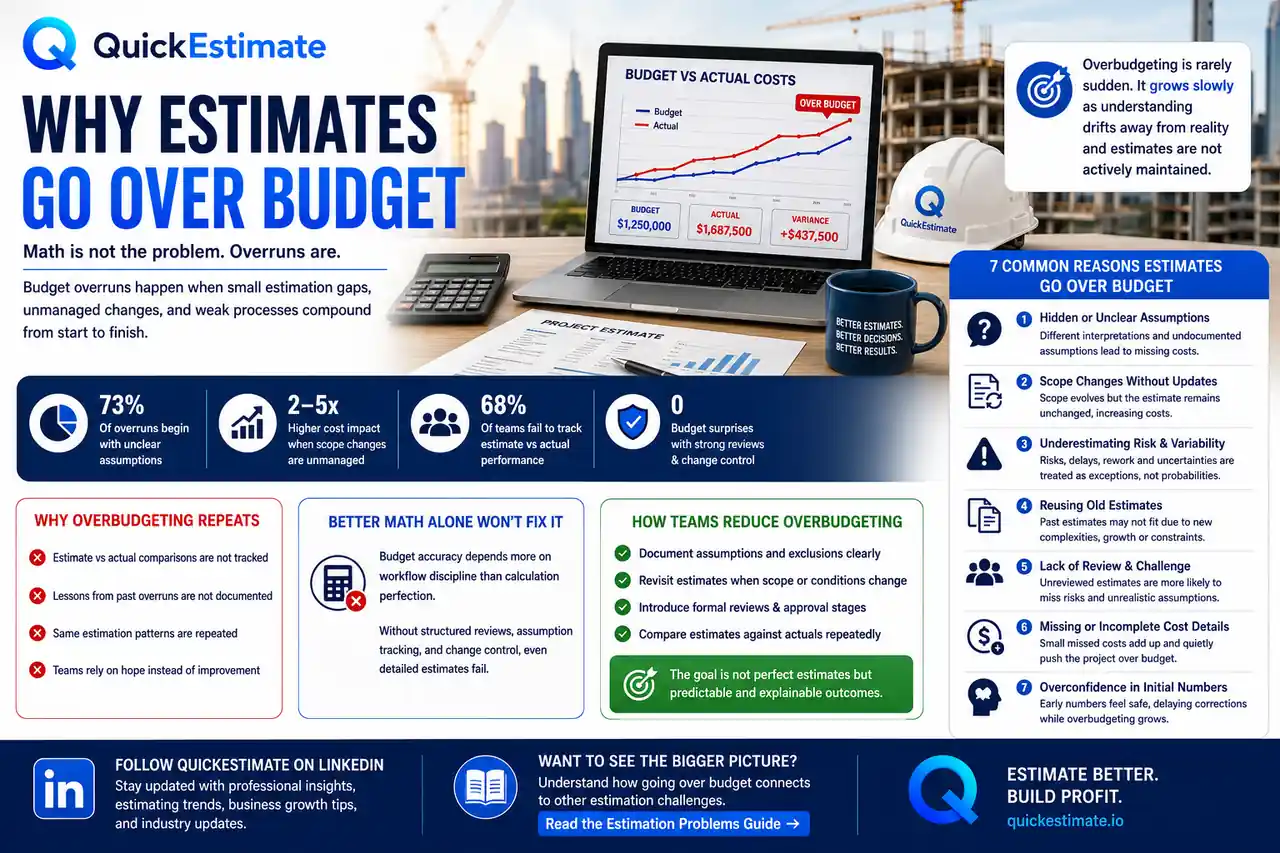
Part of a larger guide
These challenges are covered in depth in the complete
Estimation Problems Guide →
These challenges are covered in depth in the complete
Estimation Problems Guide →
Most estimates don’t go over budget because of bad math. They go over budget because small estimation gaps, missing assumptions, unmanaged scope changes, and weak review processes quietly compound throughout the project lifecycle. By the time teams realize the problem, the financial damage has already begun.
The Myth: “Our Estimates Were Wrong”
In reality, most projects don’t fail because teams cannot calculate numbers correctly.
Budget overruns usually happen because assumptions, risks, communication gaps,
and scope changes were never actively managed after the estimate was created.
Overbudgeting is rarely sudden. It grows slowly as understanding drifts away from reality while estimates remain unchanged.
Teams often assume:
- The original estimate was “accurate enough”
- Minor changes won’t affect the budget significantly
- Risks are unlikely to happen
- Existing spreadsheets already contain everything needed
These assumptions create dangerous blind spots that compound over time.
Reason 1: Hidden or Unclear Assumptions
One of the biggest causes of budget overruns is undocumented assumptions.
Different team members interpret project scope differently,
resulting in inconsistent expectations and missing costs.
Every estimate should include written assumptions, exclusions, risks,
and scope boundaries before pricing begins.
Hidden assumptions commonly include:
- Client responsibilities
- Availability of materials or resources
- Infrastructure readiness
- Approval turnaround time
- Expected revision cycles
Reason 2: Scope Changes Without Estimate Updates
Projects naturally evolve over time.
However, many teams continue using the original estimate even after the scope changes significantly.
Teams accept “small” additions during execution without revisiting the estimate.
Over time, dozens of small changes quietly destroy the original budget.
Scope changes typically include:
- Additional features or deliverables
- New compliance requirements
- Client revisions
- Schedule acceleration requests
- Unexpected technical constraints
Reason 3: Underestimating Risk and Variability
Many estimates are created under ideal conditions.
Real-world execution rarely follows ideal conditions consistently.
| Ideal Assumption | Reality | Budget Impact |
|---|---|---|
| No delays | Delays occur regularly | Extended project costs |
| No rework required | Revisions and corrections appear | Additional labor expenses |
| Stable material pricing | Prices fluctuate | Procurement overruns |
| All assumptions remain valid | Project conditions evolve | Continuous re-estimation required |
Reason 4: Reusing Old Estimates Without Validation
Copying estimates from previous projects may save time initially,
but every project contains different variables, constraints, and risks.
Teams frequently overlook:
- Inflation or supplier price changes
- Different labor productivity
- Project complexity differences
- New compliance requirements
- Regional cost variations
Historical estimates should be used as references — not copied blindly without validation.
Reason 5: Lack of Review and Challenge
Estimates prepared and approved casually are far more likely to miss risks,
cost categories, or unrealistic assumptions.
A structured review process should validate:
- Scope completeness
- Cost category coverage
- Risk assumptions
- Labor calculations
- Contingency buffers
- Supplier pricing validity
Most budget overruns could have been reduced significantly with a simple review step before approval.
Reason 6: Missing or Incomplete Cost Details
Small missing costs accumulate quickly.
Coordination effort, support work, indirect expenses,
and administrative tasks are often excluded unintentionally.
Commonly missed costs include:
- Project coordination time
- Meetings and approvals
- Administrative support
- Quality assurance and testing
- Deployment and handover work
- Training and documentation
Reason 7: Overconfidence in Initial Numbers
Once an estimate is created,
teams often treat it as fixed and trustworthy even when warning signs appear later.
Early numbers create emotional comfort.
Teams become hesitant to challenge them,
delaying important corrections until the project is already over budget.
Estimates should evolve alongside the project.
Re-estimation is responsible project management — not failure.
Why Overbudgeting Repeats
One of the biggest reasons estimates continue going over budget is the absence of feedback loops.
- Estimate vs actual performance is not tracked
- Past lessons are not documented
- The same assumptions are repeated repeatedly
- Teams rely on optimism instead of evidence
Without structured learning systems,
estimation quality improves very slowly.
Why Better Math Alone Doesn’t Fix Over Budget Problems
Better spreadsheets and formulas help,
but budget accuracy depends far more on process discipline than mathematical perfection.
Without:
- Structured reviews
- Assumption tracking
- Scope change management
- Continuous re-estimation
- Historical performance analysis
Even detailed estimates eventually fail.
How Teams Reduce Going Over Budget
Document assumptions clearly
Ensure scope definitions, exclusions, dependencies,
and risks are written before estimation begins.
Revisit estimates continuously
Update estimates whenever project conditions,
scope, or risks change significantly.
Introduce formal reviews
Validate estimates through structured review
and approval workflows before client submission.
Compare estimates against actuals
Track estimate accuracy over time to improve
future forecasting and reduce repeated mistakes.
Frequently Asked Questions
Most overruns happen because assumptions, scope changes,
risks, or indirect costs were not actively managed after the original estimate was created.
Usually no. Most budget overruns are caused by workflow problems,
missing reviews, unclear assumptions, and unmanaged changes — not calculation errors.
Projects evolve constantly. Re-estimation helps teams adapt to changing conditions,
updated requirements, and newly identified risks before costs spiral out of control.
Teams reduce overruns through structured workflows,
written assumptions, formal reviews, change management,
contingency planning, and estimate vs actual tracking.