
 Reed Jason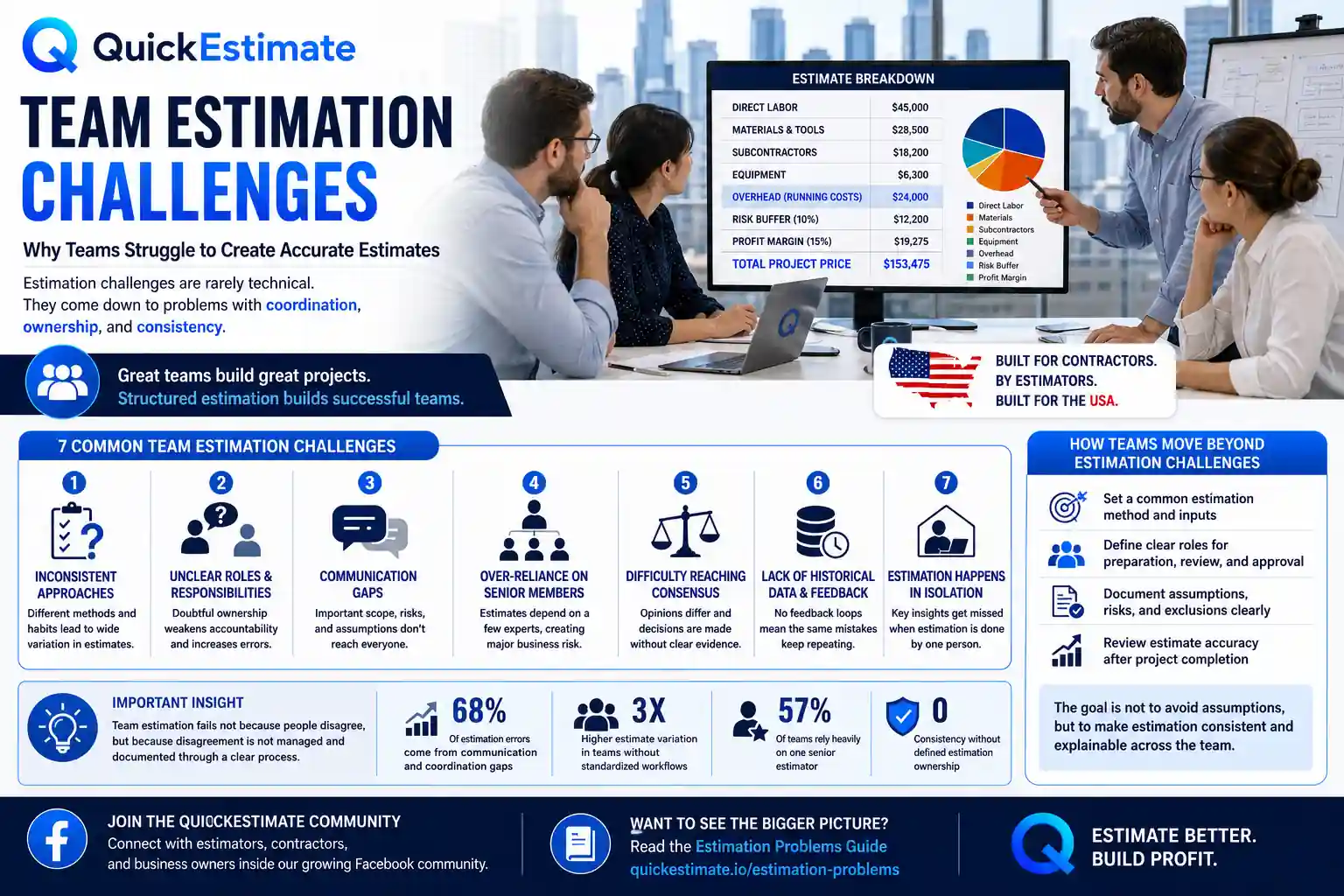
These challenges are covered in depth in the complete
Estimation Problems Guide →
Team estimation challenges rarely happen because people lack technical ability. Most estimation problems emerge when growing teams operate without standardized workflows, clear ownership, documented assumptions, and structured communication processes.
Why Team-Based Estimation Is Difficult
Estimation becomes significantly harder when responsibility moves from one individual to multiple team members. As teams grow, differences in experience levels, communication styles, assumptions, and decision-making processes begin affecting estimate consistency and reliability.
Team estimation fails not because people disagree — but because disagreement is not managed, documented, and standardized through a clear workflow.
Common challenges include:
- Different interpretations of project scope
- Variation in individual estimation habits
- Informal communication of assumptions
- Unclear accountability for estimate accuracy
- Heavy dependency on specific team members
Challenge 1: Inconsistent Estimation Approaches
Without standardized methods, every estimator develops personal estimation habits. This creates major inconsistencies where similar projects receive completely different estimates depending on who prepares them.
Create a shared estimation framework with standardized cost categories, assumptions, overhead allocation rules, contingency guidelines, and approval workflows.
Challenge 2: Unclear Roles & Responsibilities
Many teams fail to define who prepares estimates, who reviews them, and who approves them before sending them to clients. When ownership is shared informally, accountability weakens and important review steps get skipped.
Every estimate should have clearly assigned ownership for preparation, review, approval, and final delivery to maintain accountability across the workflow.
Challenge 3: Communication Gaps
Important details about project scope, dependencies, technical risks, or client expectations often fail to reach everyone involved in the estimation process. This leads to silent assumptions that later create pricing inaccuracies and project disputes.
- Document assumptions clearly
- Standardize project scope reviews
- Centralize communication history
- Ensure all stakeholders review major risks
Challenge 4: Over-Reliance on Senior Team Members
Many companies depend heavily on a few experienced estimators. While this may work temporarily, it creates major operational risks when those individuals become unavailable or overloaded.
Sustainable estimation systems distribute knowledge across the team instead of concentrating it in a single person.
Challenge 5: Difficulty Reaching Consensus
Teams often struggle to agree on pricing, timelines, risks, or contingency levels. Without structured review systems, decisions become influenced by urgency, hierarchy, or personal confidence instead of evidence-based reasoning.
| Approach | What Happens | Result |
|---|---|---|
| Informal team discussion | Opinions dominate decisions | Inconsistent estimates |
| No documented assumptions | Silent misunderstandings grow | Hidden estimation risk |
| Structured review workflow | Assumptions are reviewed openly | Reliable collaboration |
| Historical estimate validation | Decisions improve over time | Higher estimate accuracy |
Challenge 6: Lack of Historical Data and Feedback Loops
Many teams never compare estimated effort against actual project outcomes. Without feedback loops, the same estimation mistakes continue repeatedly because nobody tracks where inaccuracies originated.
Teams should regularly compare estimated vs actual labor hours, project costs, revision cycles, and timeline performance to continuously improve estimation accuracy.
Challenge 7: Estimation Happens in Isolation
Too often, estimates are prepared by one person without involving the people who actually understand the work requirements, dependencies, or operational risks. As a result, important details are missed before project execution begins.
Team estimation improves dramatically when collaboration includes operations, technical staff, project managers, and field personnel early in the estimation process.
How Teams Move Beyond Estimation Challenges
The goal is not eliminating assumptions completely. The goal is making estimation consistent, explainable, reviewable, and repeatable across the organization.
Standardize Estimation Methods
Create consistent workflows, pricing structures, and documentation rules across all estimators.
Define Clear Ownership
Assign responsibility for estimate preparation, review, approval, and delivery.
Document Assumptions Clearly
Ensure risks, exclusions, dependencies, and assumptions are visible to everyone involved.
Review Estimate Accuracy Continuously
Track estimate performance after project completion to improve future forecasting quality.
Frequently Asked Questions
As teams grow, differences in experience levels, communication styles, workflows, and assumptions increase significantly. Without standardized systems, estimate inconsistency becomes difficult to manage.
Different team members often interpret project scope, risks, complexity, and timelines differently. Structured estimation reviews help teams document and resolve these differences clearly.
No. Software improves structure and visibility, but unclear roles, undocumented assumptions, and weak communication still create estimation challenges without proper workflows.
Teams improve estimation accuracy by reviewing historical projects, comparing estimated vs actual performance, documenting lessons learned, and standardizing estimation processes.