
 Reed Jason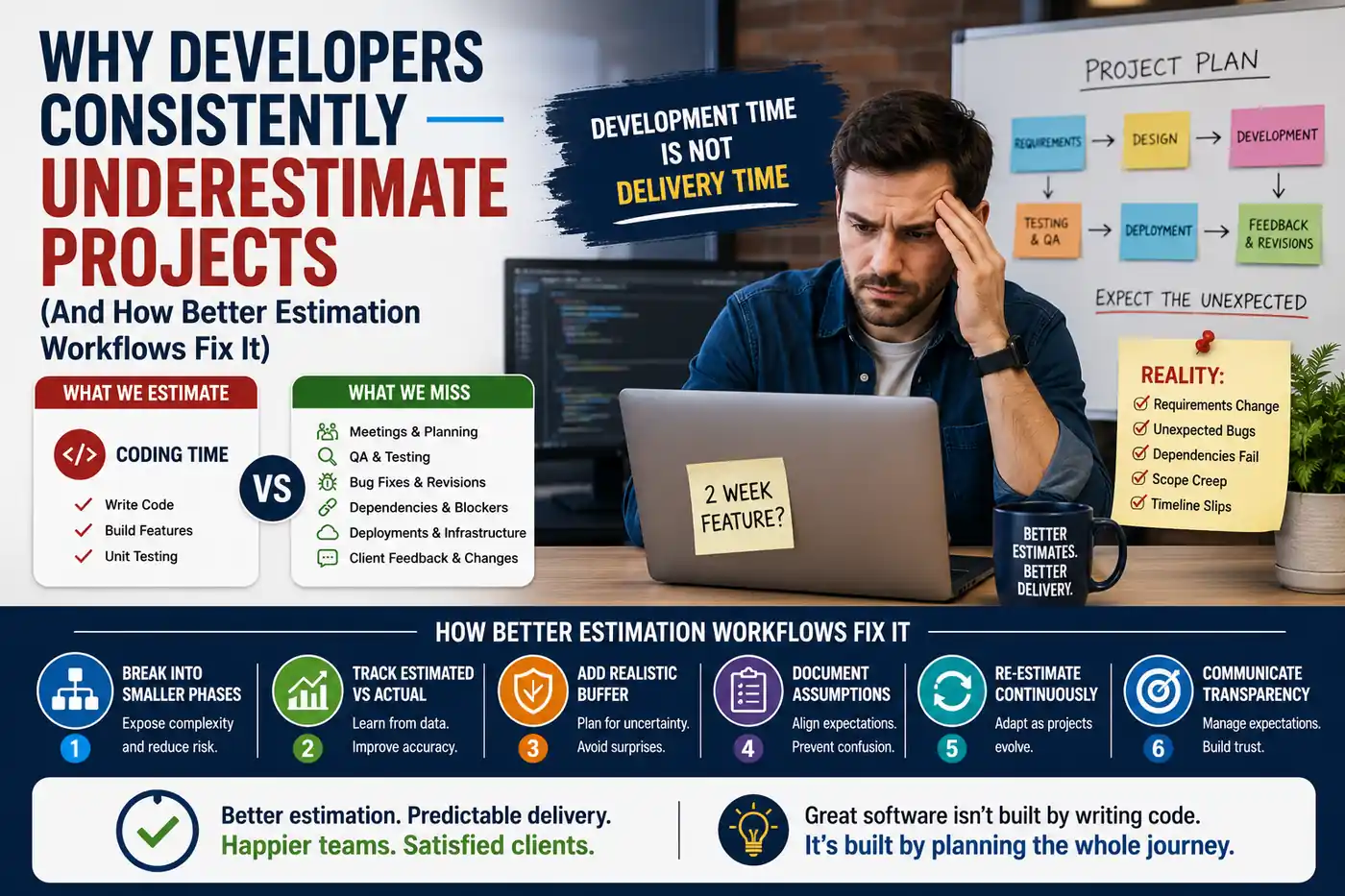
These challenges are covered in depth in the complete
Project Estimation Best Practices Guide →
Software project estimation is one of the hardest parts of engineering and project management. Most developers underestimate projects because they only calculate development time instead of the full delivery cycle including revisions, QA, blockers, meetings, dependencies, and other critical factors — the kind that are easy to avoid missing once you know what to look for.
6 Weeks
12 Days
5+
100s
Why Software Project Estimation Often Fails
Most developers estimate software projects based only on coding effort.
On paper, estimates appear manageable because development tasks seem isolated and predictable.
Real software delivery includes meetings, QA, revisions, deployments,
infrastructure setup, dependencies, blockers, communication overhead,
and unexpected edge cases — not just development itself.
Real projects also include:
- Meetings and planning sessions
- Requirement clarification
- QA and testing cycles
- Bug fixing and revisions
- Deployment issues
- Infrastructure setup
- Third-party dependency delays
- Client feedback loops
- Unexpected edge cases
- Communication overhead
- Scope changes during development
Common Software Project Estimation Mistakes
Short-term estimates already carry uncertainty.
Long-term estimates become significantly harder because software projects evolve constantly.
A 2-day estimate may carry minor uncertainty.
A 6-month roadmap contains hundreds of unknown variables.
- Requirements evolve over time
- Priorities shift during development
- Technical debt accumulates
- Integrations become more complex
- Unexpected blockers emerge
- Teams frequently change focus
The Psychological Pressure That Causes Underestimation
Many developers underestimate projects not because they lack experience,
but because larger estimates feel difficult to justify.
“What if stakeholders think I’m exaggerating?”
“What if management pushes back?”
“What if the client rejects the proposal?”
As a result, estimates become optimistic instead of realistic — a well-documented cognitive bias known as the planning fallacy.
Development Time Is Not Delivery Time
One of the biggest mindset shifts in software estimation is understanding this:
| Task | Initial Estimate | Real Delivery Impact |
|---|---|---|
| Feature Development | 5 Days | Incomplete estimate |
| QA & Testing | +2 Days | Often excluded |
| Revisions & Bug Fixes | +2 Days | Underestimated |
| Deployment & Meetings | +3 Days | Full delivery visibility |
How Better Software Project Estimation Improves Delivery
Over time, several practical changes dramatically improved estimate accuracy and reduced project stress.
Break Projects Into Smaller Phases
Smaller milestones improve predictability, expose hidden complexity,
and reduce accumulated project risk.
Track Estimated vs Actual Effort
Historical estimate tracking reveals recurring underestimation patterns,
operational bottlenecks, and realistic contingency requirements.
Add Realistic Contingency Buffers
Healthy software estimates include contingency intentionally because
ideal execution almost never happens in real projects.
Document Assumptions Clearly
Clarifying assumptions improves communication, reduces conflict,
and creates more realistic delivery expectations.
Re-Estimate Continuously
Software projects evolve constantly. Estimates should evolve too.
Why Traditional Estimation Workflows Fail
Many project management systems organize tasks,
but they do not improve estimation quality itself.
Most software projects fail estimation not because developers lack skill —
but because teams only estimate coding time instead of the full delivery cycle.
- Disconnected spreadsheets
- Static estimates
- Manual proposal tracking
- Scope confusion
- Poor revision visibility
- Lack of estimate history
Estimates Are Communication Tools, Not Guarantees
One of the healthiest mindset changes in project estimation is understanding this:
An estimate is not a promise.
It is a communication tool used to manage expectations,
identify risks early, and reduce operational surprises.
Final Thoughts
Most failed software estimates are not caused by poor technical ability.
They happen because teams estimate coding effort instead of the full delivery cycle.
The most effective estimation systems are built around:
- Structured workflows
- Smaller milestones
- Historical tracking
- Realistic contingency
- Transparent communication
- Continuous re-evaluation
If your estimates only include development time,
your delivery timeline is already incomplete.