
 Reed Jason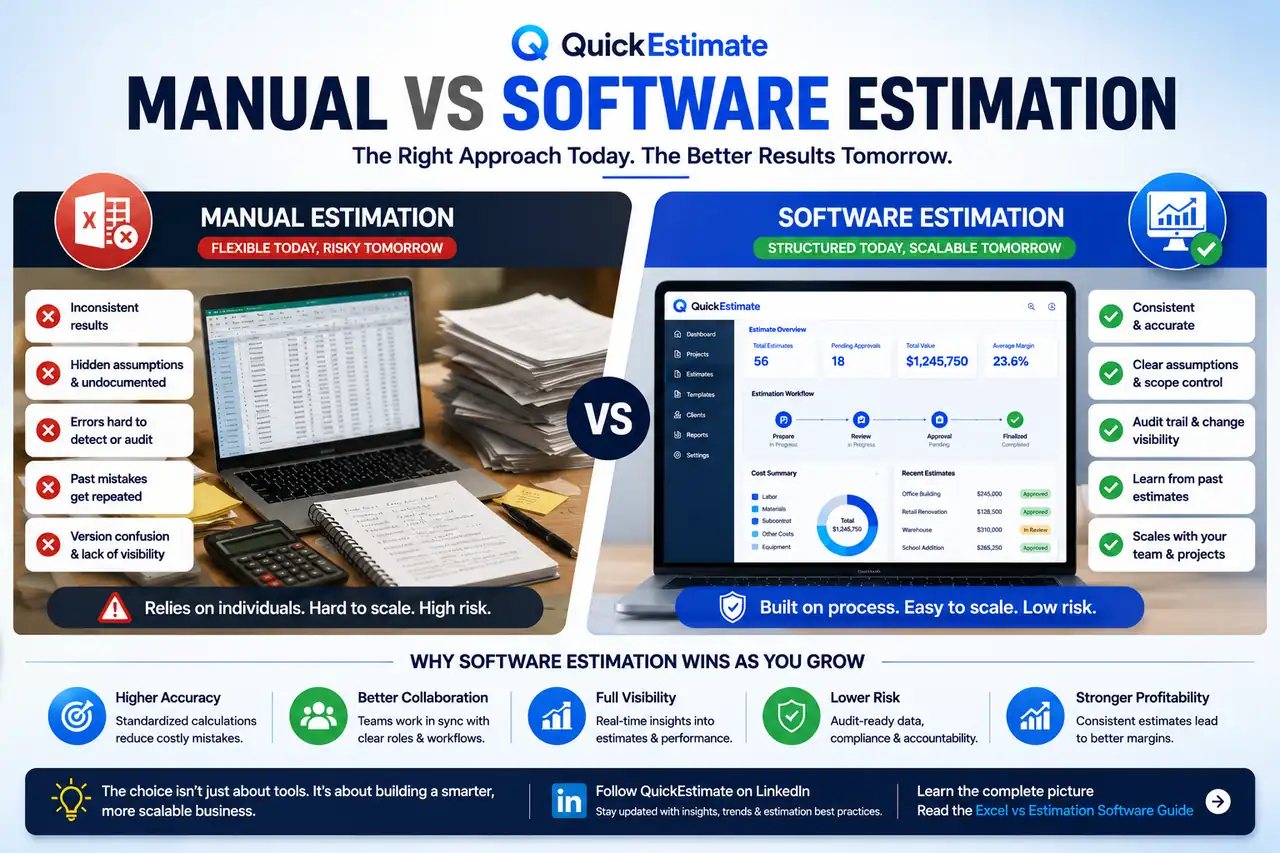
This comparison is covered in depth in the complete
Excel vs Estimation Software Guide →
Every business starts with manual estimation. Whether estimates are created in spreadsheets, documents, or by hand, manual methods initially feel flexible, fast, and fully under control.
As project volume and team size increase, however, manual estimation and software-based estimation begin producing very different results — not only in speed, but in accuracy, consistency, accountability, and business risk.
What Manual Estimation Looks Like
Manual estimation typically relies on spreadsheets, documents, handwritten calculations, and personal experience. Most businesses begin this way because the process feels familiar and flexible in the early stages.
Common manual estimation workflows include:
- Spreadsheets or static documents
- Personal judgment and estimator experience
- Copy-paste reuse of previous estimates
- Informal reviews and approvals
Manual estimation works well in smaller teams because communication is direct and the estimator usually understands every assumption behind the numbers.
Where Manual Estimation Starts to Fail
Problems begin when estimates depend too heavily on individuals instead of a shared, repeatable process. As workload and project complexity grow, inconsistencies become difficult to detect and manage.
Manual estimation rarely fails all at once. Instead, estimates gradually become less consistent, harder to audit, and more dependent on specific team members over time.
Common manual estimation problems include:
- Estimates vary depending on who prepares them
- Assumptions are undocumented or unclear
- Errors are difficult to audit or trace
- Past mistakes repeat across multiple projects
- Version confusion across spreadsheets and files
What Software-Based Estimation Changes
Estimation software does not remove human decision-making. Instead, it introduces structure, consistency, visibility, and process control throughout the estimation workflow.
Standardized calculations
Pricing logic, formulas, and workflows are standardized across all estimates and team members.
Structured review workflows
Preparation, review, and approval stages follow a clear process with accountability built into the workflow.
Version control and visibility
Teams can track updates, assumptions, and changes without relying on memory or disconnected spreadsheet files.
Software supports the estimating process itself instead of depending entirely on individual habits, memory, or spreadsheet knowledge.
Manual vs Software: The Real Trade-Offs
The choice between manual and software-based estimation is not simply about convenience or technology. It is primarily about consistency, scalability, accountability, and business risk.
| Manual Estimation | Software Estimation |
|---|---|
| Flexible for small teams | Structured and repeatable workflows |
| Depends heavily on individuals | Supports team collaboration |
| Hard to audit and review | Clear visibility and accountability |
| Errors repeat across projects | Enables learning from past estimates |
| Scales poorly as project volume grows | Designed for growth and consistency |
When Software Becomes the Better Choice
Teams usually benefit from estimation software when estimation accuracy, collaboration, and visibility become critical to business performance.
Software estimation becomes valuable when:
- Multiple people participate in estimation workflows
- Estimates require review and approval stages
- Pricing accuracy directly impacts profitability
- Leadership needs visibility into estimating performance
- Projects become larger or more complex
As project volume increases, even small inconsistencies in estimating can create major financial impact across the organization.
The Decision Is About Maturity, Not Tools
Moving from manual estimation to software estimation is not simply a technical upgrade. It represents a shift in how a business manages risk, accountability, scalability, and operational consistency.
Manual methods often limit growth because estimation quality depends heavily on specific individuals. Structured estimation systems reduce that dependency and create repeatable workflows that scale with the business.
The objective is not to eliminate human judgment — it is to create a consistent estimation process that remains accurate, auditable, and scalable as teams and projects grow.
Frequently Asked Questions
No. Manual estimation works well for many smaller teams and simpler projects. Problems usually appear as project volume, collaboration, and operational complexity increase.
The biggest advantage is consistency. Software standardizes calculations, workflows, assumptions, reviews, and approvals across all projects and team members.
No system removes all human errors completely. However, structured estimation software significantly reduces formula mistakes, inconsistent assumptions, and version confusion.
Businesses usually outgrow spreadsheets when multiple people work on estimates, project complexity increases, or pricing accuracy becomes critical to profitability and growth.