
 Micheal Torres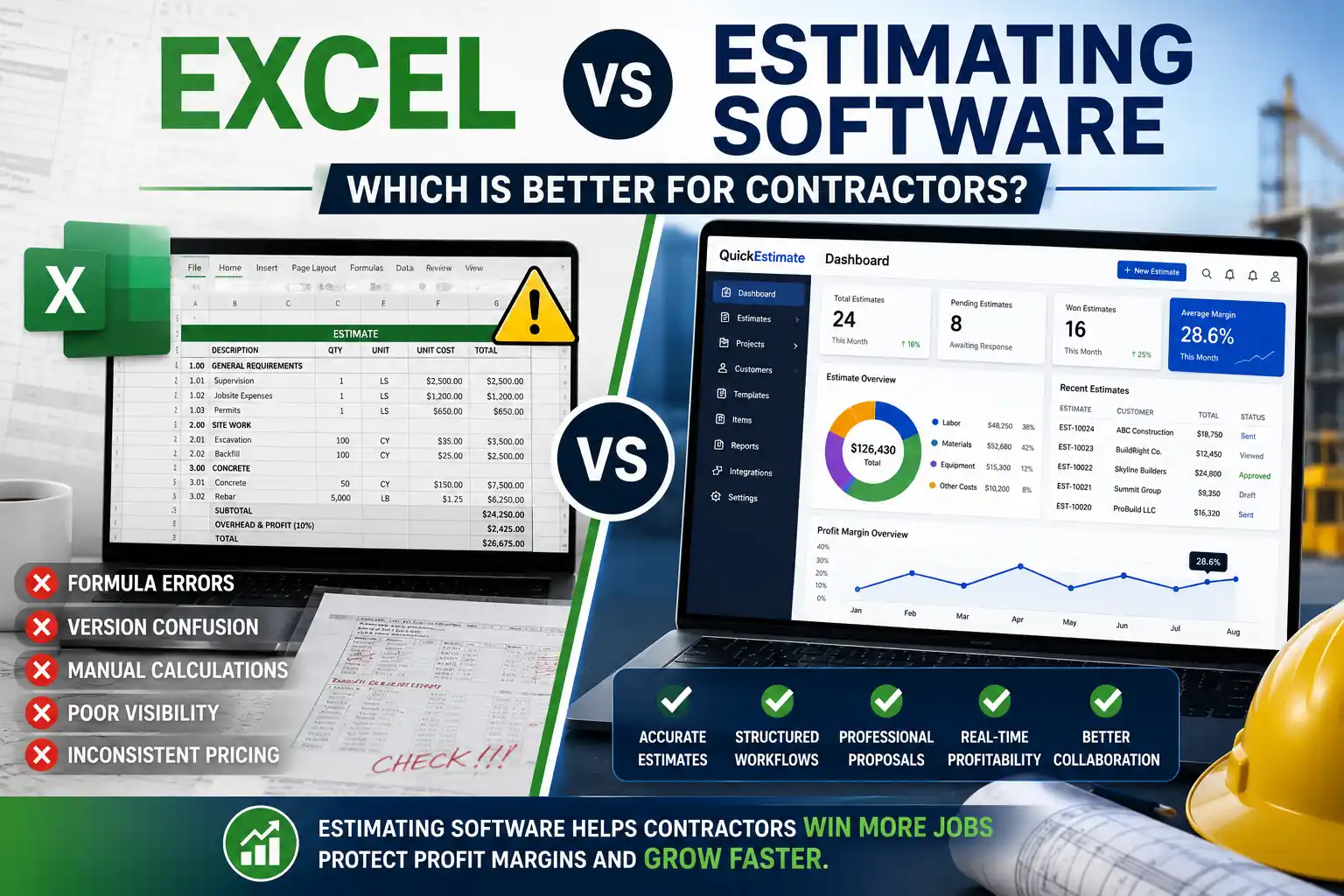
Excel vs estimating software is one of the biggest decisions contractors face when trying to improve estimate accuracy, organize workflows, protect profit margins, and scale construction operations efficiently.
Why Contractors Still Use Excel for Estimating
When weighing Excel vs estimating software, many contractors started estimating with spreadsheets because Excel provides flexibility and quick calculations without requiring complicated setup.
Excel became popular because:
- It is familiar to most teams
- Formulas can be customized easily
- Small projects are manageable
- Startup costs are low
- Estimates can be created quickly
Excel works well for small estimates, but as projects and teams grow, spreadsheets become harder to manage, validate, review, and scale consistently across construction businesses.
Spreadsheet estimating workflows often become difficult to manage as:
- Project volume increases
- Teams expand
- Pricing changes frequently
- Proposal complexity grows
- More revisions are required
What Problems Excel Creates for Construction Estimating
Many contractors do not notice spreadsheet problems immediately because the issues appear gradually over time.
Formula Errors
Incorrect references, broken formulas, overwritten cells, and copy-paste mistakes can silently create inaccurate project pricing.
Poor Version Control
Multiple spreadsheet copies create confusion around approvals, revisions, pricing updates, and current estimate versions.
Inconsistent Pricing
Different estimators often use different assumptions, labor rates, markups, and proposal structures.
As construction businesses grow, spreadsheet workflows become harder to maintain consistently across projects, teams, and revisions.
What Is Construction Estimating Software?
Construction estimating software is a digital workflow system designed specifically for contractors to create estimates, organize pricing, track profitability, generate proposals, and manage project workflows.
Unlike spreadsheets, estimating software creates structured workflows that improve:
- Estimate accuracy
- Operational visibility
- Workflow consistency
- Proposal organization
- Team collaboration
- Profit margin protection
Excel vs Estimating Software Comparison
Modern estimating software significantly improves workflow structure and operational visibility compared to spreadsheets.
| Excel Spreadsheets | Estimating Software |
|---|---|
| Manual calculations | Automated workflows |
| Formula errors | Structured pricing |
| Version confusion | Centralized records |
| Poor proposal formatting | Professional proposals |
| No margin visibility | Real-time profitability tracking |
| Disconnected workflows | Workflow organization |
Why Contractors Are Replacing Spreadsheets
Construction businesses are increasingly replacing spreadsheets because operational complexity continues growing.
Common spreadsheet estimating problems include:
- Slow estimate creation
- Pricing inconsistencies
- Missed scope items
- Formula mistakes
- Poor collaboration
- Disorganized project records
- Lack of profitability tracking
- Workflow confusion
Estimating software helps contractors centralize workflows, improve estimate accuracy, generate professional proposals, and scale operations more efficiently.
How Estimating Software Protects Profit Margins
Many contractors lose profit not because projects fail completely, but because small operational mistakes quietly compound across multiple projects.
Estimating software improves profitability by helping contractors:
- Track overhead consistently
- Standardize pricing workflows
- Improve estimate accuracy
- Monitor labor costs
- Reduce manual mistakes
- Improve proposal quality
- Track revisions professionally
Additional Construction Estimating Resources
Learn more about construction estimating best practices from:
Frequently Asked Questions About Excel vs Estimating Software
When comparing Excel vs estimating software, Excel can work for small projects and basic estimates, but it often creates operational risks as projects and teams grow.
Contractors replace spreadsheets because manual workflows create pricing inconsistencies, formula errors, poor visibility, and workflow confusion.
Estimating software improves estimate accuracy, overhead tracking, workflow organization, proposal quality, and margin visibility.