
 QuickEstimate Team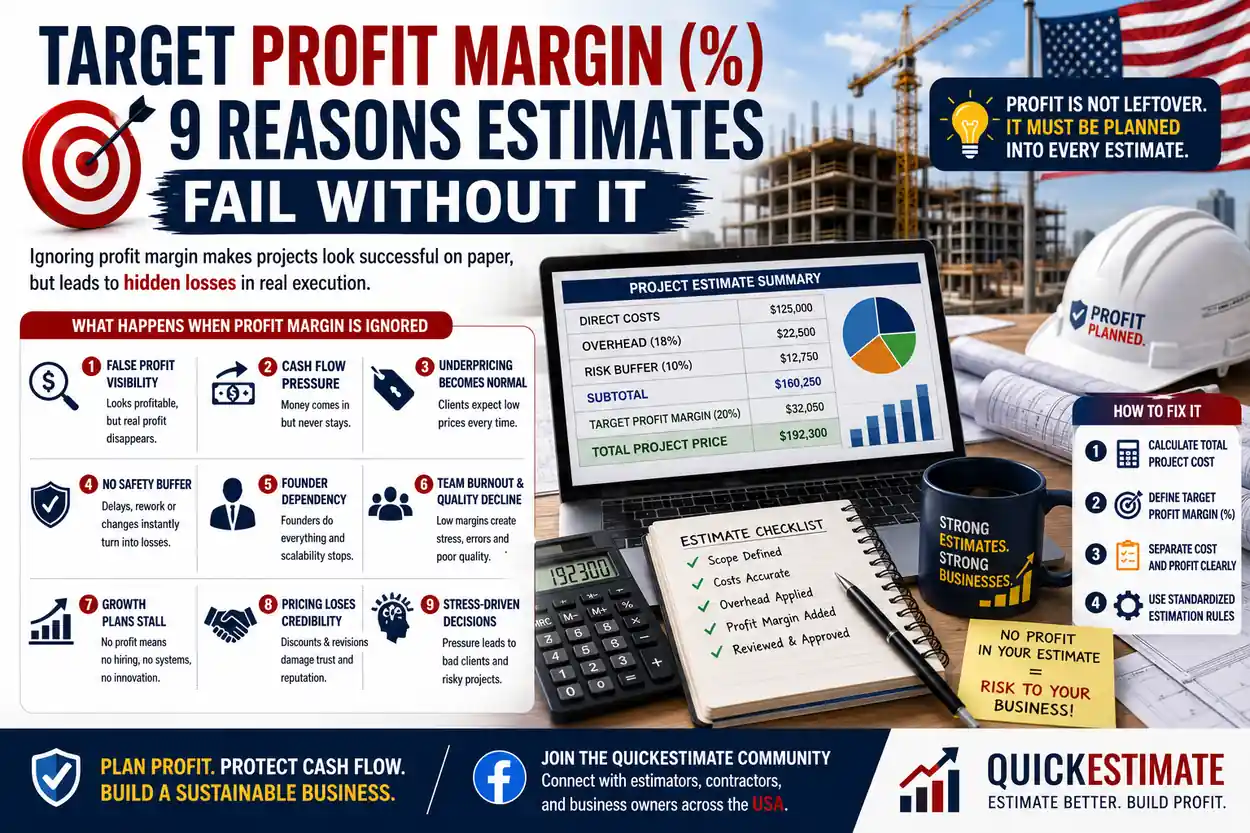
These estimation failures are covered in detail in the complete
Estimation Problems Guide →
Most businesses don’t fail because they lack revenue — they fail because their estimates never included enough profit to survive real-world execution. Without a defined target profit margin, projects appear successful on paper while silently draining cash flow, increasing stress, and preventing long-term growth.
The Trap of “Accidental” Pricing
Many businesses unknowingly use “cost-plus” pricing without a defined profit strategy. They calculate labor, materials, and operational costs — then simply add a random markup amount hoping the project remains profitable.
The problem is that random pricing ignores hidden operational realities such as:
- Administrative salaries
- Software subscriptions
- Equipment depreciation
- Insurance costs
- Unexpected delays
- Revisions and scope changes
- Taxes and financial obligations
Profit is not a leftover amount. It must be intentionally planned into every estimate, or the business slowly operates at survival level instead of growth mode.
Why Estimates Fail Without Target Profit Margin
When estimates are created without a defined target profit margin, projects may appear profitable initially but collapse financially once real execution begins.
| What Happens | Short-Term Result | Long-Term Impact |
|---|---|---|
| No defined profit margin | Lower pricing wins projects | Business stress increases |
| Underpriced estimates | Clients approve quickly | Profit disappears after expenses |
| No contingency buffer | Estimate looks competitive | Delays instantly create losses |
| Structured profit planning | Accurate pricing visibility | Long-term business sustainability |
| Standardized estimation rules | Consistent profitability | Scalable business growth |
Hidden Financial Damage Over Time
Businesses that ignore target profit margins usually experience the same long-term operational problems repeatedly.
Cash Flow Pressure
Revenue enters the business but exits immediately through payroll, operational costs, taxes, and project expenses — leaving little financial reserve.
Founder Dependency
Low margins force founders to personally manage sales, operations, estimating, and project execution just to maintain survival-level profitability.
Growth Becomes Impossible
Without healthy margins, businesses cannot hire staff, invest in systems, improve marketing, or scale operations sustainably.
Stress-Driven Decisions
Financial pressure pushes businesses toward accepting bad clients, low-quality projects, unrealistic timelines, and risky work simply to maintain cash flow.
Why Target Profit Margin Protects Long-Term Survival
A properly planned target profit margin creates protection against uncertainty, project risk, delays, and operational instability.
Estimates should separate project cost, overhead, contingency, and profit into independent categories instead of combining everything into one unclear final number.
Businesses that intentionally build profit into every estimate can:
- Protect cash flow stability
- Recover operational overhead properly
- Handle unexpected project delays
- Reduce financial stress
- Invest in future growth
- Improve long-term sustainability
If your estimate includes revenue but no planned profit margin, your business is operating at risk.
How to Fix Estimates That Ignore Profit Margin
The most effective businesses use structured estimation workflows that apply profit consistently across every project.
Calculate Total Project Cost First
Include direct labor, materials, subcontractors, tools, and operational overhead before applying profit margins.
Define Your Target Profit Margin
Low-risk projects may require 10–15%, while complex or high-risk projects often require 25–40% margins for sustainability — in line with benchmarks published by the SCORE small business mentoring network.
Separate Cost and Profit Clearly
Keep overhead, contingency, and profit visible independently instead of hiding them inside random markup percentages.
Use Standardized Estimation Rules
Structured workflows prevent emotional pricing, inconsistent discounts, and accidental underpricing.
Frequently Asked Questions
Target profit margin ensures projects remain financially sustainable after operational costs, taxes, overhead, delays, and risk factors are considered.
Businesses often experience underpricing, cash flow pressure, reduced profitability, team burnout, and long-term financial instability.
Standard projects commonly target 15–25% margins, while higher-risk projects may require 25–40% depending on complexity and operational risk.
No. Contingency handles uncertainty and unexpected events, while profit represents planned business earnings after all expenses are covered.
“`