
 Reed Jason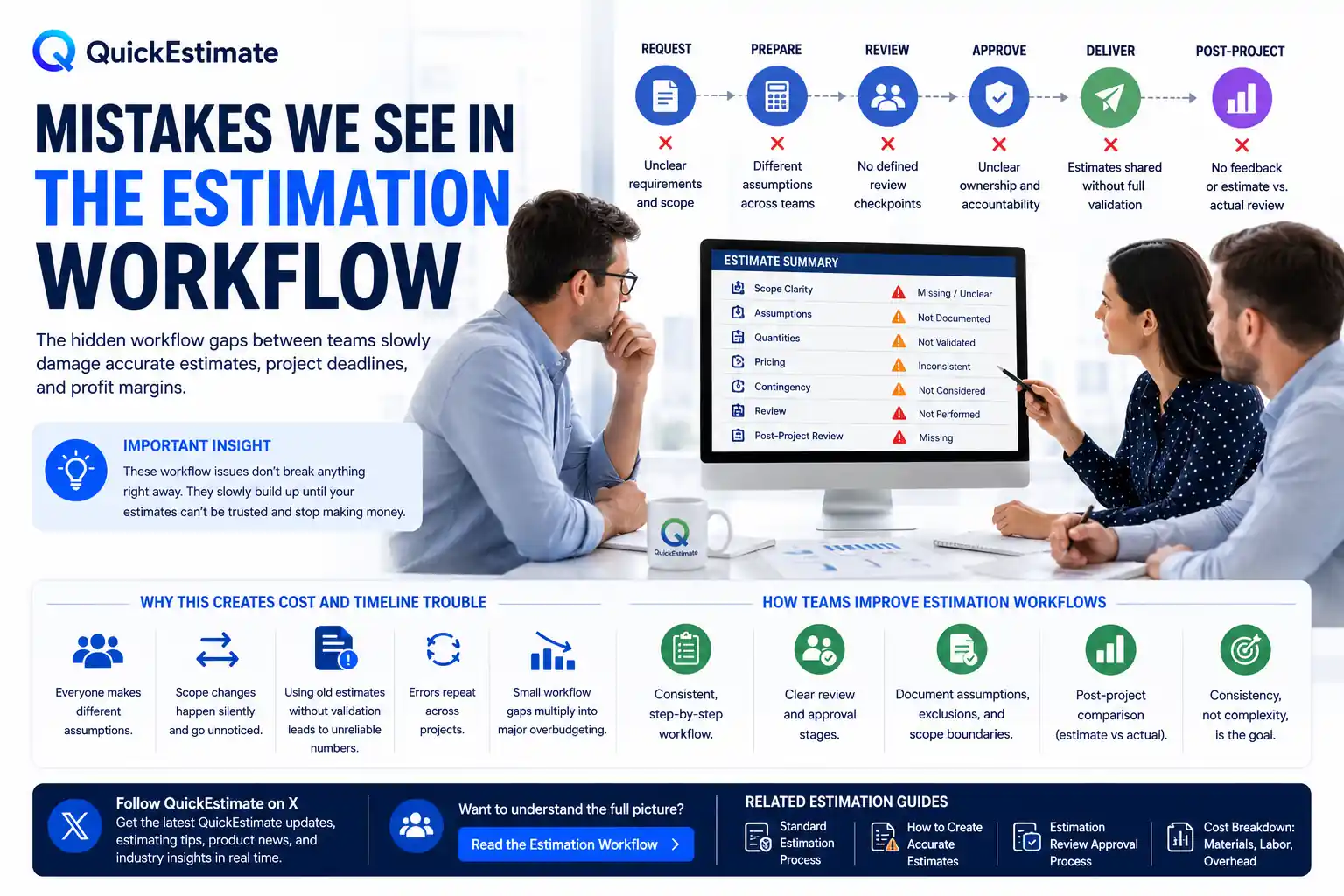
These workflow challenges are covered in depth in the complete
Estimation Workflow →
Estimation workflow mistakes rarely appear as immediate failures. Instead, they slowly reduce estimate accuracy, create approval delays, increase project uncertainty, and quietly damage profit margins over time.
As businesses grow and workloads increase, estimating often becomes rushed and informal. Without a clearly structured process, estimation depends too heavily on individual judgment instead of a reliable workflow system.
Where Estimation Workflows Fail
The core problem behind inaccurate estimates is usually not estimator skill — it is weak workflow discipline and lack of process consistency.
- No clear workflow from request to final client estimate
- No defined ownership between preparation, review, and approval
- No validation checkpoints before estimates are shared
- No standardized structure for assumptions and scope boundaries
- Little or no post-project feedback process
Workflow problems rarely break projects immediately. They slowly build up until estimates become unreliable, approvals become inconsistent, and profitability begins to decline.
Why Process Discipline Matters
Estimation workflows become unstable when teams rely mainly on personal habits, rushed communication, or undocumented decisions instead of structured estimating procedures.
As project volume increases, these gaps become more difficult to control and far more expensive to recover from later.
Reliable estimating comes from consistent workflows, not from estimator memory or individual effort alone.
How Workflow Gaps Create Cost and Timeline Problems
Unclear estimation workflows create confusion, delays, and repeated operational inefficiencies across teams and projects.
| Workflow Gap | Operational Impact |
|---|---|
| Different assumptions between teams | Inconsistent project pricing |
| Silent scope changes | Unexpected project costs |
| Reusing old estimates without validation | Unreliable numbers and approvals |
| No structured reviews | Errors repeated across projects |
| Missing workflow visibility | Overbudgeting and schedule disruption |
Over time, small workflow gaps multiply into larger operational and financial problems that become difficult to control.
How Errors Repeat Across Projects
When estimating processes are informal, the same mistakes quietly move from one project to the next. Old assumptions are reused, review gaps remain hidden, and inconsistent workflows slowly become accepted as normal operations.
Small process failures repeated consistently across projects often become more damaging than one large estimating mistake.
How Teams Improve Estimation Workflows
Organizations that improve estimate accuracy focus primarily on workflow consistency rather than increasing estimating complexity.
- Create a standardized step-by-step estimation workflow
- Define review and approval stages clearly
- Document assumptions, exclusions, and scope boundaries
- Compare estimates against actual project outcomes
- Improve estimating processes continuously over time
The goal of estimation workflows is not perfect estimates — it is creating repeatable consistency, visibility, and reduced operational risk.
Frequently Asked Questions
Workflow gaps create inconsistent assumptions, missing validations, unclear approvals, and repeated process mistakes that gradually reduce estimating reliability.
In most cases, recurring estimation issues are caused more by weak workflow structure and lack of process discipline than by individual skill limitations.
Review checkpoints help catch missing assumptions, pricing inconsistencies, scope changes, and operational risks before estimates move into approvals or execution.
Growing organizations improve workflows by standardizing estimating processes, introducing approvals, documenting assumptions clearly, and comparing estimates against actual outcomes consistently.