
 Reed Jason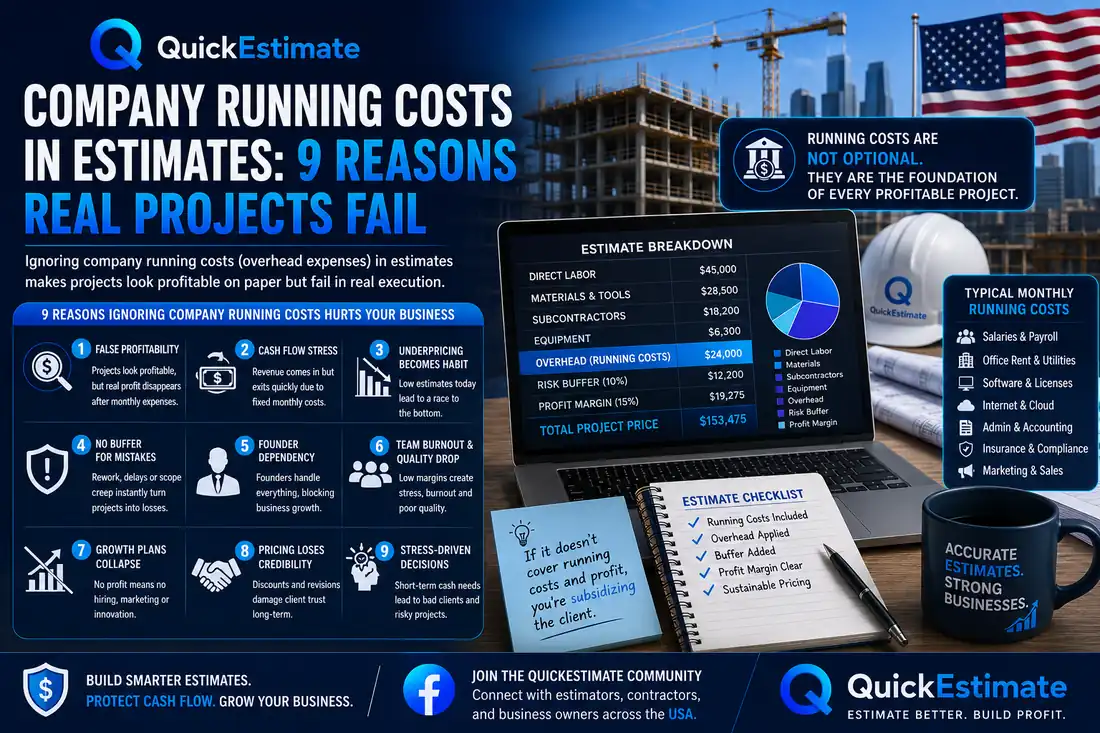
These estimation issues are covered in depth inside the complete
Estimation Problems Guide →
Most contractors and service businesses don’t fail because they lose projects — they fail because their estimates never included the company’s real operating costs in the first place. Salaries, software, rent, administration, and overhead silently drain profitability long after the project appears “successful” on paper.
72%
$25/hr
0%
9/10
Why Company Running Costs Matter in Estimates
Company running costs include all operational expenses required to keep a business functioning every month — whether projects are active or not. These are not optional expenses. They are permanent financial obligations.
If salaries, office expenses, software tools, admin costs, and overhead are missing from estimates, projects may generate revenue while still creating real financial loss.
Common company running costs include:
- Employee salaries and contractor payouts
- Office rent and utilities
- Software subscriptions and licenses
- Cloud hosting and internet services
- Accounting and administrative costs
- Sales and marketing expenses
- Insurance and compliance expenses
- Founder salary and operational management
Problems Caused by Ignoring Company Running Costs
Most businesses underestimate the damage caused by missing operational expenses in their pricing systems. Projects initially appear profitable because direct labor and materials are covered — but the business itself remains underfunded.
Revenue is not profit. If your estimate only covers project delivery costs but ignores company operating expenses, your business slowly subsidizes the client.
False Profitability
Estimates look profitable at first, but after paying salaries, software, office expenses, and operational bills, little or no real profit remains.
Cash Flow Stress
Revenue enters the business but exits immediately through recurring monthly expenses, creating ongoing financial pressure.
Underpricing Becomes Normal
Businesses repeatedly submit low estimates to stay competitive, locking themselves into unsustainable pricing structures.
How Cash Flow Problems Begin
Most business failures don’t happen because projects disappear. They happen because estimates never recovered enough money to sustain operations between projects.
| Pricing Approach | What Happens | Result |
|---|---|---|
| Direct costs only | Labor and materials covered only | Business loses money monthly |
| Random pricing buffer | No structured overhead recovery | Unstable cash flow |
| Calculated operating overhead | Monthly expenses included properly | Stable operations |
| Structured estimation workflow | Costs, buffers, and margins enforced | Long-term profitability |
Why Projects Look Profitable But Fail
One of the biggest estimation mistakes is assuming that “remaining money” automatically becomes profit. In reality, operational expenses consume that leftover revenue quickly.
If an estimate doesn’t recover company running costs AND profit margin, the project is financially dangerous no matter how busy the business looks.
Ignoring running costs causes:
- Founder burnout
- Pricing instability
- Quality decline
- Employee pressure
- Cash shortages
- Inability to scale operations
- Dependence on constant new projects
How to Fix Estimates That Ignore Company Running Costs
Businesses improve estimation accuracy significantly once operational overhead becomes part of every estimate automatically.
Calculate Your Monthly Operating Cost
Include salaries, software, rent, cloud tools, internet, admin, accounting, marketing, and founder compensation.
Convert Overhead into Hourly Cost
Divide monthly running costs by total billable hours to calculate the real operational cost per hour.
Separate Every Cost Bucket Clearly
Direct labor, materials, overhead allocation, contingency, and profit margin should all appear separately inside the estimate.
Frequently Asked Questions
Company running costs are operational expenses such as salaries, rent, software, administration, utilities, insurance, and overhead required to keep the business functioning every month.
Many businesses focus only on labor and materials while trying to stay competitive. As a result, operational overhead gets ignored, causing long-term financial pressure.
If operational expenses are not included in estimates, projects may generate revenue but fail to create sustainable profit after business expenses are paid.
Add all monthly operating expenses together and divide them by total billable hours or project volume to calculate the true overhead recovery rate.