
 Reed Jason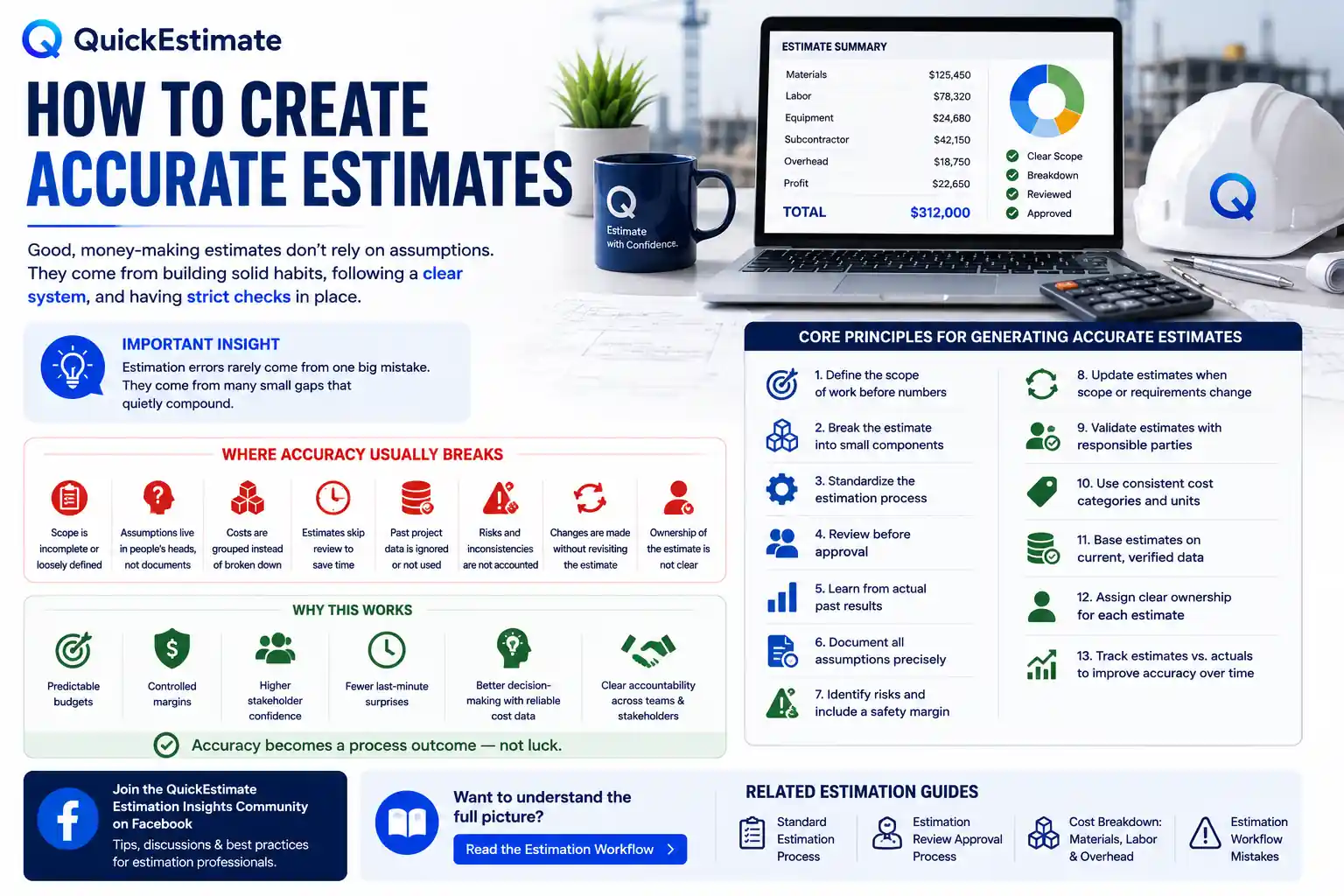
These estimation workflow challenges are covered in depth in the complete
Estimation Workflow →
Accurate estimates do not come from assumptions, luck, or experience alone. Reliable estimates are created through structured workflows, disciplined preparation, consistent review, and repeatable estimating systems.
In many organizations, estimates are created under time pressure, causing overhead, margins, assumptions, and risks to be rushed or overlooked completely. Long-term estimate accuracy depends on process consistency — not estimator speed.
Where Accuracy Usually Breaks
Most estimation problems are not caused by mathematical calculations. Accuracy usually fails during preparation, documentation, review, communication, and workflow consistency.
- Scope definitions are incomplete or unclear
- Assumptions remain undocumented
- Costs are grouped instead of separated clearly
- Review stages are skipped to save time
- Past project data is ignored or unused
- Risks and inconsistencies are not considered
- Changes occur without updating estimates
- Ownership and accountability remain unclear
Estimation failures rarely come from one major mistake. They usually develop through many small workflow gaps that quietly compound over time.
Why Small Gaps Create Large Problems
Small inconsistencies inside estimation workflows often remain invisible early in the project lifecycle. Over time, these hidden gaps create inaccurate budgets, unreliable forecasts, delayed approvals, and shrinking margins.
Accurate estimates are process outcomes created through consistency, validation, and visibility — not guesswork or estimator memory.
Core Principles for Accurate Estimates
Teams that consistently improve estimate accuracy follow structured estimating principles throughout the workflow.
Define the scope before numbers
Clear scope boundaries reduce assumptions, misunderstandings, and hidden project risks.
Break estimates into smaller components
Separate materials, labor, overhead, and risk allowances for better visibility and control.
Standardize the estimation workflow
Consistent workflows improve reliability across teams, projects, and approvals.
Review before approval
Structured reviews help identify missing scope items, assumptions, and hidden risks.
Learn from actual project results
Comparing estimates against real outcomes improves future forecasting accuracy.
- Document assumptions clearly
- Identify risks and include safety margins
- Update estimates when scope changes
- Validate estimates with responsible parties
- Use consistent cost categories and units
- Base estimates on verified current data
- Assign clear ownership to each estimate
- Track estimated versus actual project outcomes
Why Structured Estimation Works
Organizations that follow structured estimating workflows create more reliable decisions, stronger accountability, and more predictable financial outcomes.
| Structured Workflow Benefit | Operational Result |
|---|---|
| Clear scope definition | Reduced misunderstandings and rework |
| Consistent review stages | Higher estimate confidence |
| Separated cost categories | Better margin visibility |
| Validated assumptions | More reliable planning decisions |
| Tracking actual outcomes | Improved future estimate accuracy |
Business Benefits of Accurate Estimates
Teams that improve estimation consistency create stronger operational control across planning, delivery, budgeting, and resource management.
- Predictable budgets and controlled margins
- Higher stakeholder confidence
- Reduced last-minute surprises
- Better project decision-making
- Improved accountability across teams
- Reduced rework caused by unclear scope
- Better resource allocation and planning
- Improved trust between delivery, finance, and leadership
- Easier operational scaling as project volume increases
- More accurate forecasting for future projects
Accurate estimating becomes a repeatable process outcome — not a matter of luck, memory, or individual heroics.
Frequently Asked Questions
Estimation accuracy usually breaks down because of unclear scope, undocumented assumptions, inconsistent workflows, missing reviews, and lack of visibility into risks and changes.
Clear scope definitions reduce misunderstandings, hidden assumptions, scope creep, and unexpected cost changes during execution.
Reviews help identify missing information, unrealistic assumptions, pricing inconsistencies, and operational risks before projects move forward.
Comparing estimated versus actual results helps organizations learn from past projects and continuously improve forecasting accuracy over time.