
 QuickEstimate Team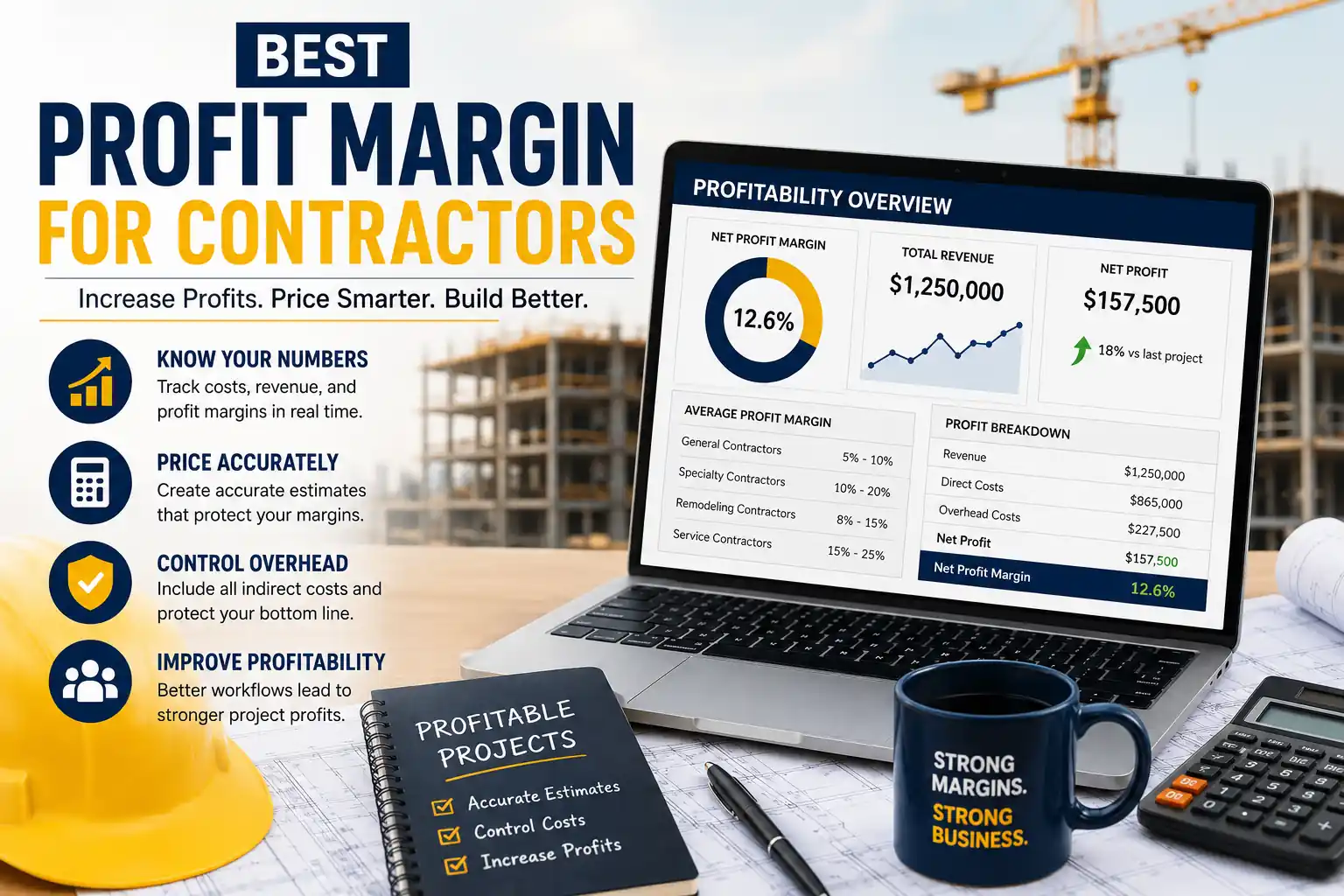
Profit margin for contractors directly affects project profitability, pricing accuracy, business growth, and long-term financial stability in construction projects.
5%–10%
20%
$10K+
68%
What Is Profit Margin for Contractors?
Profit margin for contractors refers to the percentage of revenue remaining after all construction project costs and operational expenses are paid.
Contractor profit margins help businesses understand:
- Project profitability
- Pricing health
- Financial stability
- Operational efficiency
- Business sustainability
Many contractors believe projects are profitable because labor and materials are covered. However, ignored overhead and inaccurate pricing quietly reduce actual profit margins over time.
Construction profit margins are heavily affected by:
- Labor costs
- Material pricing
- Overhead recovery
- Workflow efficiency
- Estimate accuracy
- Project scheduling
Why Profit Margin Matters in Construction
Construction projects involve constant operational and financial risk. Even small pricing mistakes can significantly reduce contractor profitability across multiple projects.
Profit margin directly affects:
- Cash flow stability
- Business growth
- Equipment investments
- Hiring decisions
- Operational scalability
- Financial planning
Contractors with healthy profit margins are better positioned to handle market fluctuations, invest in technology, improve workflows, and scale operations successfully.
Average Profit Margin for Contractors
Profit margins vary depending on contractor type, business overhead, project complexity, and operational efficiency.
| Contractor Type | Average Net Profit Margin |
|---|---|
| General Contractors | 5% – 10% |
| Specialty Contractors | 10% – 20% |
| Remodeling Businesses | 8% – 15% |
| Service Contractors | 15% – 25% |
Healthy contractor profit margins depend heavily on accurate estimates, labor management, workflow organization, and overhead tracking.
What Reduces Contractor Profit Margins?
Many contractors lose profit not because projects fail completely, but because small operational problems quietly compound throughout the project lifecycle.
Inaccurate Estimates
Poor estimating creates underpriced bids, missed scope items, incorrect labor assumptions, and material shortages.
Ignored Construction Overhead
Many contractors calculate only labor and materials while forgetting indirect operational expenses such as insurance, office rent, software, and administration.
Spreadsheet Estimating Problems
Spreadsheet workflows often create formula errors, pricing inconsistencies, version confusion, and missed scope items.
How Contractors Improve Profit Margins
Modern construction businesses improve profitability by implementing better estimating workflows, overhead tracking systems, and operational visibility tools.
- Improve estimate accuracy
- Track construction overhead properly
- Standardize pricing workflows
- Reduce spreadsheet dependency
- Track estimate vs actual performance
- Improve proposal organization
Contractors using structured estimating systems often improve pricing consistency, proposal quality, workflow visibility, and long-term financial stability.
Why Estimating Software Helps Protect Contractor Profit Margins
Modern construction estimating software improves visibility into labor costs, overhead allocation, material pricing, and profitability tracking.
Construction estimating software helps contractors:
- Track profit margins automatically
- Apply overhead consistently
- Reduce manual pricing errors
- Generate professional proposals
- Improve workflow organization
- Track project profitability in real time
Additional Construction Profitability Resources
Learn more about construction estimating and contractor profitability from:
Frequently Asked Questions About Profit Margin for Contractors
Most general contractors target net profit margins between 5% and 10%, while specialty contractors often target 10%–20% or higher.
Contractors often lose profit because of inaccurate estimates, missed overhead costs, labor overruns, poor workflow visibility, and scope creep.
Profit margin is typically calculated by subtracting total project costs from revenue and dividing the remaining profit by total revenue.