
 QuickEstimate Team
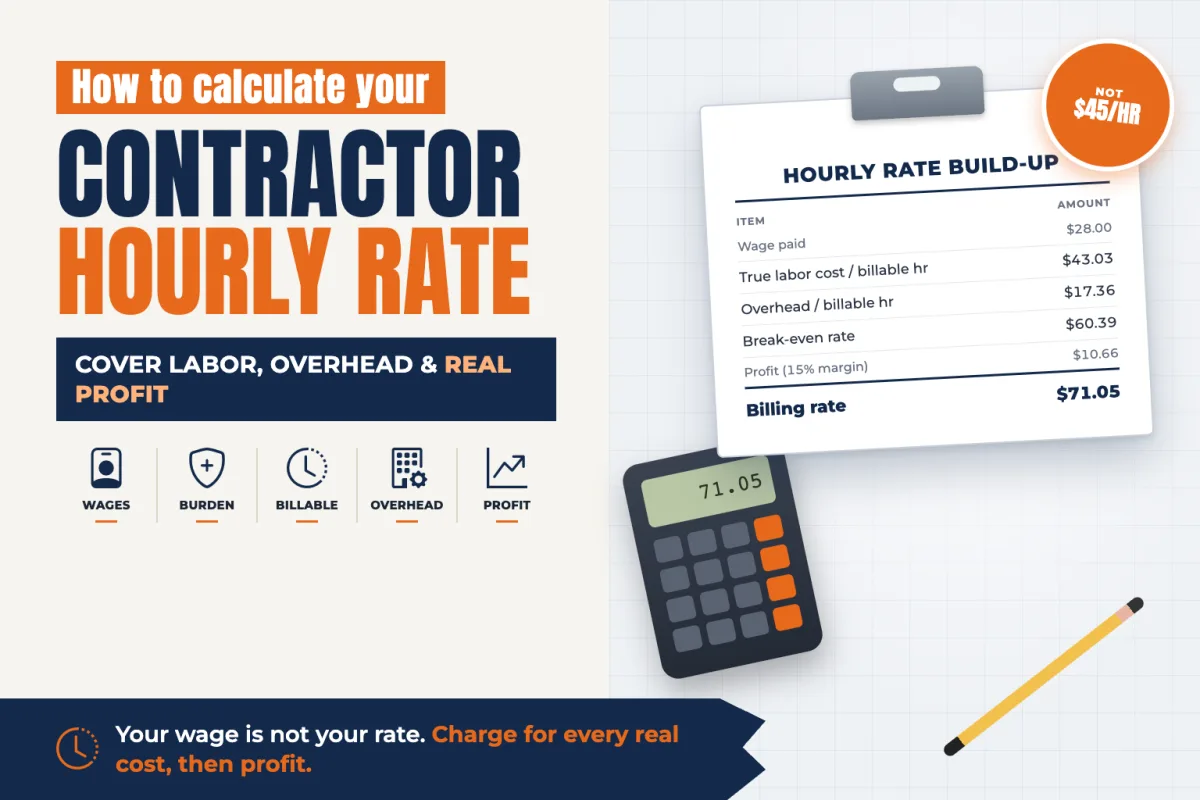
Your contractor hourly rate is one of the most important numbers in your business, and one of the most commonly guessed. Many contractors take what they pay a worker, add a few dollars, and call it their rate. Then they wonder why the business is always busy but never has any money.
This guide shows you how to calculate a contractor hourly rate that actually covers your costs: the true cost of labor, the hours you can really bill, your overhead and your profit. There’s a full worked example, so you can plug in your own numbers.
Key takeaways
- Your contractor hourly rate is not the wage you pay. It has to cover burden, non-billable time, overhead and profit.
- Payroll taxes, workers’ comp, insurance and benefits often add 25 to 40% on top of wages.
- Nobody bills 2,080 hours a year. Holidays, time off, driving and estimating eat into billable time.
- Spread overhead across billable hours, not paid hours.
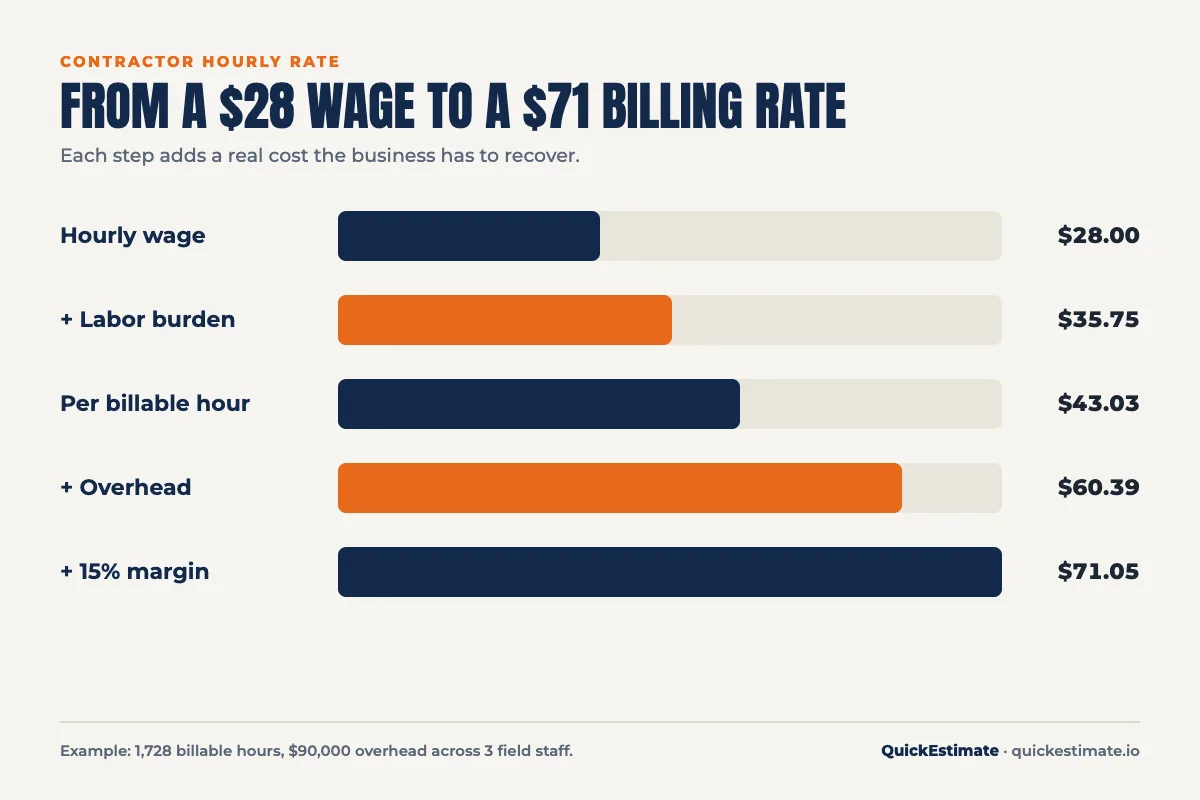
- In our example, a $28-an-hour employee needs a billing rate of about $71 an hour to hit a 15% margin.
Why your wage is not your contractor hourly rate
Say you pay a carpenter $28 an hour and bill them out at $45. That looks like a $17-an-hour profit. It isn’t. On top of the $28, you’re paying payroll taxes, workers’ comp, insurance and paid time off. The carpenter also spends hours every week driving between jobs, picking up materials and cleaning up, which you pay for but can’t bill. And the business itself has costs, such as trucks, tools, phones, software and your own time spent estimating, that have to be paid from somewhere.
Once you add all of that up, a $45 rate on a $28 employee can lose money on every hour worked. The fix is to calculate your contractor hourly rate from the bottom up, in five steps.
Step 1: Work out the true cost of labor
Start with the full annual cost of each employee, not just their wage. That includes:
- Wages for all paid hours, including holidays and paid time off
- Employer payroll taxes. The IRS sets the employer share of Social Security at 6.2% and Medicare at 1.45%, so 7.65% combined, plus federal and state unemployment taxes
- Workers’ compensation insurance, which varies widely by trade and state
- Benefits such as health insurance and retirement contributions
- Other employee costs such as uniforms, phones, training and tool allowances
Together these are called labor burden. For many contractors they add 25 to 40% to the wage bill, sometimes more in high-risk trades. Our guide to labor burden in estimates goes deeper, and the free employee cost calculator will work out the total for you.
Step 2: Count your real billable hours
A full-time year is 2,080 paid hours (40 hours × 52 weeks). But you can’t bill all of them. Subtract:
- Holidays (often 6 to 10 days)
- Paid time off and sick days
- Non-billable time: driving between jobs, supply runs, shop time, training, callbacks and weather days
Non-billable time is where most contractors fool themselves. Track it for a few weeks. It’s common for 10 to 20% of on-the-clock time to be non-billable, and in service trades with lots of short jobs it can be higher.
What’s left is billable hours: the only hours that can bring in revenue. Your contractor hourly rate has to recover the whole year’s cost from these hours alone.
Step 3: Add overhead per billable hour
Overhead is everything the business spends that isn’t tied to one job: vehicles, fuel, insurance, rent, software, phones, accounting, marketing, and the office or owner time spent estimating and managing.
Add up a year of overhead from your books, then divide it by the total billable hours of your whole field crew:
Overhead per hour = annual overhead ÷ total crew billable hours
If you’re not sure what counts as overhead, our guides to company running costs and construction overhead percentage walk through it line by line.
Step 4: Find your break-even rate
Break-even rate = true labor cost per billable hour + overhead per billable hour
This is the lowest contractor hourly rate you can charge without losing money. At this rate the business covers every cost, but earns nothing. Every hour you bill below it costs you money.
Step 5: Add profit
Profit is what lets you replace equipment, survive slow months, grow and pay yourself properly beyond a wage. Decide on a target margin, then convert it to a rate:
Billing rate = break-even rate ÷ (1 − target margin)
Note that this divides rather than multiplies. A 15% margin is not the same as adding 15%. If that’s unclear, read our guide to markup vs margin. It’s the most common reason contractors earn less than they planned.
Contractor hourly rate: a worked example
A small remodeling company has three field employees. Here’s the calculation for one carpenter paid $28 an hour. Insurance and benefit figures are examples, so use your own.
| Annual labor cost | Amount |
|---|---|
| Wages: 2,080 hrs × $28 | $58,240 |
| Employer Social Security and Medicare (7.65%) | $4,455 |
| Federal and state unemployment | $1,000 |
| Workers’ comp (example 8% of wages) | $4,659 |
| Health insurance contribution | $6,000 |
| True annual cost | $74,354 |
Burden here is $16,114, about 27.7% on top of wages.
Billable hours:
- 2,080 paid hours − 80 holiday hours − 80 PTO hours = 1,920 hours worked
- 10% non-billable (driving, supply runs, cleanup) = 192 hours
- Billable hours: 1,728
Now build the rate:
- True labor cost per billable hour: $74,354 ÷ 1,728 = $43.03
- Overhead per billable hour: $90,000 annual overhead ÷ (3 employees × 1,728 hours) = $17.36
- Break-even rate: $43.03 + $17.36 = $60.39
- Billing rate for a 15% margin: $60.39 ÷ 0.85 = $71.05 per hour
So the company’s contractor hourly rate for this carpenter should be around $71. At the $45 they were charging, they lost about $15 on every billable hour. That’s roughly $26,000 a year on one employee, before they’d made a dollar of profit.
Hourly rate for owner-operators
If you work alone, the same method applies, with two changes:
- Pay yourself a salary in the calculation. Decide what you’d need to earn as an employee doing your job, and treat it as your labor cost, including self-employment taxes and your own health insurance.
- Expect fewer billable hours. A solo contractor also estimates, invoices, answers calls and buys materials. Many only bill 1,000 to 1,400 hours a year, which pushes the rate up.
This is why a one-person business often needs a higher hourly rate than a larger company. It isn’t greed; there are fewer billable hours to spread the costs over.
Different rates for different roles and crews
One contractor hourly rate for everyone is simple, but it’s rarely accurate. A lead carpenter, an apprentice and a laborer cost you different amounts, and they produce different amounts of work. Run the same five steps for each role to get a rate for each.
Then, if you send crews rather than individuals, add the rates together for a crew rate. For example, if your lead’s calculated billing rate is $80 an hour and your apprentice’s is $52, a two-person crew hour is $132. Pricing by crew hour is often easier to explain to clients than listing each person, and it keeps your estimates consistent.
A blended rate across the whole company can work for very small teams, but watch for drift. If you start sending more senior people to jobs priced at a blended rate, your margin shrinks without you noticing.
Overtime, after-hours and emergency rates
Overtime costs you more, often time and a half on wages, plus the burden that rises with it. If a client needs evening, weekend or emergency work, your contractor hourly rate for those hours should reflect the higher cost and the disruption to your schedule.
Many contractors set a separate after-hours rate, a minimum call-out charge, or both. State these clearly in your terms before the work starts, so there are no surprises on the invoice.
Hourly rate vs fixed price: which pays better?
Both have a place:
- Hourly (time and materials) protects you when the scope is unclear, such as repairs, troubleshooting and old buildings full of surprises. The risk sits with the client.
- Fixed price is what most homeowners prefer for defined projects. The risk sits with you, but so does the reward: if your crew works efficiently, you keep the difference.
Even when you quote a fixed price, your contractor hourly rate is working in the background. Estimated hours multiplied by your true cost per hour is the labor line, and overhead and profit are applied on top. A fixed price that isn’t built from real hours and real rates is just a guess.
How to raise your hourly rate with existing clients
If your calculation shows you’ve been undercharging, you’ll need to raise your rate. A few ways to do it without losing good clients:
- Give notice. Tell regular clients 30 to 60 days ahead, in writing.
- Explain briefly. Rising insurance, wages and material costs are real, and most clients understand.
- Apply it to new work first. Honor quotes already sent, and use the new rate from a set date.
- Review every year. Small annual increases are easier for clients to accept than one big jump after years of flat rates.
How to use your contractor hourly rate in estimates
Once you know your rate, you have two ways to use it:
- Bill by the hour for service work, repairs and jobs with an unclear scope.
- Use it inside fixed-price estimates. Multiply estimated labor hours by your true cost per hour, then apply overhead and profit to the whole job. This keeps fixed prices tied to real costs.
For fixed-price work, be careful not to double-count. If your billing rate already includes overhead and profit, don’t add them again on top of the labor line. Pick one method and use it consistently. Our step-by-step guide on how to estimate electrical work shows the fixed-price approach in practice.
Check your rate against the market
Your calculated rate tells you what you need to charge. The market tells you what clients will pay. If your number is well above local rates, don’t just cut it. Look at why:
- Is overhead too high for the size of the business?
- Is non-billable time eating too many hours? Better scheduling and routing can recover a lot.
- Are you competing on the wrong jobs? Specialty work, faster response or better quality often supports a higher rate.
If your number is below the market, you may be leaving money on the table. Many contractors find they can raise their rate without losing clients once they can explain their value.
Recover more billable hours
Raising your price isn’t the only way to fix a low contractor hourly rate. Increasing billable hours spreads the same costs over more revenue. Common wins:
- Batch supply runs and use supplier delivery where you can.
- Schedule jobs by area to cut drive time between sites.
- Prepare material lists before the crew arrives, so nobody waits on site.
- Bill for small extras with a clear change order instead of absorbing them.
- Reduce callbacks with a final walkthrough checklist.
Even a 5% gain in billable hours can make a noticeable difference to your break-even rate.
Contractor hourly rate checklist
- Wages for all paid hours, including holidays and PTO
- Employer payroll taxes and unemployment insurance
- Workers’ comp, liability insurance share and benefits
- Realistic billable hours after non-billable time
- Annual overhead from your books, spread over crew billable hours
- A target margin converted correctly into a rate
- Separate rates for roles, overtime and after-hours work
- A date on the calendar to recalculate next year
When a client asks why your rate is so high
Some clients know roughly what tradespeople earn and question the gap. A calm, simple answer works best: your contractor hourly rate covers far more than the person on site. It pays for their payroll taxes and insurance, the licensed and insured business behind them, the vehicle and tools they arrive with, the time spent planning and buying materials, and the warranty that stands behind the work. A cheaper rate usually means one of those things is missing.
You don’t need to show your numbers. But knowing exactly how your rate was built gives you the confidence to hold it.
Hourly rate mistakes contractors make
- Using the wage as the cost. Always use the fully burdened cost.
- Dividing by 2,080 hours. Use billable hours, or every calculation will come in low.
- Leaving out the owner’s time. If you estimate, manage and sell, that time has a cost.
- Forgetting to update it. Wages, insurance and fuel change every year. Recalculate at least annually.
- Copying a competitor’s rate. Their costs aren’t your costs.
Keep your rates in one place
Once you’ve calculated your contractor hourly rate, it should be used the same way in every estimate. In QuickEstimate you save labor rates, overhead and profit settings once, and every estimate applies them automatically. A margin indicator shows what you’ll really earn before you send the proposal, so a low rate can’t slip through unnoticed.
Frequently asked questions
How do I calculate my contractor hourly rate?
Add up the true annual cost of labor (wages plus burden), divide by real billable hours, add overhead per billable hour to get your break-even rate, then divide by one minus your target margin to add profit.
What is a good hourly rate for a contractor?
There’s no single number. It depends on your trade, location, labor costs, overhead and billable hours. Calculate yours from your own costs, then compare it with what similar businesses charge locally.
How many billable hours does a contractor have in a year?
Far fewer than 2,080. After holidays, time off and non-billable work such as driving and estimating, many field employees bill roughly 1,500 to 1,800 hours. Solo owner-operators often bill less.
What is labor burden?
Labor burden is the cost of employing someone beyond their wage: payroll taxes, unemployment insurance, workers’ comp, benefits and similar costs. It commonly adds 25 to 40% to wages.
Should my hourly rate include overhead?
Yes, if you bill by the hour. Your billing rate must cover labor, overhead and profit. For fixed-price estimates, use your true labor cost and apply overhead and profit to the whole job instead.
How often should I update my contractor hourly rate?
At least once a year, and whenever a major cost changes: a raise, a new vehicle, an insurance renewal or a big jump in fuel prices. Put the review on your calendar so it actually happens.
Can I charge a different hourly rate to different clients?
Yes. Many contractors charge more for rush work, small jobs or difficult sites. What matters is that no rate falls below your break-even contractor hourly rate.
The bottom line
A contractor hourly rate built on guesswork will quietly drain your business. Built from true labor cost, real billable hours, overhead and a deliberate profit margin, it becomes the foundation of every profitable estimate you send.
Want your rates applied the same way on every job? Try QuickEstimate free and see the real margin on your next estimate before it goes out.