
 Reed Jason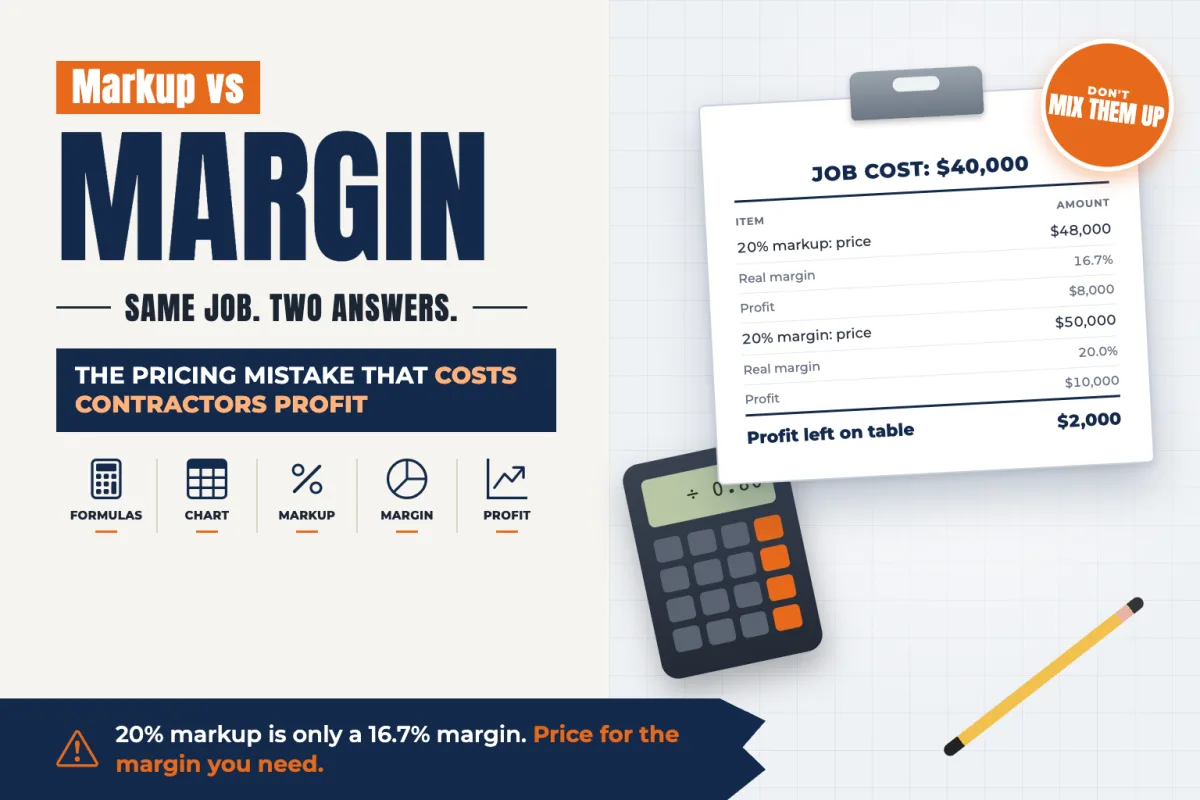
Markup vs margin sounds like an accounting question, but for contractors it’s a pricing mistake that quietly costs real money on almost every job. Many contractors say “I work on a 20% margin” when what they actually do is add 20% to their costs. Those are not the same thing, and the gap between them comes straight out of profit.
This guide explains the difference in plain terms, gives you the formulas, and includes a conversion chart you can keep next to your desk. By the end you’ll know exactly what to add to your costs to hit the profit you actually want.
Key takeaways
- Markup vs margin comes down to one thing: markup divides profit by cost, margin divides profit by price.
- A 20% markup is only a 16.7% margin. To earn a 20% margin you need a 25% markup.
- Set your target margin first (overhead plus net profit), then convert it to the markup you apply in estimates.
- Check the blended margin on every job, especially when different costs carry different markups.
- Discounts come straight out of margin, so know your floor before you negotiate.
Markup vs margin: the simple difference
In markup vs margin, both numbers describe the same dollars of profit. The difference is what you divide that profit by.
- Markup is profit as a percentage of your cost.
- Margin is profit as a percentage of the selling price.
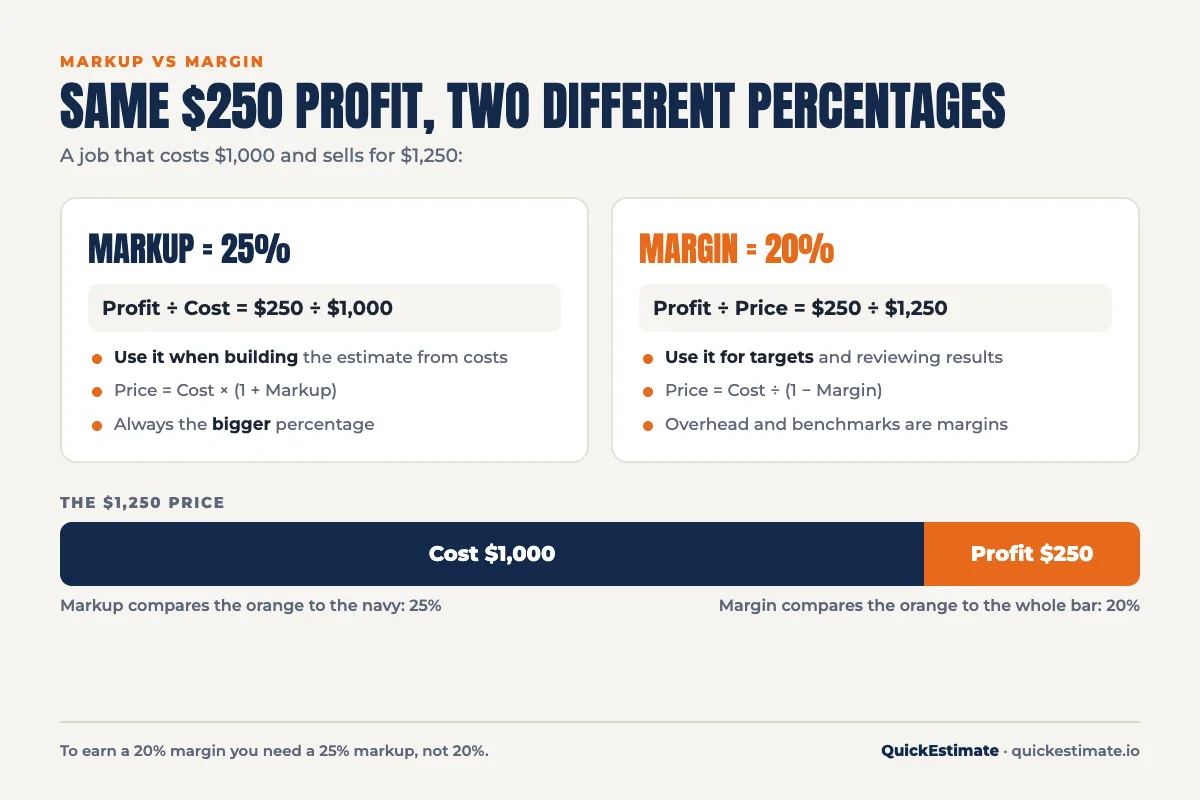
Because the price is always bigger than the cost, the same profit always looks smaller as a margin than as a markup. A job that costs $1,000 and sells for $1,250 has a $250 profit. That’s a 25% markup ($250 ÷ $1,000) but only a 20% margin ($250 ÷ $1,250).
Neither number is wrong. Problems start with markup and margin when you mean one and calculate the other.
The markup and margin formulas
Markup formula
Markup % = (Price − Cost) ÷ Cost × 100
To find a price from a markup: Price = Cost × (1 + Markup). A $10,000 job with a 25% markup is priced at $12,500.
Margin formula
Margin % = (Price − Cost) ÷ Price × 100
To find a price from a target margin: Price = Cost ÷ (1 − Margin). A $10,000 job with a 20% target margin is priced at $10,000 ÷ 0.80 = $12,500.
Notice both examples land on the same price: a 25% markup and a 20% margin are the same thing. That’s the whole markup vs margin idea in one sentence.
Converting between them
- Markup to margin: Margin = Markup ÷ (1 + Markup)
- Margin to markup: Markup = Margin ÷ (1 − Margin)
If you’d rather not do this by hand, our free markup calculator and margin calculator do the conversion instantly.
Markup vs margin conversion chart
Use this markup vs margin chart to see what a markup really gives you as a margin, and what markup you need to reach a target margin.
| If you add this markup | Your margin is |
|---|---|
| 10% | 9.1% |
| 15% | 13.0% |
| 20% | 16.7% |
| 25% | 20.0% |
| 30% | 23.1% |
| 35% | 25.9% |
| 40% | 28.6% |
| 50% | 33.3% |
| 75% | 42.9% |
| 100% | 50.0% |
| To earn this margin | Add this markup |
|---|---|
| 10% | 11.1% |
| 15% | 17.6% |
| 20% | 25.0% |
| 25% | 33.3% |
| 30% | 42.9% |
| 35% | 53.8% |
| 40% | 66.7% |
The markup vs margin gap widens as the numbers grow. At 10% the difference is small. At 40% it’s huge: a 40% markup is only a 28.6% margin, and a 40% margin needs a 66.7% markup.
Why the markup vs margin mix-up costs contractors money
Here’s the most common version of the markup vs margin mistake. A contractor decides they need a 20% margin to cover overhead and leave a profit. They build an estimate, total their costs, and multiply by 1.20.
Say the job costs $40,000:
- What they did: $40,000 × 1.20 = $48,000. Profit is $8,000, which is a 16.7% margin.
- What a 20% margin actually needs: $40,000 ÷ 0.80 = $50,000. Profit is $10,000.
That’s $2,000 left on the table on one job, not from bad work or a bad bid, just from dividing by the wrong number. Across 25 jobs of that size in a year, it’s $50,000 of profit that was never priced in.
It gets worse when overhead is involved. If your overhead alone is 15% of revenue and you think you’re earning a 20% margin but you’re really earning 16.7%, your actual profit after overhead is 1.7% instead of 5%. That’s the difference between a healthy business and one that’s always short of cash. Our guide to company running costs in estimates goes deeper on this.
Gross margin vs net margin
When contractors talk about margin, they usually mean one of two things, and mixing them up causes its own problems.
- Gross margin is what’s left after the direct costs of the job: materials, labor, subcontractors and equipment. It’s the number you control inside each estimate.
- Net margin is what’s left after overhead too. It’s your real profit, the money you can save, reinvest or pay yourself beyond wages.
A job can show a healthy 25% gross margin and still produce almost no net profit if overhead is 20% of revenue. That’s why “we’re busy but there’s no money” is such a common complaint. The estimate looked profitable at the gross level, but the business needed more to cover its running costs.
When you set targets, work from net margin backwards: overhead plus the net profit you want equals the gross margin every job needs to earn.
Which should contractors use: markup or margin?
Use both markup and margin, for different jobs:
- Use markup when building the estimate. Estimates start from costs, so it’s natural to add a percentage to each cost category.
- Use margin when setting targets and reviewing performance. Your financial statements, your overhead percentage and most industry benchmarks are expressed as a percentage of revenue, which is margin.
The key is to decide your target margin first, then convert it to the markup you apply in the estimate. Setting that target is covered in our guide to target profit margin in estimates.
How overhead fits into markup vs margin
In any markup vs margin decision, remember your markup has two jobs: recover overhead and create profit. Overhead is the cost of running the business, such as trucks, insurance, office staff, software and the hours spent estimating. It isn’t tied to any single job, so it has to be spread across all of them.
A simple way to set your markup:
- Work out overhead as a percentage of revenue. For example, $150,000 of overhead on $1,000,000 of revenue is 15%.
- Choose a net profit target, say 10%.
- Add them for your required margin: 15% + 10% = 25%.
- Convert to markup: 25% ÷ (1 − 25%) = 33.3%.
So on this business, every dollar of job cost needs a 33.3% markup, not 25%. If it helps to see the logic, the SBA’s break-even guidance uses the same idea: fixed costs have to be covered by the margin on every sale before you make a dollar of profit. For the overhead number itself, see how to calculate construction overhead percentage.
Markup vs margin: a worked contractor example
A remodeling contractor prices a bathroom job. Direct costs from the estimate:
| Cost category | Amount |
|---|---|
| Materials | $6,200 |
| Labor (true cost incl. burden) | $7,400 |
| Subcontractors (plumbing, electrical) | $3,900 |
| Permits, dumpster, equipment | $1,000 |
| Total direct cost | $18,500 |
The business needs a 25% margin (15% overhead plus 10% profit).
- Wrong way (25% markup): $18,500 × 1.25 = $23,125. Margin is only 20%. After 15% overhead, net profit is 5%, or $1,156.
- Right way (25% margin): $18,500 ÷ 0.75 = $24,667. Margin is 25%. After overhead, net profit is 10%, or $2,467.
Same job, same crew, same materials. Getting markup vs margin right more than doubles the net profit.
Using different markups on different costs
Some contractors apply one markup to everything. Others use different markups by category, for example a higher markup on materials they source and a lower one on subcontractor work. Both can work, as long as you check the blended margin on the whole job.
Here’s an example on a $20,000 job:
| Category | Cost | Markup | Price |
|---|---|---|---|
| Materials | $6,000 | 40% | $8,400 |
| Labor | $8,000 | 35% | $10,800 |
| Subcontractors | $5,000 | 15% | $5,750 |
| Permits and equipment | $1,000 | 10% | $1,100 |
| Total | $20,000 | $26,050 |
The profit is $6,050. As a markup that’s 30.3% on cost, and as a margin it’s 23.2% of the price. If this business needs a 25% margin, this job is short, even though the materials line looks generous. Checking the blended margin catches that before the estimate goes out.
3 costly markup vs margin mistakes
1. Using the margin percentage as the markup
This is the example above, and it’s the most common markup vs margin error. If you want a 20% margin, you need a 25% markup. Always convert.
2. Marking up some costs but not others
Some contractors add markup to materials but pass subcontractor costs through at cost. Your overhead doesn’t stop working while a sub is on site. You still manage the schedule, carry the insurance and take the risk, so every cost category needs to carry its share of overhead.
3. Discounting from the price without checking the margin
A client asks for 10% off. On a job priced at a 25% margin, the whole discount comes out of your profit: profit drops from 25% of the original price to 15%, a 40% cut. If your overhead is 15%, there’s nothing left at all. Know your floor before you negotiate.
Markup vs margin on change orders
Change orders are where the markup vs margin mix-up does the most damage. The client asks for an extra outlet, a different tile or a wall moved, and the contractor prices it at cost plus a quick percentage while standing on site.
Change orders usually deserve a higher markup than the original job, not a lower one. They interrupt the schedule, need new material orders, create extra paperwork and often cost more per unit because the quantities are small. If your standard job needs a 25% margin, a change order priced at a 20% markup is earning a 16.7% margin before you account for the disruption.
A simple rule: price every change order with the same margin target as the main job at minimum, then add a fixed handling fee for the admin time. Put it in writing and get it approved before the work starts. Our change order template makes that quick.
How often to review your markup vs margin numbers
Your markup isn’t a number you set once. Overhead changes when you add a truck, hire an office manager or your insurance renews. Material and labor costs shift through the year. If your markup stays the same while overhead grows, your real margin shrinks without anyone noticing.
A good rhythm for most contractors:
- Every quarter: compare the margin you estimated with the margin you actually earned on finished jobs.
- Every year: recalculate overhead from your books and reset your target margin and markup.
- After any big change: a new hire, new vehicle, office move or a big jump in material prices.
If finished jobs keep coming in below the estimated margin, the problem is usually labor hours or unpriced extras, not the markup itself. Fix the estimate inputs first, then adjust the markup.
How to set the right number for your business
There’s no universal “correct” answer to markup vs margin targets for contractors. It depends on your overhead, your trade, your market and the risk in each job. Instead of copying a number from someone else:
- Calculate your real overhead from last year’s books.
- Decide the net profit you need to grow, save and handle slow months.
- Add them to get your target margin, then convert it to a markup.
- Check the result against past jobs. If jobs you thought were profitable weren’t, your number is too low.
Our help center article on setting profit margins walks through this inside QuickEstimate, and our guide to profit margin for contractors covers what affects margins across the industry.
What to say when a client questions your markup
Sooner or later a client will find the price of a fixture online and ask why your number is higher. It helps to have an answer ready that isn’t defensive.
Explain that your price isn’t the cost of the parts. It includes sourcing and delivering the right product, handling returns and warranty issues, insurance, licensing, the vehicle and tools, and the time spent planning the job. The markup is what keeps a licensed, insured business around long enough to honor the warranty.
You also don’t have to show your markup at all. Many contractors present grouped prices (“Bathroom plumbing: $4,200”) rather than cost plus a percentage. That keeps the conversation on the value of the finished job rather than line-by-line haggling. What matters is that you know your margin, even if the client never sees it.
Let software handle the markup vs margin math
The easiest way to avoid markup and margin mistakes is to stop doing the conversion by hand. In QuickEstimate you set your overhead and profit once, and every estimate applies them the same way. As you build the job, a margin indicator shows the real margin you’ll earn, so there’s no guessing whether 1.2 was the right number to multiply by.
Frequently asked questions
What is the difference between markup vs margin?
Markup is profit divided by cost. Margin is profit divided by selling price. The same profit gives a higher markup percentage than margin percentage, because cost is smaller than price.
Is a 20% markup the same as a 20% margin?
No. A 20% markup gives a 16.7% margin. To earn a 20% margin you need a 25% markup.
How do I convert margin to markup?
Divide the margin by one minus the margin. For a 30% margin: 0.30 ÷ 0.70 = 0.429, so you need a 42.9% markup.
What markup should a contractor use?
It depends on your overhead and profit goal. Add your overhead percentage and target net profit to get a target margin, then convert it to a markup. Many contractors land somewhere between 25% and 50% markup, but your own numbers are what matter.
Why is margin always lower than markup?
Because margin divides the profit by the price, which includes the profit itself, while markup divides by the cost alone. The larger the denominator, the smaller the percentage.
Should I show my markup on the estimate?
You don’t have to. Most residential contractors show grouped prices by area or trade rather than cost plus markup, which keeps the conversation on the finished result. On cost-plus or open-book contracts, the markup is usually agreed up front and shown as a separate line. Either way, you should always know the real margin inside every price you send.
Does markup vs margin matter for small jobs?
Yes, often more. Small jobs carry the same drive time, scheduling and admin as bigger ones, so overhead takes a bigger share of the price. Many contractors set a minimum job charge so that small jobs still earn their target margin.
The bottom line
Markup vs margin isn’t a technicality. It decides whether the profit you plan for is the profit you actually earn. Decide your target margin, convert it to a markup, apply it to every cost, and check the real margin before any estimate goes out.
Want that done for you on every job? Try QuickEstimate free and see the real margin on your next estimate before you send it.