
 QuickEstimate Team
Learning how to write a construction proposal that wins work is one of the highest-return skills a contractor can build. Your price might be fair and your crew might be the best in town, but the client only sees the document you send. A clear, professional proposal makes the decision easy. A vague one makes the client call someone else.
This guide covers what a construction proposal is, the nine sections every proposal needs, a step-by-step writing process, and the mistakes that quietly lose jobs.
Key takeaways
- A construction proposal sells the job. An estimate only prices it.
- Every construction proposal needs a clear scope, exclusions, price, timeline, payment terms, terms and conditions, and a way to accept.
- Offering two or three options usually wins more work than a single take-it-or-leave-it price.
- Write in the client’s language, not trade shorthand, and put an expiry date on every price.
- Send it fast and follow up. Speed alone wins a surprising number of jobs.
What is a construction proposal?
A construction proposal is the document you send a client to win a project. It describes the work, the price, the schedule and the terms, and it ends with a way for the client to say yes.
It’s related to an estimate, but it isn’t the same thing:
- An estimate is your internal calculation of what the job will cost: materials, labor, subcontractors, overhead and profit.
- A construction proposal is the client-facing version. It turns that calculation into a clear offer, explains why you’re the right choice and sets the terms of the deal.
Most contractors build the estimate first, then write the proposal from it. If your estimating process needs work, start with our construction estimate template, then come back here.
Why the way you write a construction proposal matters
Homeowners and general contractors often compare three or more bids. When prices are close, the proposal becomes the tiebreaker. Clients choose the contractor who seems most organized, most trustworthy and least likely to cause surprises.
A well-written construction proposal also protects you. A clear scope and exclusions list prevents “I thought that was included” arguments. Written payment terms reduce late payments. And a signed acceptance turns a handshake into an agreement you can rely on.
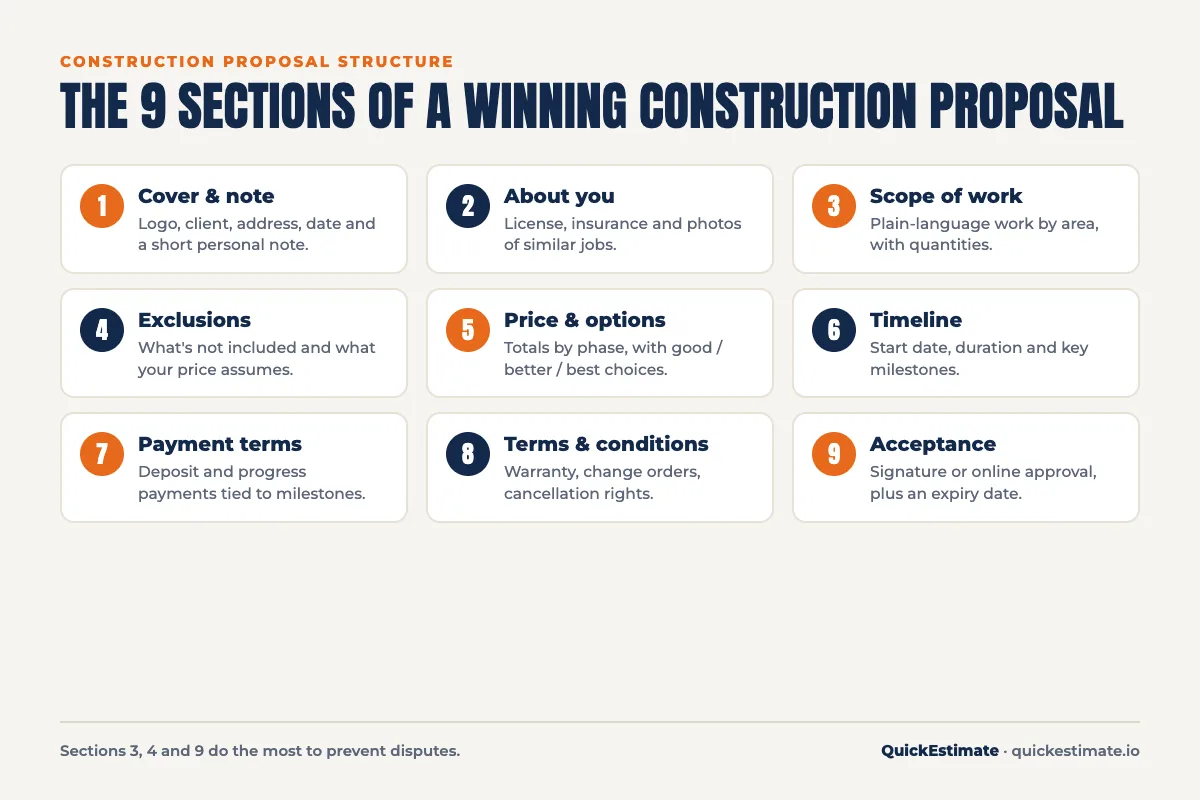
The 9 sections every construction proposal needs
1. Cover page and personal note
Start with your logo, the client’s name, the project address and the date. Add two or three sentences that show you listened: “Thanks for walking us through the kitchen on Tuesday. Below is our proposal for the layout and finishes we discussed.” It costs nothing and immediately sets you apart from a bare price sheet.
2. About your company
Keep it short: years in business, license number, insurance, and one or two relevant past projects. Photos of similar finished jobs work better than paragraphs about quality.
3. Scope of work
This is the heart of the proposal. Describe the work in plain language, grouped by area or phase: demolition, framing, electrical, finishes. Be specific about quantities and materials where it matters (“install 14 LED recessed lights on 3 dimmer circuits”).
4. Exclusions and assumptions
List what’s not included: permits (if the client pulls them), patching and painting, owner-supplied fixtures, hidden conditions behind walls. Also note any assumptions, such as “price assumes the existing subfloor is sound”. Exclusions are the cheapest insurance you’ll ever buy.
5. Price and options
Show the total, and break it down enough that the client understands what they’re paying for, by phase or area rather than every screw. If you offer options, show them side by side. More on that below.
6. Timeline
Give an estimated start date, duration and key milestones. Be honest about lead times on materials. Clients forgive a realistic schedule far more easily than a missed promise.
7. Payment terms
State the deposit, progress payments and final payment, and how you accept payment. Tie progress payments to milestones (“rough-in complete”) rather than dates, so payments follow the work.
8. Terms and conditions
Cover warranty, change orders, cleanup, site access, delays outside your control and how disputes are handled. If you sign contracts at the client’s home, check the cancellation rules that apply to you. The FTC’s home improvement guidance tells homeowners to expect a written statement of their right to cancel within three business days in that situation, along with your license number and estimated start and completion dates. Clients who have read that advice will look for those details.
9. Acceptance and signature
End with a clear next step: a signature block, or better, an online “Approve” button. Include an expiry date for the price (for example, 30 days) so an old number can’t be accepted after material prices change.
How to write a construction proposal step by step
- Finish the estimate first. Don’t write a single sentence until your numbers are final and checked.
- Re-read your site notes. Pull out the client’s own words about what they want and what worries them. Use those words in the proposal.
- Write the scope from the client’s point of view. “New kitchen lighting you can dim for evenings” lands better than a code reference.
- List exclusions and assumptions. Anything you’re not doing, and anything your price depends on.
- Build your options. A standard version, an upgraded version and, if it makes sense, a premium version.
- Add timeline, payment terms and conditions. Reuse standard wording so you’re not rewriting it every time.
- Add proof. Two or three photos of similar work, a short review, your license and insurance.
- Proofread and send the same day if you can. Speed signals reliability.
Once you’ve written a few, you’ll notice most of the construction proposal is the same every time. Only the scope, price and timeline really change. That’s why a good proposal template saves hours each week.
Sample scope of work wording
The scope is where most construction proposals are weakest, so here’s what good wording looks like for a small bathroom remodel:
- Demolition: remove existing vanity, toilet, tub surround and floor tile. Haul away and dispose of all debris.
- Plumbing: relocate vanity drain and supply lines up to 24 inches. Install new pressure-balance shower valve.
- Electrical: add one GFCI receptacle at vanity and replace exhaust fan with a 110 CFM humidity-sensing fan.
- Tile: install client-selected porcelain floor tile (approx. 60 sq ft) and wall tile in the shower (approx. 90 sq ft) with waterproof membrane.
- Fixtures: install client-supplied vanity, toilet and mirror.
- Not included: painting, replacing subfloor if rot is found (priced separately if needed), accessories.
Every line says what, where and how much. The client can check it against what they asked for, and you can check it against your estimate.
Use options to win more construction proposals
A single price gives the client one decision: yes or no. Two or three options change the question to “which one?”, and that’s a much better conversation to be in.
A common structure is good, better, best:
| Option | What it includes | Why it works |
|---|---|---|
| Standard | The scope exactly as discussed, quality materials | Meets the budget-conscious client |
| Upgraded | Better finishes, extra features the client mentioned | Often the most popular choice |
| Premium | Top-tier materials, extended warranty, extras | Anchors value and raises average job size |
Many clients pick the middle option instead of asking you to cut your price. Make sure every option is priced from real costs and earns your target margin. If you’re unsure how, read our guide to markup vs margin.
Writing tips that make a construction proposal persuasive
- Lead with the client’s goal, not your process. “A bathroom that’s easy to clean and safe for your parents” beats “Demo existing tile”.
- Use short sentences and headings. Clients skim. Make the scope and price easy to find.
- Avoid jargon. If a term needs explaining, explain it or leave it out.
- Be specific. “Premium materials” means nothing. “Porcelain tile, 12×24, installed with a lifetime-warranty grout” means something.
- Keep it consistent. The same fonts, logo and colors on every page look professional. Our help center explains proposal branding in QuickEstimate.
- Show, don’t claim. One photo of a finished job does more than “we take pride in our work”.
Residential vs commercial construction proposals
The nine sections apply to both, but the emphasis changes with the audience.
Residential clients are usually spending their own money on their own home, often for the first time with a contractor. They want reassurance. Put more weight on photos, reviews, a clear timeline and how you’ll protect their home during the work: dust control, daily cleanup, where the crew parks. Plain language matters most here.
Commercial clients and general contractors care about compliance and risk. They’ll read the scope against the drawings and specifications line by line, so reference drawing numbers and spec sections, list inclusions and exclusions in detail, and state your insurance limits and bonding capacity. They often have their own bid forms, so fill those in exactly as requested, even if you attach your own construction proposal as well.
In both cases, the fastest way to lose is to ignore what the client asked for. Read the request carefully and answer every question in it.
How to price a construction proposal to stay competitive
You don’t win by being the cheapest. You win by being the clearest good value. A few ways to stay competitive without cutting your margin:
- Price from real costs. Start with an accurate estimate, then apply the margin your business needs. See our step-by-step estimating guide for the process.
- Offer a lower-cost option instead of discounting. Reduce scope or change materials rather than dropping your price for the same work.
- Explain what’s included that others may skip. Permits, cleanup, disposal and warranty are often missing from a cheaper bid.
- Use allowances for undecided items. A clear dollar allowance for fixtures or finishes keeps the base price comparable without guessing the client’s taste.
Construction proposal checklist before you hit send
- Client name, address and project details are correct
- Scope matches the estimate, with nothing missing or duplicated
- Exclusions and assumptions are listed
- Totals and options add up, and taxes are handled correctly
- Start date, duration and milestones are realistic
- Deposit and payment schedule are clear
- Warranty, change order and cancellation terms are included
- License number and insurance details are shown
- Expiry date is set
- There’s a clear way to accept: a signature line or an online approval button
Construction proposal example outline
Here’s how a real construction proposal for a small remodel might be laid out, page by page:
| Page | Content |
|---|---|
| 1 | Cover: logo, client, address, date, a short personal note |
| 2 | About us: license, insurance, 3 photos of similar projects |
| 3–4 | Scope of work by area, then exclusions and assumptions |
| 5 | Price with standard, upgraded and premium options |
| 6 | Timeline, payment schedule, terms and conditions |
| 7 | Acceptance: signature or online approval, plus expiry date |
Seven pages sounds like a lot, but most of it is reusable. For smaller jobs, the same structure fits on two pages.
Construction proposal mistakes that lose jobs
- Sending a price with no scope. The client can’t compare it, so they default to the cheapest bid.
- Leaving out exclusions. You’ll end up doing the “obvious” extras for free, or arguing about them.
- No expiry date. A price from three months ago can be accepted after your costs have gone up.
- Taking a week to send it. By then, a faster competitor has already been hired.
- Not following up. Many clients simply get busy. A polite follow-up after a few days wins jobs that would otherwise go quiet.
- Math that doesn’t add up. One wrong total and the client questions every number. Have someone check it, as we describe in our estimation review and approval process.
What to do after you send it
Knowing how to write a construction proposal is half the job. The other half is what happens next:
- Confirm it arrived. A short text or email the same day.
- Know when it’s opened. Proposal software can tell you when the client views it, so you can call at the right moment.
- Follow up after 2 to 3 days, then again after a week. Ask if they have questions, not whether they’ve decided.
- Make it easy to say yes. An online approval button removes the print-sign-scan step that stalls so many jobs.
- Handle changes cleanly. If the client wants changes, send a revised version rather than editing by email. Once work starts, use a change order template for anything new.
Using software to write a construction proposal faster
Writing every construction proposal from a blank document is slow, and copying last month’s file is where mistakes creep in: the wrong client name, an old price, a scope item from a different job.
Construction proposal software like QuickEstimate builds the proposal straight from your estimate. Your branding, standard terms and payment schedule are saved once. You add the scope and options, send a link, and the client can review and approve online. You also see when they open it, and you can set an automatic expiry date so old prices can’t come back to bite you.
Frequently asked questions
How do you write a construction proposal?
Finish and check your estimate, then write a proposal that includes a cover note, company information, scope of work, exclusions, price and options, timeline, payment terms, terms and conditions, and a way to accept. Send it quickly and follow up.
What is the difference between a construction proposal and an estimate?
An estimate calculates what a job will cost. A construction proposal presents that price to the client with the scope, schedule and terms, and asks them to accept it.
How long should a construction proposal be?
As long as it needs to be clear. A small repair might fit on one page. A remodel or new build might run five to ten pages. Clients care more about clarity than length.
Should I include a breakdown of costs?
Show enough detail for the client to understand what they’re paying for, usually by phase or area. You don’t need to show your markup or every line item unless the contract is cost-plus.
How long should a proposal price be valid?
Many contractors use 30 days. Use a shorter window when material prices are moving quickly, and always state the expiry date on the proposal.
Should I charge for a construction proposal?
Most contractors write proposals for free on standard jobs. For design-heavy or large projects, some charge a design or estimating fee and credit it against the contract if the client hires them.
What should I do if a client says my proposal is too expensive?
Ask which part of the scope matters most to them, then offer a version with reduced scope or different materials. Avoid cutting the price for the same work, because that tells the client your first number wasn’t real.
The bottom line
Once you know how to write a construction proposal well, you stop competing on price alone. Clear scope, honest exclusions, a few good options, firm terms and a fast send will win you more of the jobs you actually want.
Want professional proposals without the formatting work? Try QuickEstimate free and send your next construction proposal in minutes, with online approval built in.