
 QuickEstimate Team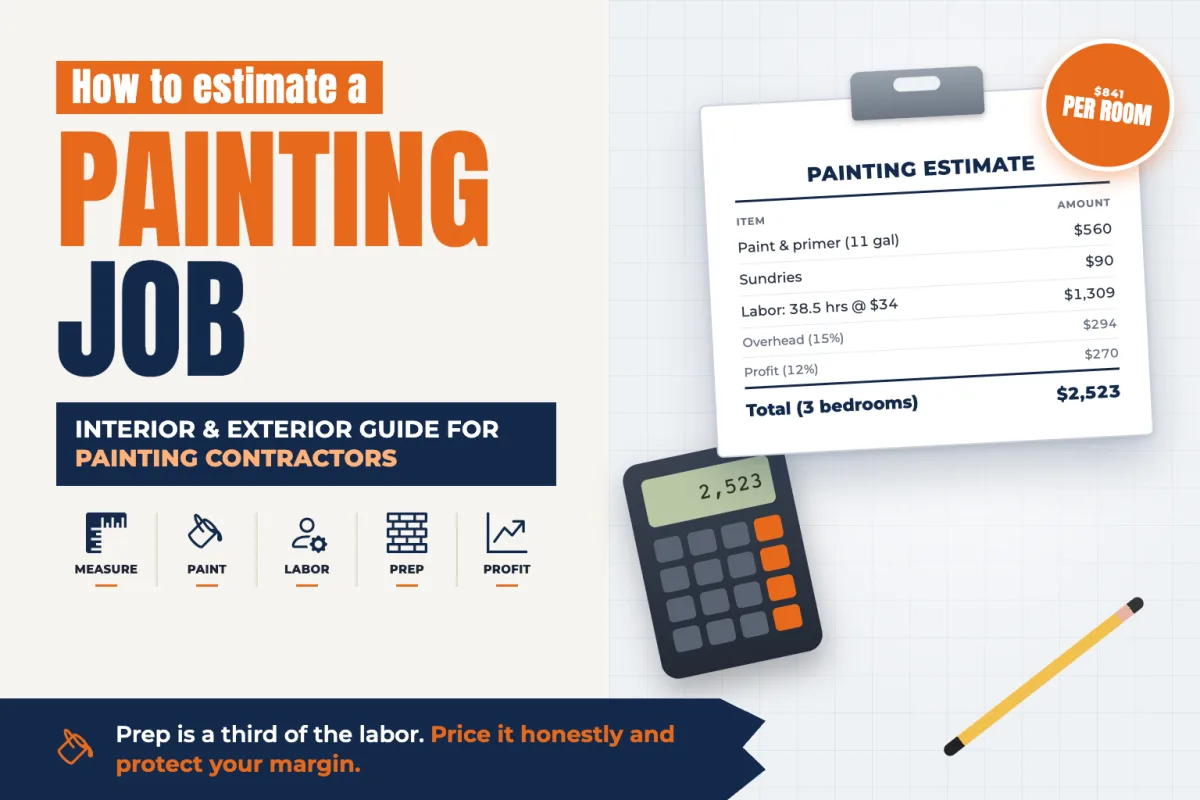
If you run a painting business, knowing how to estimate a painting job accurately decides whether you make money or just stay busy. Painting looks simple from the outside: measure the walls, buy the paint, roll it on. But the real cost hides in prep work, trim, access and the number of coats, and those are exactly the things rushed estimates leave out.
This guide gives you a repeatable process for interior and exterior jobs, the formulas to measure surfaces and calculate paint, a way to estimate labor from your own crew’s speed, and a full worked example with real numbers.
Key takeaways
- A painting estimate is mostly labor. Prep work often takes as long as the painting itself.
- Measure every surface: walls, ceilings, trim, doors and windows, and count coats separately.
- Calculate paint from the label’s coverage rate, then round up to whole gallons.
- Price labor at its true cost (wage plus burden), then add overhead and profit on purpose.
- For homes built before 1978, factor in lead-safe work practices and certification.
What goes into a painting estimate
Every painting estimate, from a single bedroom to a full exterior, is built from the same parts:
- Surface area: walls, ceilings, trim, doors, windows, siding, fascia
- Paint and primer: gallons needed for the number of coats
- Sundries: tape, plastic, caulk, patching compound, sandpaper, roller covers
- Labor: prep, painting, cleanup, and moving furniture or setting up ladders
- Equipment: ladders, scaffolding, lifts, sprayers, pressure washers
- Overhead and profit: the cost of running your business, plus the return you need
Get each part right and the price takes care of itself. Skip one and it comes out of your profit.
Step 1: Walk the job and define the scope
Never estimate a painting job from photos alone if you can avoid it. On the walkthrough, note:
- Surfaces and condition. Peeling, cracks, water stains, nail pops and glossy surfaces all add prep time.
- Color changes. Going from dark to light, or covering a strong color, often needs primer and an extra coat.
- Height and access. Vaulted ceilings, stairwells and second-story exteriors need ladders, planks or a lift.
- Occupied or empty. Furnished rooms mean moving and covering furniture, which takes real time.
- Age of the building. Under the EPA’s Renovation, Repair and Painting (RRP) rule, anyone paid to disturb painted surfaces in homes, childcare facilities and preschools built before 1978 must be certified in lead-safe practices. Containment, cleaning and verification add time and materials, so price them in.
Write down exactly what’s included and excluded: which rooms, which surfaces, how many coats, who moves the furniture and who picks the colors.
Step 2: Measure every surface
Accurate measurements are the foundation when you estimate a painting job. Use these simple formulas:
Interior walls
Wall area = room perimeter × wall height − doors and windows
A 12 × 14 ft room with 8 ft walls has a perimeter of 52 ft, so 416 sq ft of wall. Subtract about 21 sq ft for a standard door and 15 sq ft for each average window. Some painters don’t subtract small openings at all, because cutting around them takes as long as painting the space would. Choose one approach and use it every time.
Ceilings
Ceiling area = length × width. That same room has a 168 sq ft ceiling.
Trim, doors and windows
Measure baseboard and crown in linear feet. Count doors and windows as units, since pricing them by the piece is faster and more accurate than converting to square feet.
Exterior walls
Exterior area = perimeter × wall height, plus gables. For a triangular gable, use ½ × width × height. Add fascia, soffits and trim separately. Siding with deep grooves or rough texture takes more paint and more time than smooth surfaces.
Step 3: Calculate how much paint you need
Most paint labels list a coverage rate, often somewhere around 350 to 400 sq ft per gallon on smooth, primed surfaces. Rough, porous or unprimed surfaces soak up more.
Gallons = (area × number of coats) ÷ coverage per gallon
Always round up to whole gallons, and use the lower end of the label’s coverage range unless you know the surface well. Running out mid-job means another trip to the store, and color matching between batches isn’t guaranteed.
Calculate primer separately. New drywall, repairs, stains and big color changes usually need it. Spot priming patched areas is often enough on a repaint.
Step 4: Estimate labor hours
Labor is usually the largest part of any painting estimate, and prep is the part most often underestimated. Break labor into tasks:
- Prep: moving furniture, covering floors, masking, patching, caulking, sanding
- Cutting in and rolling walls, per coat
- Ceilings, which are slower than walls
- Trim, doors and windows, which are slow, detailed work
- Cleanup and walkthrough
The best production rates are your own. Time your crew on a few typical jobs: square feet of wall per hour, linear feet of trim per hour, minutes per door. Your estimates will be far more accurate than any published average, because they reflect your people, your tools and your standards.
What an hour of painting labor really costs
According to the U.S. Bureau of Labor Statistics, the median pay for construction and maintenance painters was $23.75 an hour in May 2025. Add payroll taxes, workers’ comp, insurance and benefits, often 30 to 50% more, and that hour costs you roughly $31 to $36 before overhead or profit. Our employee cost calculator gives you your exact figure.
Step 5: Add sundries and equipment
Tape, plastic, drop cloths, caulk, patching compound, roller covers and brushes add up quickly. Many painters add a set amount per room or a percentage of the paint cost. Track it on a few jobs to find your real number.
Add equipment separately when a job needs it: extension planks, scaffolding, a lift rental, a sprayer or a pressure washer for exterior prep. These can be a large line item on exterior work.
Step 6: Apply overhead and profit
Your direct costs (paint, sundries, labor and equipment) don’t cover your van, insurance, phone, marketing or the hours you spend estimating. That’s overhead, and it needs its own line. Our guide to calculating overhead percentage walks through it.
Then add profit on purpose. Be careful with the math: a 20% markup is only a 16.7% margin. If that’s news to you, read markup vs margin before your next painting estimate, or check your numbers with our markup calculator.
Step 7: Present a clear proposal
Turn the numbers into a proposal the client can understand: which rooms, which surfaces, how many coats, what prep is included, the product line you’ll use, the timeline and the price. Offering a standard and a premium paint option is an easy way to raise the average job value. Our guide on how to write a construction proposal covers the structure.
How to estimate a painting job: worked example
Here’s a complete estimate for repainting three 12 × 14 ft bedrooms with 8 ft ceilings: walls (two coats), ceilings (one coat), baseboards, three doors and six windows. Paint prices and production rates are examples, so use your supplier’s prices and your own crew’s rates.
| Surface | Quantity | Paint |
|---|---|---|
| Walls (365 sq ft per room × 3) | 1,095 sq ft × 2 coats | 7 gal |
| Ceilings (168 sq ft per room × 3) | 504 sq ft × 1 coat | 2 gal |
| Baseboards, doors, window trim | 150 lf, 3 doors, 6 windows | 1 gal |
| Spot primer | Patched areas | 1 gal |
| Cost | Detail | Amount |
|---|---|---|
| Wall paint | 7 gal × $55 | $385 |
| Ceiling paint | 2 gal × $40 | $80 |
| Trim paint | 1 gal × $60 | $60 |
| Primer | 1 gal × $35 | $35 |
| Sundries | Tape, plastic, caulk, patch, rollers | $90 |
| Materials | $650 |
Labor, using example production rates:
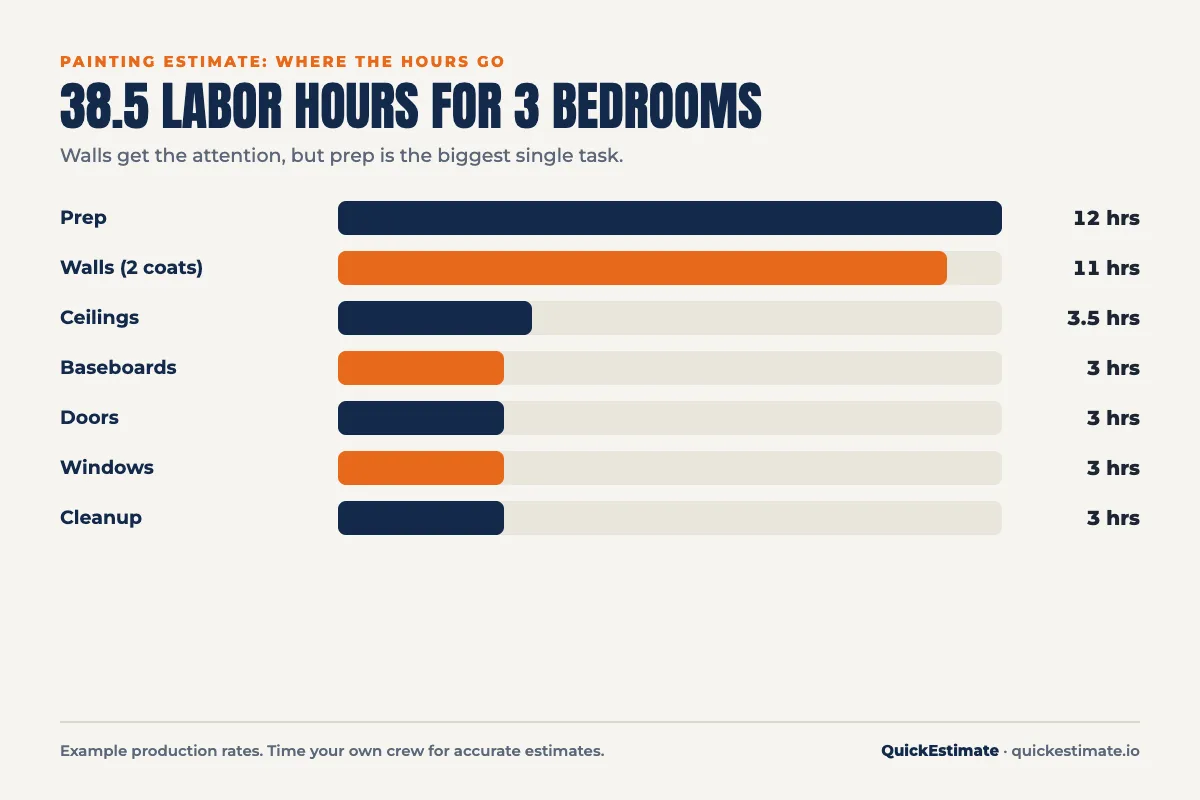
- Prep (furniture, masking, patching, caulking): 4 hours per room = 12 hours
- Walls: 2,190 sq ft of coats at about 200 sq ft per hour = 11 hours
- Ceilings: 504 sq ft at about 150 sq ft per hour = 3.5 hours
- Baseboards: 150 lf at about 50 lf per hour = 3 hours
- Doors: 3 at 1 hour each = 3 hours
- Windows: 6 at 30 minutes each = 3 hours
- Cleanup and walkthrough = 3 hours
- Total: 38.5 hours
Now build the price:
- Labor cost: 38.5 hours × $34 true hourly cost = $1,309
- Direct cost: $650 materials + $1,309 labor = $1,959
- Overhead at 15%: $294, bringing cost to $2,253
- Profit at 12% markup: $270
- Price to the client: $2,523, or about $841 per room
Notice that prep alone is nearly a third of the labor, and labor is about two-thirds of the direct cost. A painter who prices only “walls at so much per square foot” would miss most of what this job actually takes.
Interior vs exterior painting estimates
The process is the same, but the risks are different.
Interior jobs are slowed by furniture, occupied homes, detailed trim and cutting in around fixtures. Protecting floors and belongings is part of the job and should be part of the price.
Exterior jobs carry more prep (washing, scraping, sanding, caulking), more access equipment and weather risk. Rain delays cost you time even when no paint goes on the wall. Many painters use a higher contingency or markup on exteriors to cover that uncertainty, and schedule them with buffer days.
Commercial painting estimates
Commercial work follows the same steps, with a few extra things to price into the painting estimate:
- Specifications. Commercial jobs usually specify exact products, sheen and number of coats. Price what’s specified, not what you’d normally use.
- Working hours. Offices, stores and schools often need night or weekend work, which can mean overtime rates.
- Access and safety. Lifts, fall protection and site safety requirements add time and equipment.
- Scale. Large, repetitive areas can be faster per square foot, especially if spraying is allowed.
- Paperwork. Submittals, certified payroll, insurance certificates and retainage all affect your cost and cash flow.
When you estimate a painting job for a general contractor, read the bid documents carefully and list your inclusions and exclusions line by line. It’s the best protection you have against scope creep.
Painting estimate checklist
Before you send any painting estimate, check that you’ve covered:
- Every room and surface in the scope, with the number of coats for each
- Primer for repairs, stains, new drywall and big color changes
- Prep time for patching, caulking, sanding and masking
- Furniture moving and floor protection in occupied homes
- Ladders, planks, lifts or sprayers the job needs
- Lead-safe practices for pre-1978 homes
- Sundries, cleanup and disposal
- Overhead and profit, calculated rather than guessed
- Clear product names, colors and an expiry date on the proposal
Common ways to price painting jobs
- Itemized (cost-plus): the process above. Most accurate, and it shows you exactly where the money goes.
- Per square foot: quick and easy to explain, but only safe if the rate was built from your real costs and adjusted for condition and access.
- Per room: popular for standard interior repaints. Define what a “room” includes (walls only, or ceilings and trim too).
- Hourly: fair for small or unclear jobs, but most homeowners prefer a fixed price for larger work.
Whichever you show the client, build it from the itemized numbers first. A per-room or per-square-foot rate that isn’t based on real costs is just a guess.
Painting estimate mistakes to avoid
- Underpricing prep. It’s the most common mistake and the most expensive.
- Using best-case coverage. Use the lower end of the label’s range and round up.
- Forgetting the second coat. Or the primer on a big color change.
- Ignoring access. High ceilings, stairwells and second stories take longer and may need equipment.
- Skipping lead-safe costs on pre-1978 homes.
- No written scope. “Paint the living room” can mean very different things to you and the client.
How to estimate a painting job faster
Speed matters. The painter who sends a clear number the same day often wins the job before slower competitors have even measured. A few habits help you estimate a painting job faster without cutting corners:
- Use a standard room sheet. Walls, ceiling, trim, doors, windows, condition notes, coats. Fill in the same fields for every room.
- Save your production rates. Once you know your crew’s speed for walls, ceilings, trim and doors, you never have to guess again.
- Keep a current price list for your usual paint lines and sundries, and update it when your supplier changes prices.
- Build templates for common jobs, such as a standard bedroom repaint or a single-story exterior, and adjust them for each site.
- Measure with a laser. It’s faster than a tape and reduces mistakes on high walls.
With these in place, most residential painting estimates can go out within an hour or two of the walkthrough.
Painting estimating software
Once you’re sending several painting estimates a week, spreadsheets become slow and error-prone. Painting estimating software like QuickEstimate stores your paint prices, production rates, overhead and markup, so you build each estimate from saved items instead of starting over. The client gets a clean, branded proposal they can approve online, and you can see when they’ve opened it.
Frequently asked questions
How do you estimate a painting job?
Walk the job and define the scope, measure every surface, calculate paint and primer from coverage rates, estimate labor hours by task, add sundries and equipment, then apply overhead and profit. Present it as a clear, written proposal.
How much paint do I need for a room?
Multiply the wall area by the number of coats and divide by the coverage on the label, often around 350 to 400 sq ft per gallon. A 12 × 14 ft room with 8 ft walls has about 365 sq ft of wall after openings, so two coats need roughly 2 gallons.
How long does it take to paint a room?
For a professional, a standard bedroom often takes most of a day including prep, two coats on the walls, ceiling, trim and cleanup. Heavy repairs, dark color changes or lots of trim can add several hours.
Should I charge per square foot or per room?
Either can work, as long as the rate comes from your real costs. Per-room pricing is easy for standard repaints. Square-foot pricing suits larger or open-plan spaces. Always define what’s included.
Do I need lead certification to paint older homes?
If you’re paid to disturb painted surfaces in homes, childcare facilities or preschools built before 1978, the EPA’s RRP rule requires lead-safe certification. Check the EPA’s guidance and any state rules that apply to you.
What’s the biggest mistake when estimating a painting job?
Underestimating prep. Patching, caulking, sanding, masking and moving furniture can take as long as the painting itself, and a painting estimate that prices only the square footage of wall will almost always come in low.
The bottom line
Learning how to estimate a painting job comes down to not skipping steps: scope, measurements, paint, labor by task, sundries and equipment, then overhead and profit. The painters who make money are the ones who price prep honestly and know their crew’s real speed.
Ready to build painting estimates faster? Try QuickEstimate free and send your next painting proposal in minutes.