
 QuickEstimate Team
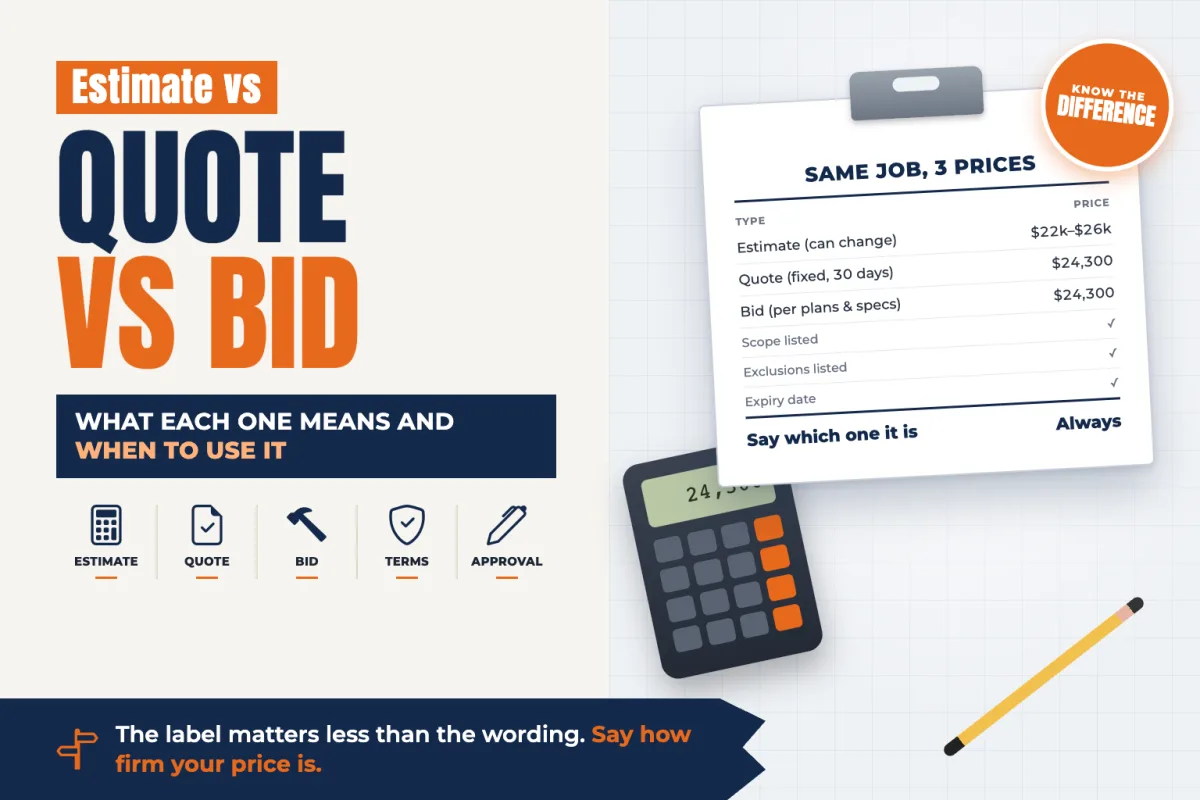
Estimate vs quote vs bid: most contractors use these words interchangeably, and most clients do too. That’s exactly where the trouble starts. When you send an “estimate” and the client treats it as a fixed price, or you send a “quote” and then need to change it, you end up in an argument that clear wording would have prevented.
This estimate vs quote vs bid guide explains what each term means, how binding each one usually is, when to use each, and how to word your documents so the client knows exactly what they’re getting.
Key takeaways
- An estimate is an informed approximation of cost. It can change as details become clear.
- A quote is a fixed price for a defined scope, usually valid for a set period.
- A bid is a formal price submitted to compete for a project, often against a set of plans and specifications.
- The label matters less than the wording: always state whether the price is fixed, what’s included and when it expires.
- A proposal wraps any of these in scope, terms and a way to accept.
What is an estimate?
An estimate is your best calculation of what a job will cost, based on the information you have now. It’s an educated approximation, not a promise. If the scope changes, or you find something unexpected once work begins, the final price can move.
In the estimate vs quote vs bid lineup, estimates are useful when:
- The client is still deciding whether to go ahead or is setting a budget
- The scope isn’t fully defined yet
- There may be hidden conditions, such as work behind walls in an old building
A good estimate still needs to be built carefully, from real material costs, labor hours, overhead and profit. “Estimate” doesn’t mean “guess”. Our guide to creating accurate estimates covers the process, and our estimate template gives you a starting point.
What is a quote?
A quote (or quotation) is a fixed price for a clearly defined scope of work. Once the client accepts it, you’re generally expected to do that work for that price, unless the scope changes.
On the estimate vs quote question, quotes work best when:
- The scope is clear and measurable
- You’ve seen the site and know the conditions
- Material prices are stable enough to commit to for a set period
Because a quote is a commitment, it should always state exactly what’s included, what isn’t, and how long the price is valid. Without an expiry date, a client could accept a quote months later, after your costs have gone up.
What is a bid?
A bid is a formal price you submit to compete for a project. Bids are common in commercial, public and larger residential work, where an owner or general contractor sends the same plans and specifications to several contractors and compares their prices.
What sets a bid apart in estimate vs quote vs bid is structure. Bids usually have:
- A set deadline and a required format, sometimes a specific bid form
- Detailed plans and specifications that every bidder prices against
- Rules about what can be changed after submission
- For public work, requirements such as bonds, licensing and registration
Public bidding can be strict. For federal work, for example, the SBA’s guide on how to win government contracts explains registration and the bidding process. On private jobs, “bid” is often used loosely to mean any competitive price.
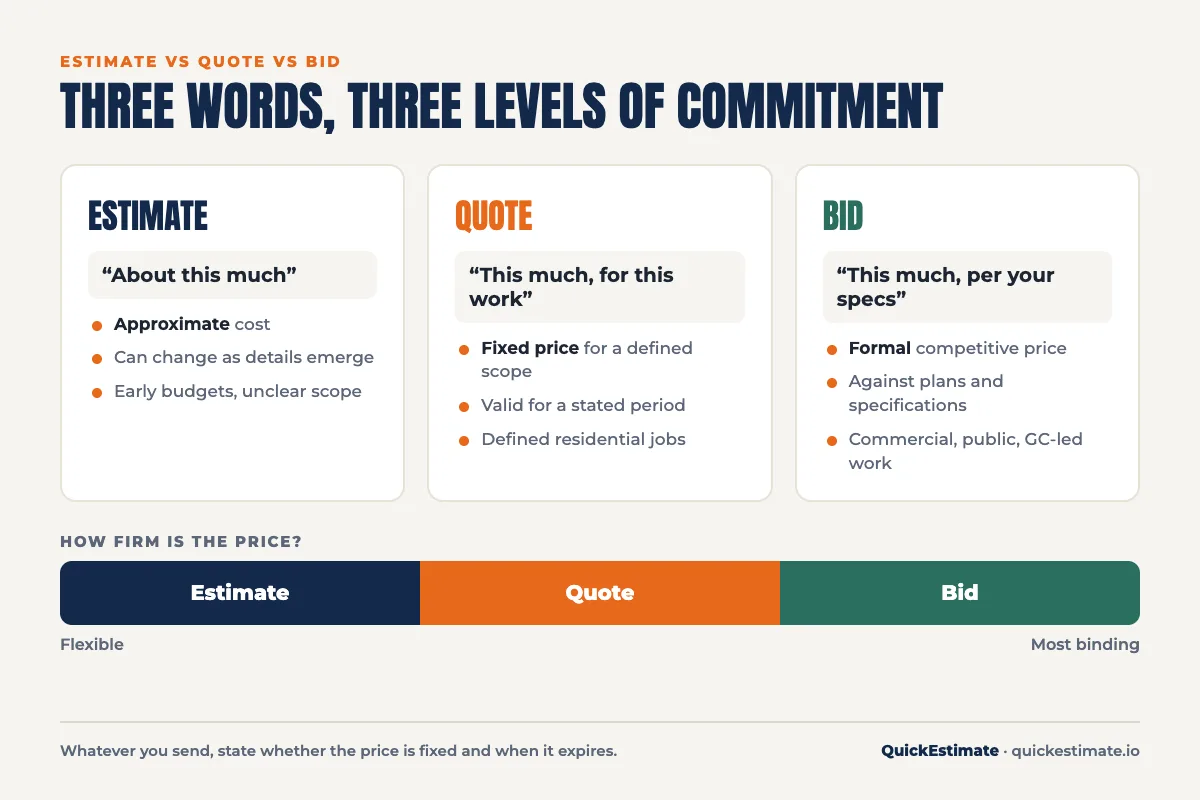
Estimate vs quote vs bid: side-by-side comparison
| Estimate | Quote | Bid | |
|---|---|---|---|
| What it is | Approximate cost | Fixed price for a defined scope | Formal competitive price |
| Price can change? | Yes, as details emerge | Only if scope changes | Usually not, once accepted |
| Level of detail | Moderate | High | Very high, against plans and specs |
| Typical use | Early budgeting, unclear scope | Defined residential jobs | Commercial, public, GC-led projects |
| Validity period | Short, informal | Stated, e.g. 30 days | Set by bid rules |
| Competition | Sometimes | Often | Always |
The key difference in estimate vs quote vs bid is certainty. An estimate says “about this much”. A quote says “this much, for this work”. A bid says “this much, for exactly what’s in your documents, submitted on your terms”.
What clients hear when you say estimate, quote or bid
Contractors often use the three words based on habit. Clients hear them differently:
- “Estimate” can sound like a firm number to a homeowner who has never hired a contractor. Many assume the final bill will match it exactly.
- “Quote” sounds official and fixed, which is good when you mean it and a problem when you don’t.
- “Bid” sounds formal and competitive. Homeowners may assume you’re one of several contractors being compared, even when you’re not.
Because clients don’t share your definitions, the estimate vs quote vs bid label alone isn’t enough. Spell out, in one plain sentence near the price, whether the number is fixed and what could change it.
Bid vs estimate for subcontractors
If you’re a subcontractor, the bid vs estimate distinction matters even more. General contractors collect subcontractor prices to build their own bid to the owner. Once they submit, they’re counting on your number. If you later say your price was “just an estimate”, the GC may be stuck with a gap they can’t pass on.
When a GC asks for pricing, treat it as a bid unless you clearly say otherwise:
- Price against the exact drawings and specifications you received, and list them by number
- State your inclusions and exclusions line by line
- Note any assumptions, alternates or allowances
- Give a validity period, and note if it depends on material price changes
Clear subcontractor bids build trust with GCs, and GCs who trust your numbers invite you to bid again.
How precise does each need to be?
Precision should match commitment. A rough estimate for budgeting can be built from past jobs and square-foot costs. A quote needs a full takeoff, real supplier prices and labor hours by task. A bid needs all of that, checked against every drawing and specification section, with nothing left to assumption.
A useful habit: whatever you call it, build every price from the same cost structure of materials, labor, equipment, subcontractors, overhead and profit. Then the only difference between your estimate vs quote vs bid is how much of the detail is confirmed. Our construction cost estimating tips cover how to tighten your numbers.
Are estimates, quotes and bids legally binding?
Whether an estimate vs quote vs bid is binding depends on your state, your contract and the exact wording you use, so treat this as general information, not legal advice. In general:
- Estimates are usually treated as approximations. Some states limit how far a final bill can exceed a written estimate without the client’s consent, so check the rules where you work.
- Quotes, once accepted, are often treated as a firm offer for the stated scope and price.
- Bids in public work can be binding once submitted, and withdrawing one may forfeit a bid bond.
What matters most is what your document actually says. A page titled “Estimate” that reads like a fixed-price contract, with no statement that the price may change, can be treated as fixed. That’s why wording matters more than the label at the top.
Where does a proposal fit in?
A proposal is the document you send the client that presents your price, whether it’s an estimate, quote or bid, together with the scope, schedule, terms and a way to accept. Think of the estimate, quote or bid as the number, and the proposal as the package that sells it.
A strong proposal makes the type of price clear: “This is a fixed-price quote, valid for 30 days, for the scope listed below.” Our guide on how to write a construction proposal covers the full structure.
It also helps to be consistent inside your own business. Decide as a team what you call each type of price, use the same wording on every document, and train anyone who talks to clients to explain it the same way. When your office manager calls a number a “quote” and your estimator calls it an “estimate”, the client hears two different promises. One shared definition of estimate vs quote vs bid removes that confusion before it starts.
When to use each: estimate vs quote vs bid in practice
Use an estimate when
- A client wants a ballpark before committing
- You can’t see everything yet, such as a remodel with unknown conditions behind walls
- The job is time-and-materials by nature, such as repairs and troubleshooting
Use a quote when
- You’ve walked the site and the scope is clear
- The client is ready to decide
- You’re confident in your material and labor numbers for the next few weeks
Submit a bid when
- You’ve been invited to price a project against plans and specifications
- A general contractor is collecting subcontractor prices
- You’re pursuing public or institutional work
One job, three ways
Here’s how the same bathroom remodel might be presented as an estimate, a quote and a bid:
- Estimate: “Based on our initial visit, we estimate this remodel at $22,000 to $26,000, depending on your tile and fixture choices and the condition of the subfloor. We’ll confirm a fixed price once selections are made.”
- Quote: “Fixed price of $24,300 for the scope listed on page 2, using the selections listed. Valid for 30 days. Subfloor replacement, if needed, will be priced as a change order.”
- Bid: “Our bid for Bathroom 2B per drawings A-201 to A-204 and specification section 09 30 00 is $24,300, inclusive of all labor and materials as specified. Exclusions listed on the bid form.”
Same work, same contractor, three very different levels of commitment. That is the estimate vs quote vs bid difference in one example. Choosing the right one protects both sides.
Estimate vs quote vs bid across different trades
How the words are used varies by trade and type of work:
- Service trades (plumbing, HVAC, electrical repair) often give a quote on the spot for a defined repair, and an estimate for anything that depends on what they find once they open things up.
- Remodelers usually start with an estimate range during design, then move to a fixed quote once selections are made.
- Roofers and painters commonly give fixed quotes after measuring, with allowances for hidden damage such as rotten decking or failed siding.
- Commercial subcontractors almost always bid against plans and specifications.
Whatever your trade, choose deliberately between estimate vs quote vs bid, and make sure your team uses the words the same way every time.
Quick reference: which one should you send?
| Situation | Send |
|---|---|
| Client wants a rough budget before deciding | Estimate (as a range) |
| Scope unclear or hidden conditions likely | Estimate, with a plan to confirm |
| Site visited, scope and selections final | Quote with an expiry date |
| Invited to price plans and specifications | Bid, on the requested form |
| GC asks for your trade price | Bid, with inclusions and exclusions |
How to word your documents to avoid disputes
- Say what type of price it is. “This is an estimate and may change” or “This is a fixed-price quote”.
- List inclusions and exclusions. Especially permits, disposal, patching and owner-supplied items.
- State assumptions. “Price assumes existing framing is sound.”
- Set an expiry date. Every quote and bid should have one.
- Explain how changes are handled. Refer to change orders in writing. Our change order template makes this easy.
- Get acceptance in writing. A signature or an online approval creates a clear record.
How to turn an estimate into a quote
Many jobs start as an estimate and become a quote, which is the most common estimate vs quote transition. The step in between is closing the unknowns:
- Visit the site, or revisit it, and confirm conditions.
- Get the client’s final selections: fixtures, finishes, colors.
- Replace allowances with real prices from suppliers and subcontractors.
- Recheck labor hours against the final scope.
- Apply your overhead and profit. Check the math with our guide to markup vs margin.
- Send a quote with a clear scope, fixed price and expiry date.
Common mistakes with estimates, quotes and bids
- Calling a firm price an “estimate” to avoid commitment, then being held to it anyway.
- Quoting too early, before you’ve seen the site or the client has made selections.
- No expiry date on quotes and bids.
- Ignoring bid instructions. A late or incorrectly formatted bid is often rejected outright, however good the price.
- Vague exclusions that leave room for “I thought that was included”.
Manage estimates, quotes and bids in one place
Whether you’re sending a quick estimate, a fixed-price quote or a formal bid, the numbers underneath should come from the same place: your real costs, labor rates, overhead and profit. QuickEstimate lets you build the price once, then send it as a clear, branded proposal with an expiry date and online approval. You can see when it’s been viewed, and every version is kept, so there’s never any confusion about which price the client accepted.
Frequently asked questions
What is the main difference between an estimate vs quote vs bid?
An estimate is an approximate cost that can change. A quote is a fixed price for a defined scope. A bid is a formal, competitive price submitted against plans and specifications, usually by a deadline.
What is the difference between an estimate and a quote?
In the estimate vs quote comparison, the difference is commitment. An estimate is your best approximation and can change as details emerge. A quote is a fixed price for a clearly defined scope, valid for a stated period, and is usually treated as firm once the client accepts it.
Should homeowners ask for a quote vs estimate?
If the scope is clear and they’re ready to hire, a quote gives them price certainty. If they’re still planning or the job may uncover surprises, an estimate range is more honest. Good contractors explain which one they’re giving and why.
Is a quote more accurate than an estimate?
Usually, yes. A quote is prepared once the scope is clear, so it’s more detailed and is meant to be the final price for that scope.
Can a contractor charge more than the estimate?
Often, if the scope changes or unexpected conditions are found, but it should be discussed and approved in writing before the extra work is done. Some states limit how much a bill can exceed a written estimate, so check local rules.
Is a bid the same as a proposal?
Not quite. A bid is the price you submit to compete. A proposal is the document that presents your price with the scope, terms and schedule. On private jobs the words are often used interchangeably.
Should I charge for estimates?
Many contractors give free estimates for standard jobs and charge for detailed design work or complex bids, sometimes crediting the fee back if they win the job.
How long is a quote valid?
As long as you say it is. Many contractors use 30 days, and some use 14 days when material prices are moving quickly. Always write the expiry date on the quote itself.
Can I change a bid after submitting it?
On private jobs, you can usually ask, but the client may treat it as a new bid. On public work, rules are often strict and changes or withdrawals after the deadline may not be allowed. Read the bid instructions carefully.
The bottom line
Estimate vs quote vs bid isn’t just vocabulary. Each tells the client how firm your price is. Pick the right one for the stage of the job, say clearly which one you’re sending, and back it with a written scope, exclusions and an expiry date.
Want to send clear, professional pricing every time? Try QuickEstimate free and turn your next estimate into a client-ready quote in minutes.