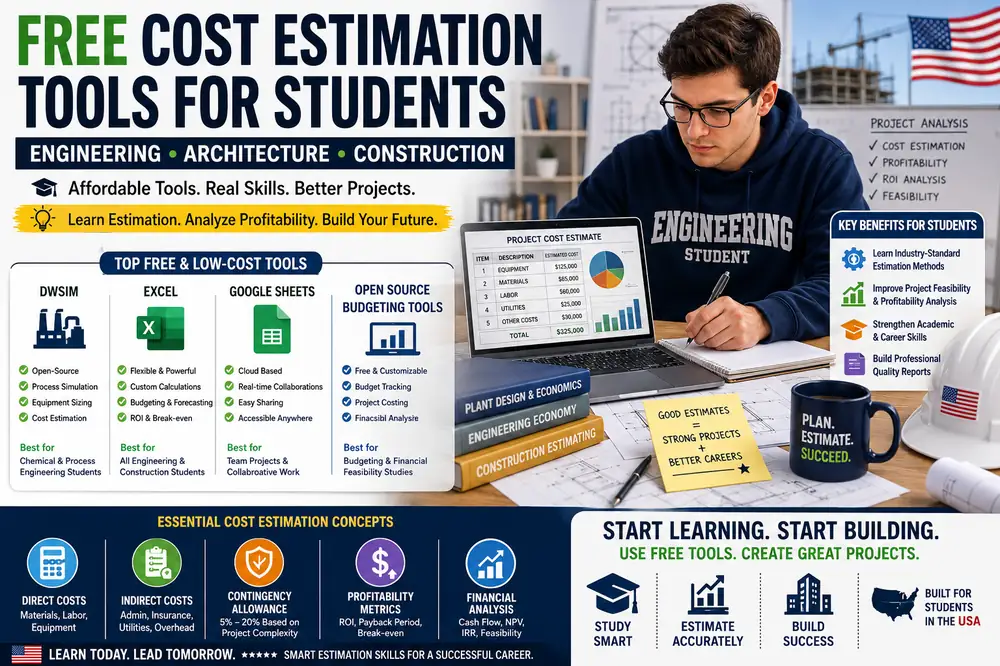
University engineering, architecture, and construction students often struggle to find affordable cost estimation software for academic projects. Many professional estimating tools are expensive, difficult to access, or require commercial licenses.

Fortunately, several free and low-cost estimation tools help students perform project profitability analysis, equipment costing, quantity takeoffs, budgeting, and financial feasibility studies without enterprise-level software expenses.

Context:
Students working on engineering, construction, industrial design, and architecture projects often require structured profitability calculations, budgeting workflows, and project estimation methodologies similar to professional industry standards.

Table of Contents

Free cost estimation tools for students are becoming increasingly important for university engineering, architecture, construction, and industrial design projects. Students often require affordable software to estimate project costs, analyze profitability, prepare quantity takeoffs, calculate operational expenses, and create professional feasibility reports for academic submissions.Many students search for free alternatives to CapCost because professional estimation software can be expensive, difficult to access, or unavailable through university licenses. Fortunately, free cost estimation tools for students such as DWSIM, Excel, Google Sheets, and open-source budgeting systems help students perform project profitability analysis without expensive enterprise software.

Why Cost Estimation Matters in University Projects

Most university design projects eventually require students to evaluate the following:

  • Project feasibility
  • Equipment costs
  • Material pricing
  • Labor expenses
  • Operational costs
  • Profitability analysis
  • Return on investment (ROI)
  • Break-even calculations
  • Risk assessment

Cost estimation helps students understand how real-world engineering and construction projects are evaluated financially before execution.

Many professors focus more on:

  • Estimation methodology
  • Financial assumptions
  • Project structure
  • Calculation logic
  • Economic reasoning

rather than expecting perfectly accurate industrial pricing databases.

Is CapCost free for students?

Free cost estimation tools for students including Capcost alternatives for university engineering and construction projects

Top free Capcost alternatives for students working on engineering, construction, and university profitability projects.

QuickEstimate.io
regularly explores construction estimation workflows, quantity takeoffs, budgeting systems, and modern project estimation methods used by contractors, engineers, and estimators worldwide.

Capcost
It is widely used in chemical engineering and process economics courses for plant cost estimation and profitability analysis. Some universities provide student access through software licenses or simulation platforms like DWSIM.

However, many students face challenges such as the following:

  • Limited access
  • Restricted licenses
  • High software costs
  • Limited database availability
  • Complex installation requirements

Because of this, students often search for free alternatives to Capcost.

Best Free Cost Estimation Tools Similar to Capcost

1. DWSIM

DWSIM
is one of the best free alternatives for chemical engineering students. It is an open-source process simulator that supports thermodynamic calculations, equipment sizing, process flowsheets, and basic cost estimation workflows.

Why Students Use DWSIM

  • Completely free and open-source
  • Useful for chemical process simulation
  • Supports equipment calculations
  • Good for university feasibility studies
  • Widely recommended in engineering communities

Best For

  • Chemical engineering students
  • Process design projects
  • Plant economics studies
  • Academic simulations
  • Process profitability analysis

Important Insight

Most universities do not expect students to create industrial-grade cost databases. They primarily evaluate whether students understand estimation principles, project economics, and financial decision-making processes.

2. Microsoft Excel for Cost Estimation

Many professional engineers still use Excel-based estimation systems because they offer flexibility, transparency, and customization. For university projects, Excel is often more than sufficient.

Students can build:

  • Equipment costing sheets
  • Material takeoffs
  • Labor calculations
  • Inflation adjustment models
  • Cash flow projections
  • Break-even analysis
  • ROI calculators
  • Budget forecasting sheets

Why Professors Prefer Excel-Based Workflows

Many professors prefer manual calculation structures because they show the following:

  • Understanding of assumptions
  • Calculation transparency
  • Financial reasoning
  • Problem-solving ability

Instead of relying entirely on automated software outputs.

3. Google Sheets

Google Sheets is another excellent free option for collaborative university projects.

Students commonly use Google Sheets for:

  • Construction budgeting
  • Project estimation tables
  • Bill of Quantities (BOQ)
  • Cost tracking
  • Team collaboration

Advantages include:

  • Cloud-based access
  • Easy sharing with professors
  • Real-time collaboration
  • No installation required

Engineering Textbooks Still Play a Huge Role

Many experienced engineers recommend textbooks over expensive software when students are learning project economics.

Several engineering textbooks contain:

  • Equipment cost equations
  • Scaling formulas
  • Profitability analysis methods
  • Inflation adjustment techniques
  • Capital investment calculations

Recommended Engineering Books

Coulson & Richardson Volume 6

Popular for:

  • Chemical engineering design
  • Plant economics
  • Cost estimation principles
  • Project feasibility studies

Towler and Sinnott

Useful for:

  • Equipment costing equations
  • Economic analysis
  • Process plant design
  • Financial calculations

Peters, Timmerhaus & West

Widely respected for:

  • Plant economics
  • Manufacturing cost analysis
  • Capital investment calculations
  • Industrial project evaluation

How Professional Cost Estimation Actually Works

Many students assume estimation software automatically generates perfect budgets.

In reality, professional estimation still depends heavily on:

  • Engineering assumptions
  • Supplier quotations
  • Labor productivity knowledge
  • Regional pricing
  • Material understanding
  • Project complexity analysis

Even expensive enterprise software still requires experienced estimators to validate assumptions and adjust calculations.

Important Cost Estimation Concepts Students Should Learn

Direct Costs

Direct costs include the following:

  • Materials
  • Equipment
  • Labor
  • Installation expenses

Indirect Costs

Indirect costs may include the following:

  • Administration
  • Insurance
  • Transportation
  • Permits
  • Office overhead

Contingency Costs

Most estimates include contingency allowances to handle uncertainty.

Typical contingency values:

  • 5% to 20%

Depending on project complexity.

Inflation Adjustment

Students should understand how historical cost data is adjusted using inflation or cost indexes.

Capacity Factor Estimation

One common engineering estimation formula used in process economics is:

Cost scaling formula infographic for estimating equipment and project costs based on capacity changes in engineering and construction projects

The engineering cost scaling formula is used to estimate project and equipment costs based on capacity changes.

Where:

  • C1 = known cost
  • C2 = estimated cost
  • Q1 & Q2 = capacities
  • n = scaling exponent

This formula is commonly used in:

  • Industrial equipment estimation
  • Chemical process economics
  • Manufacturing systems
  • Plant design studies

Free Construction Estimation Tools for Students

Students working on construction or civil engineering projects often require quantity takeoffs and budgeting systems.

Construction Estimation Platforms

Platforms like
QuickEstimate.io
help students understand:

  • Quantity takeoff workflows
  • Construction budgeting
  • Bid preparation methods
  • Labor forecasting
  • Material estimation systems

Students can study:

  • Concrete takeoffs
  • Drywall estimation
  • Electrical estimating
  • Painting estimation
  • Commercial bid workflows

How to Structure a University Profitability Report

Most successful university reports include the following structure.

1. Project Introduction

Include:

  • Project objective
  • Design overview
  • Scope definition
  • Target users

2. Technical Description

Add:

  • Process diagrams
  • Layouts
  • Equipment descriptions
  • Workflow explanations

3. Cost Estimation Section

Break down:

  • Equipment costs
  • Material costs
  • Labor expenses
  • Utility costs
  • Operational expenses

4. Revenue Projection

Estimate:

  • Sales revenue
  • Production output
  • Service income
  • Market assumptions

5. Profitability Analysis

Include:

  • Gross profit
  • Net profit
  • ROI
  • Break-even analysis
  • Payback period

6. Risk Assessment

Mention:

  • Market risks
  • Price fluctuations
  • Technical uncertainty
  • Supply chain risks

Common Mistakes Students Make in Cost Estimation

Trying to Create Perfect Accuracy

Real-world estimation is never perfectly accurate.

Universities mainly want students to:

  • Show logic
  • Explain assumptions
  • Demonstrate methodology

Ignoring Labor Costs

Labor is often one of the largest project expenses.

Forgetting Maintenance Costs

Operational projects usually require:

  • Repairs
  • Consumables
  • Maintenance budgets
  • Equipment replacement planning

No Contingency Allowance

Every realistic estimate should include uncertainty buffers.

How Students Can Improve Their Estimation Projects

Step 1: Focus on Methodology

Professors value structured thinking more than expensive software.

Step 2: Use Reliable Assumptions

Clearly explain pricing assumptions and data sources.

Step 3: Build Organized Spreadsheets

Professional formatting improves report quality significantly.

Step 4: Explain Financial Logic

Show why your project could realistically become profitable.

Why SEO Matters for Construction Estimation Businesses

Many contractors search online for:

  • Construction estimating services
  • Commercial takeoff services
  • Residential estimators
  • Project budgeting help

SEO helps estimate companies:

  • Generate inbound leads
  • Build trust
  • Increase visibility
  • Reduce cold outreach dependency

The structure of successful SEO content often includes:

  • Proper headings
  • Internal linking
  • Relevant keywords
  • Educational content
  • User-focused formatting

similar to the optimization structure used across
QuickEstimate.io.

Frequently Asked Questions About Free Cost Estimation Tools

What is the best free alternative to CapCost?

DWSIM is one of the most recommended free alternatives to Capcost for chemical engineering and process simulation projects.

Can students use Excel for project cost estimation?

Yes. Many university projects successfully use Excel for equipment costing, budgeting, ROI analysis, and profitability calculations.

Do universities expect industrial-level estimation accuracy?

Usually no. Most universities focus on methodology, financial reasoning, assumptions, and structured project analysis.

What should a university’s profitability report include?

A good report should include project scope, technical description, cost estimation, revenue projection, profitability analysis, and risk assessment.

Why is cost estimation important in engineering projects?

Cost estimation helps evaluate project feasibility, budgeting requirements, financial risks, and potential profitability before project execution.

Golden Rule:
University cost estimation projects are not about perfect pricing accuracy,
They are about demonstrating strong financial reasoning, estimation methodology, and project evaluation skills.


Explore Estimation Resources

Michael Torres

Founder & CEO β€” QuickEstimate.io

Michael Torres is the Founder & CEO of QuickEstimate.io , a modern construction estimating software platform focused on proposal automation, estimating workflows, operational systems, and contractor productivity.

With 8+ years in construction operations, project estimation, and contractor coordination, Michael helps contractors build more professional, transparent, and scalable estimating systems.