
 QuickEstimate Team
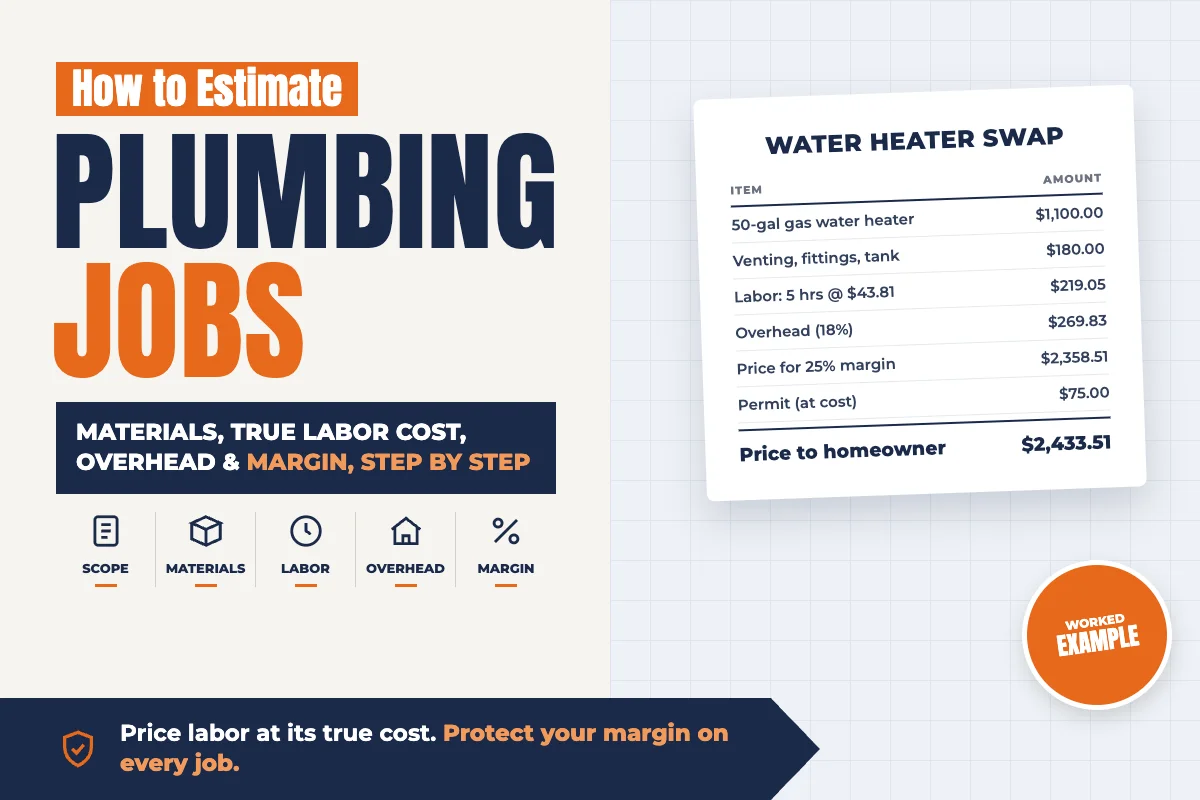
To estimate a plumbing job, list every material at your cost, work out the hours and your true cost per labor hour, add your overhead, then set the price for the profit margin you want. Most underpriced plumbing jobs skip one of the last three steps, not the first.
This guide walks through each step, then prices a real-world job from start to finish.
Key takeaways
- Price materials at what your supplier charges you today, including the small parts.
- Use your true cost per labor hour, not the wage. Taxes, insurance and benefits add a lot.
- Add overhead as a percentage of materials and labor.
- Price for a margin by dividing cost by one minus the margin. A 25% markup is only a 20% margin.
- Write down exclusions so extra work becomes a change order, not free work.
1. Walk the job and write down the scope
Before you price anything, write down exactly what you will and won’t do. For a fixture swap that might be one line. For a remodel rough-in it should list every fixture, the pipe runs, and anything you’re excluding, like drywall repair or permits the homeowner pulls.
Things to check on site:
- Access: crawl space, slab, finished walls or ceilings you’ll need to open
- What’s there now: pipe material, age, shutoffs that work, venting and gas lines
- Code items the job will trigger, such as expansion tanks, venting changes or a permit
- Who supplies the fixtures: you, or the homeowner
A clear scope protects your price. If the homeowner asks for more later, you have a written baseline for a change order.
2. Price materials at your real cost
List each item with its quantity and what you pay your supplier, not a price from memory. Include the small parts, because fittings, valves, supply lines, solder, sealant and hangers add up quickly on every job.
If you buy the same items often, keep a price list and update it when your supplier’s prices change. That way every plumbing estimate starts from current costs.
3. Work out labor hours and your true cost per hour
Estimate the hours for each task, including travel, setup, cleanup and disposal. Then use what an hour really costs you, not just the wage.
According to the US Bureau of Labor Statistics, the median pay for plumbers, pipefitters and steamfitters was $30.67 an hour in May 2025. On top of wages, employers pay for payroll taxes, insurance and benefits. Across private industry, those added costs averaged 30% of total employee compensation in June 2026 (BLS), which means wages were 70%.
To turn a wage into a true hourly cost, divide by that wage share:
$30.67 ÷ 0.70 = $43.81 an hour
Your own number will differ with your wages, workers’ comp rate and benefits. The free employee cost calculator works it out from your real figures.
4. Add your overhead
Overhead is what it costs to run your business: your vehicle, insurance, tools, phone, office, and the hours you spend on quotes and paperwork. Express it as a percentage, then add it to your materials and labor.
If you don’t know your overhead percentage, divide a year of overhead costs by a year of materials and labor costs. The free overhead calculator does this for you.
5. Set the price for your profit margin
Margin is the share of the price you keep as profit. To price for a margin, divide your total cost by one minus the margin:
Price = total cost ÷ (1 − margin)
This is not the same as adding a markup. Adding 25% to your cost gives you a 20% margin, not 25%. Our guide to markup vs margin explains the difference.
Permits and fees you pass straight through can be added at cost after this step.
Worked example: replacing a 50-gallon gas water heater
These are example figures to show how to estimate a plumbing job with this method. Use your own supplier prices and rates.
| Item | Amount |
|---|---|
| Water heater, 50-gallon gas | $1,100.00 |
| Venting, gas connector, expansion tank, fittings and supply lines | $180.00 |
| Materials | $1,280.00 |
| Labor: 5 hours at $43.81 | $219.05 |
| Materials and labor | $1,499.05 |
| Overhead at 18% | $269.83 |
| Total cost | $1,768.88 |
| Price for a 25% margin: $1,768.88 ÷ 0.75 | $2,358.51 |
| Permit, passed through at cost | $75.00 |
| Price to the homeowner | $2,433.51 |
Your profit is $589.63, which is 25% of the $2,358.51 before the permit. If you had priced this as materials and labor plus 25%, you’d have quoted $1,873.81, with your overhead eating most of the profit.
Common plumbing estimating mistakes
- Pricing labor at the wage. The wage leaves out taxes, insurance and benefits.
- Forgetting the small parts. Fittings, valves and supply lines are easy to leave off.
- Leaving out travel and disposal. Both take time, and the old water heater has to go somewhere.
- Confusing markup with margin. A 25% markup only gives a 20% margin.
- No written exclusions. Without them, extra work turns into free work.
Frequently asked questions
How do plumbers estimate jobs?
Most list materials at cost, estimate the hours, multiply by a labor rate, then add overhead and profit. The difference between a profitable and an unprofitable estimate is usually whether the labor rate and overhead reflect the real cost.
What should a plumber charge per hour?
It depends on your costs and market. Start from your true cost per hour, including taxes, insurance and benefits, then add your overhead and margin. That gives a rate that covers your business, rather than one copied from a competitor.
Should I give flat-rate or hourly plumbing quotes?
Flat-rate quotes are easier for homeowners to approve. Hourly pricing suits work where you can’t see the problem until you start. Either way, build the price from the same costs.
Do I add the permit fee to my price?
Many plumbers add permit fees at cost, as in the example, and list them separately so the homeowner sees what they’re for.
Price your next plumbing job with QuickEstimate
QuickEstimate does the overhead and margin math for you on every estimate. You enter materials and labor, it builds the price, and you send a proposal the homeowner can approve and sign online. It doesn’t do takeoffs from plans or job costing. See how it works for plumbers, or start free.