
 QuickEstimate Team
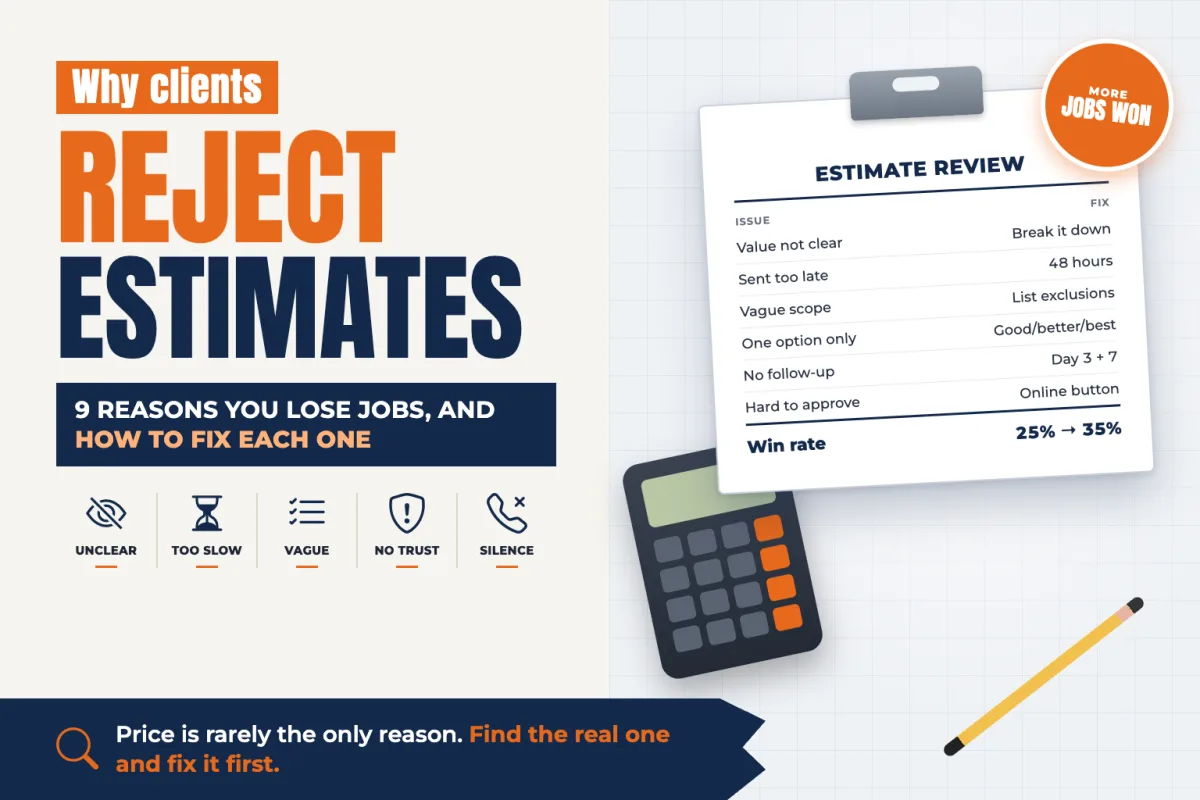
If you’ve ever wondered why clients reject estimates that you know were fair, you’re not alone. Most contractors assume a lost job means their price was too high. Sometimes it was. But far more often the client said no, or said nothing at all, for reasons that have little to do with the number at the bottom of the page.
This guide covers the nine most common reasons clients turn estimates down, how to spot which ones are costing you work, and what to change so more of your estimates turn into signed jobs.
Key takeaways
- Price is rarely the only reason clients reject estimates. Unclear value is far more common.
- Slow estimates, vague scopes and hard-to-approve proposals lose jobs before price is even considered.
- Options, clear exclusions and visible proof of quality win more work than discounts.
- Following up turns many “no answers” into yes.
- Track your win rate and ask lost clients why. Patterns tell you exactly what to fix.
How clients actually compare estimates
Most homeowners collect several prices before they hire. The Better Business Bureau advises consumers to get at least three quotes, compare them on the same criteria, and remember that the cheapest option isn’t always the best. Many clients follow that advice.
So when a client reads your estimate, they’re asking three questions: Do I understand what I’m getting? Do I trust this contractor? Is this good value compared with the others? Your estimate has to answer all three. Understanding why clients reject estimates starts with seeing which of those questions yours leaves open.
9 reasons why clients reject estimates
1. The value isn’t clear
A single total with no explanation forces the client to compare on price alone, so the lowest number wins. When the client can see what’s included (scope, materials, prep, cleanup, warranty), a higher price becomes easier to justify.
Fix: Break the price into clear sections by area or phase, and describe the work in plain language.
2. The estimate arrived too late
Speed signals reliability. If a competitor sends a clear estimate the same day and yours arrives a week later, the client may already have decided, or may assume you’ll be just as slow on the job.
Fix: Aim to send estimates within 24 to 48 hours of the site visit. Templates and saved prices make that realistic.
3. The scope is vague
“Bathroom remodel: $24,000” leaves the client guessing. Vague estimates feel risky, and clients worry about surprise charges later.
Fix: List exactly what’s included and, just as importantly, what’s excluded. Clear exclusions build trust because they show you’re not hiding anything.
4. It doesn’t look professional
A price scribbled on a notepad or a plain text email makes a big project feel like a gamble. Clients judge the job by the paperwork.
Fix: Send a clean, branded estimate with your logo, license number, insurance details and a clear layout. Our guide on how to write a construction proposal shows the structure.
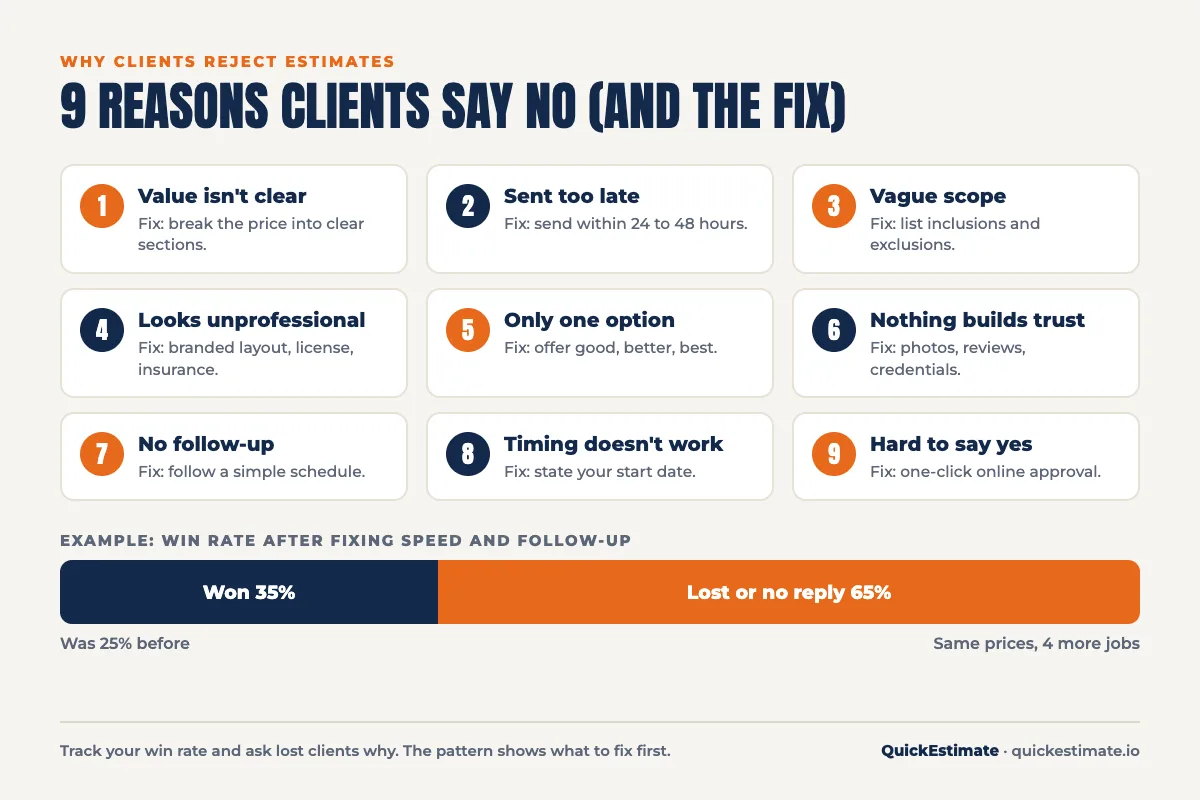
5. There’s only one option
A single price gives the client a yes-or-no decision, and no is easier. Two or three options turn the question into “which one?”
Fix: Offer good, better and best choices, each built from real costs. Many clients pick the middle option instead of asking for a discount.
6. Nothing builds trust
Clients are letting a stranger into their home and handing over a deposit. If your estimate doesn’t show reviews, photos of similar work, your license and insurance, they fill the gap with doubt.
Fix: Add two or three photos of similar finished jobs, a short review and your credentials to every estimate.
7. No follow-up
Many clients never actively reject an estimate. They get busy and it slides down the inbox. Without a follow-up, you never find out whether they had a question, and a competitor who called back wins the job.
Fix: Follow a simple schedule. Our guide on how to follow up on an estimate includes seven templates.
8. The timing doesn’t work
Sometimes the client likes your estimate but needs the work done sooner, or later, than you offered. Or your schedule wasn’t mentioned at all.
Fix: Include a realistic start date and duration, and mention your next available slot in your follow-up.
9. It’s hard to say yes
If accepting your estimate means printing, signing, scanning and emailing a PDF, some clients simply won’t get around to it.
Fix: Make approval one click. An online approval button with a clear deposit step removes friction at the exact moment the client is ready.
Win trust before the estimate arrives
Many jobs are won or lost before the client ever reads your number. The site visit is part of your estimate. Clients notice:
- Whether you arrived on time, or called ahead if you were running late
- Whether you listened and asked good questions about what they want and what worries them
- Whether you explained the next step: when they’ll get the estimate and what it will include
- How you look and communicate: a clean truck, a clear business card, a professional email address
A client who trusts you after the walkthrough reads your estimate looking for reasons to say yes. One who doesn’t reads it looking for reasons to say no.
Present big estimates in person or on a call
For larger jobs, don’t just email the estimate and wait. Offer to walk the client through it, in person or on a short video call. Going through it together lets you explain the options, answer questions immediately and hear objections you’d never see in an email.
It also changes the dynamic. Instead of three PDFs sitting side by side in an inbox, the client has a real conversation with one contractor, and that contractor is usually the one who gets the job. Even ten minutes on the phone can make the difference between a yes and a quiet no.
When price really is the reason
Sometimes your price genuinely is higher. That isn’t automatically a problem. If you’re pricing from real costs and a healthy margin, a lower bid may be missing something, or the contractor may be underpricing and heading for trouble. Still, check your own numbers:
- Are your labor hours realistic, or padded?
- Is your overhead calculated from your books, or guessed?
- Are you applying markup correctly? A 20% markup is only a 16.7% margin, as our guide to markup vs margin explains.
- Are you competing for the right jobs? Some clients will always choose the lowest price. You don’t have to win them.
If price is the objection, offer a lower-cost option with a reduced scope or different materials rather than cutting your price for the same work. Discounting the same scope tells the client your first number wasn’t real.
How to find out why clients reject estimates
You can’t fix what you don’t measure. Two simple habits help:
Ask every lost client
A short, friendly message works: “Thanks for letting us know. So we can improve, was it mainly price, timing or something else?” Many clients will answer honestly, especially if you don’t argue.
Track your win rate
Win rate = jobs won ÷ estimates sent × 100
Track it monthly, and if you can, by job type and lead source. You may find you win most kitchen remodels but few bathrooms, or most referrals but few online leads. That tells you where to focus, and which estimates need a different approach.
Reading the patterns
| What you notice | Likely reason | What to change |
|---|---|---|
| Clients go quiet after receiving the estimate | No follow-up, or unclear next step | Follow-up schedule and online approval |
| “Another contractor was cheaper” | Value not clear, or pricing too high | Clearer scope, options, check your costs |
| “We went with someone who could start sooner” | Schedule or speed | Faster estimates, state your start date |
| Lots of questions before a no | Vague scope | Detailed inclusions and exclusions |
| Wins mostly from referrals | Trust gap with new clients | Add photos, reviews and credentials |
Why clients reject estimates by type of job
The reasons shift depending on the kind of work:
- Emergency and service calls: speed and availability matter most. Clients reject estimates that arrive after they’ve already called someone else.
- Remodels: clients worry about budget overruns and disruption. Clear scope, allowances and a realistic timeline reduce that fear.
- New construction and large projects: trust, track record and financial stability carry more weight. References and similar completed projects matter.
- Commercial and subcontract bids: completeness and compliance with the bid documents come first. A missing item or late submission is often an automatic loss.
Knowing which reasons apply to your typical jobs tells you where to focus first.
Checklist to stop losing estimates
- Estimate sent within 24 to 48 hours of the site visit
- Scope described in plain language, grouped by area or phase
- Inclusions, exclusions and assumptions listed
- Good, better and best options where they make sense
- Photos of similar work, a review, license and insurance included
- Start date and duration stated
- Expiry date on the price
- One-click online approval and a clear deposit step
- Follow-up scheduled before the estimate goes out
- Win rate tracked and lost clients asked why
Example: fixing the biggest problem first
Here’s how this plays out for a typical small remodeling company. Over three months they send 40 estimates and win 10, a win rate of 25%. When they look back, they notice two things: most estimates went out four or five days after the site visit, and 18 of the 30 lost jobs never replied at all.
That points to speed and follow-up, not price. So they change two things. Estimates now go out within 48 hours using saved templates, and every estimate gets a follow-up on day 3 and day 7. Over the next three months they send 40 estimates again and win 14, a win rate of 35%. That’s four extra jobs from the same number of estimates, without touching their prices.
The exact numbers will differ for every business. The lesson doesn’t: find out why clients reject estimates in your business, fix the biggest reason first, then measure your win rate again. It’s the most reliable way to win more jobs without cutting your margin.
Give any change at least a couple of months before judging it. A handful of estimates can swing either way by chance, and the pattern only becomes clear once you have enough of them to compare.
Mistakes that make it worse
- Cutting price by reflex. It trains clients to negotiate and erodes your margin.
- Arguing with a no. Thank them and leave the door open. Many come back later.
- Blaming the market. Some losses are out of your control, but most patterns can be fixed.
- Changing everything at once. Fix the biggest problem first, then measure again.
Small changes that win more jobs
You don’t need to rebuild your whole process to win more jobs. A few small changes often make the biggest difference:
- Send a same-day thank-you after the site visit, with the date the estimate will arrive.
- Put the client’s own words from the walkthrough into the scope. It shows you listened.
- Lead with the finished result, not the demolition. “A bright, easy-to-clean kitchen” before “remove existing cabinets”.
- Add one photo of a similar finished job to every estimate.
- End with one clear next step: “Approve online and we’ll confirm your start date.”
Each one takes minutes. Together they change how the estimate feels to the client, and that’s often enough to win more jobs at the same price.
Turn lost jobs into future work
A no today isn’t always a no forever. Clients who chose another contractor sometimes come back when that contractor doesn’t show up, the project grows, or they need another job done next year. Lost jobs can still become future work if you handle the no well:
- Thank the client and wish them well on the project
- Ask one short question about why, and record the answer
- Keep their details and a note about the job
- Check in once, a few months later, if it’s appropriate
Contractors who stay gracious after lost jobs are the ones clients remember when their first choice falls through. And the reasons you collect show you exactly why clients reject estimates in your market, which is worth more than any generic advice.
How estimating software helps you win more
Many of the reasons clients reject estimates come down to speed, clarity and ease of approval, and those are exactly what estimating software fixes. QuickEstimate lets you build estimates from saved prices in minutes, send a branded proposal with options, see when the client opens it, set follow-up reminders and let the client approve online. You also get a clear view of which estimates are won, lost or waiting.
Frequently asked questions
Why do clients reject contractor estimates?
Common reasons include unclear value, slow delivery, a vague scope, an unprofessional presentation, no options, a lack of trust signals, no follow-up, schedule conflicts and a difficult approval process. Price is only one factor.
What is a good win rate for contractors?
It varies by trade, job type and how leads are generated. Referral leads usually convert better than cold leads. Track your own win rate over time and focus on improving it, rather than comparing to someone else’s.
Should I lower my price if clients keep rejecting estimates?
Not as a first step. Check whether the issue is clarity, speed, trust or follow-up. If your price truly is too high, review your costs and offer lower-cost options rather than discounting the same work.
How can I make my estimates more convincing?
Send them quickly, describe the scope clearly, list exclusions, offer options, include photos and reviews, state your schedule and make approval easy.
Should I ask clients why they rejected my estimate?
Yes. A short, polite question after a no gives you valuable feedback, and it leaves a good impression that can bring the client back later.
How quickly should I send an estimate after a site visit?
As fast as you can do it accurately. Within 24 to 48 hours is a good target for most residential jobs. Larger or more complex projects can take longer, but tell the client when to expect it and stick to that date.
How do I calculate my win rate?
Divide the number of jobs you won by the number of estimates you sent in the same period, then multiply by 100. If you sent 30 estimates and won 9, your win rate is 30%. Track it monthly so you can see whether changes to your estimates are working.
Is a low win rate always bad?
Not always. If you’re pricing for healthy margins, you won’t win every job, and you shouldn’t want to. A very high win rate can mean your prices are too low. Aim for a win rate that keeps your crews busy at the margin your business needs.
The bottom line
Understanding why clients reject estimates is the fastest way to win more work without spending more on marketing. Make your value clear, send estimates fast, offer options, build trust, follow up and make it easy to say yes. Then measure your win rate and keep improving.
Want estimates that are faster to send and easier to approve? Try QuickEstimate free and see which of your estimates clients are opening.