
 QuickEstimate Team
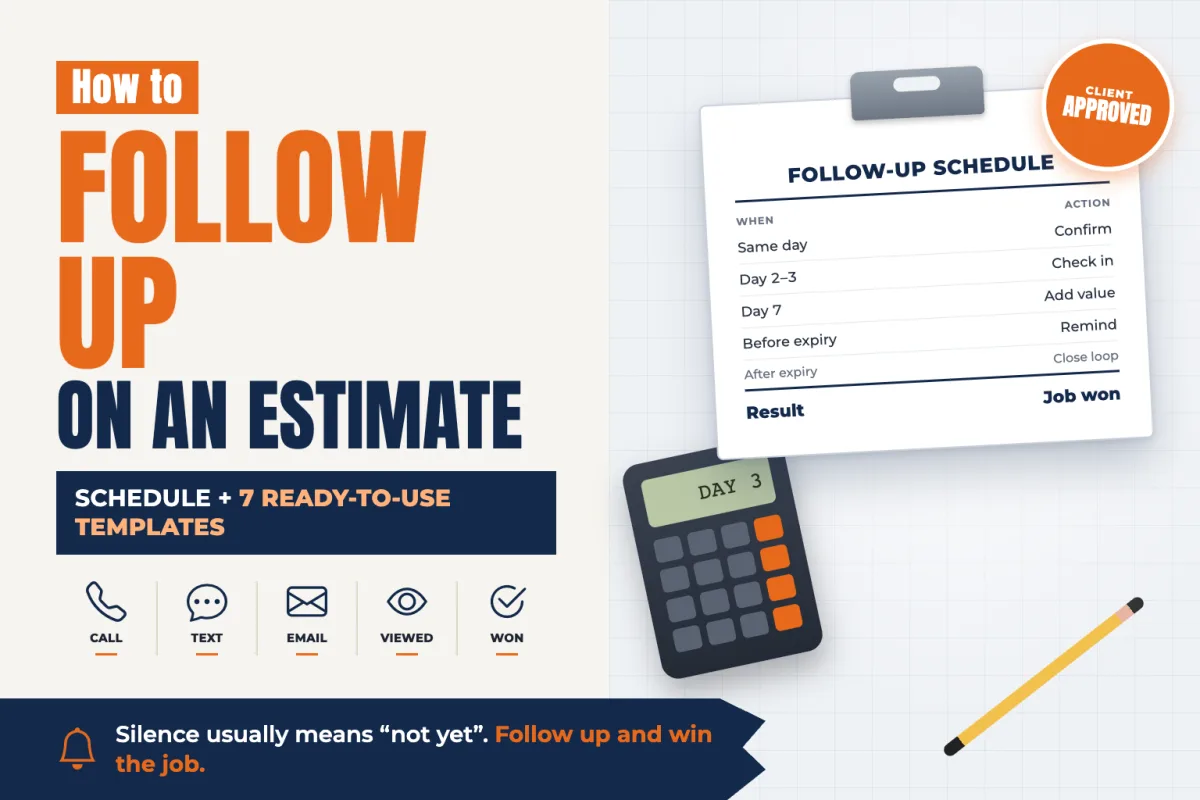
Knowing how to follow up on an estimate is one of the easiest ways to win more work, and one of the most neglected. Most contractors put hours into measuring, pricing and writing a proposal, send it, and then wait. When the client goes quiet, they assume the answer is no and move on.
Often it isn’t no. The client got busy, is comparing bids, has a question they haven’t asked, or simply forgot. A well-timed, helpful follow-up brings many of those jobs back. This guide gives you a simple follow-up schedule, seven ready-to-use templates, and the mistakes that make follow-ups feel pushy.
Key takeaways
- Silence after an estimate usually means “not yet”, not “no”.
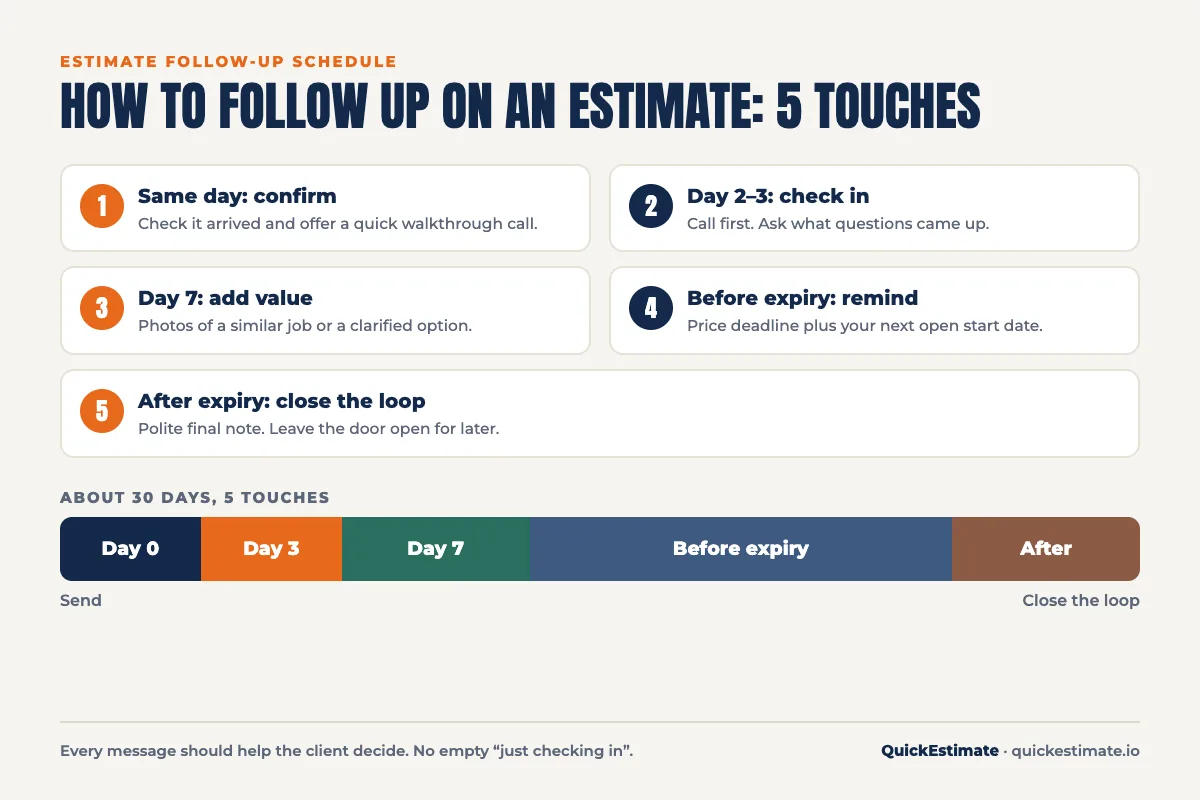
- Follow up on a schedule: same day, after 2 to 3 days, after a week, before the price expires, then close the loop.
- Every follow-up should help the client decide: answer a question, clarify an option or remind them of a deadline.
- Offer options instead of discounts when price is the objection.
- Knowing when a client opened your estimate lets you call at the right moment.
Why you should follow up on an estimate
Clients rarely say yes the moment an estimate arrives. They talk to a partner, check their budget, wait for other bids, or put it aside for the weekend. In that gap, the contractor who stays in touch in a helpful way stays top of mind. The one who disappears gets forgotten.
There’s also a practical reason. Clients often have a small question that’s holding them back: which option includes the new vanity, whether you can start before the holidays, whether the price includes disposal. If you don’t follow up, you never hear the question, and they may hire someone who answered it.
Following up isn’t nagging. Done right, it’s customer service.
The math is worth doing. Say you send 10 estimates a month and win 3. If a consistent follow-up routine wins you just one more job a month, that’s a third more work from the same number of estimates, with no extra marketing spend and no extra site visits. For most contractors, learning how to follow up on an estimate is the cheapest growth available.
Following up also gives you information. Even the clients who say no usually tell you why, and that feedback makes your next estimate stronger.
A simple estimate follow-up schedule
Here’s a schedule that works for most residential jobs. Adjust the timing to the size of the job and how quickly the client said they wanted to decide.
| When | What to do | Channel |
|---|---|---|
| Same day | Confirm the estimate arrived and offer to walk through it | Text or email |
| Day 2–3 | Check in and ask if they have questions | Phone, then email |
| Day 7 | Add something useful: a photo of a similar job, a clarified option | |
| A few days before expiry | Remind them when the price expires and your next available start date | Email or text |
| After expiry | Close the loop politely and leave the door open |
That’s five touches over about a month. Most clients will answer somewhere along the way, and the ones who don’t will remember you as professional rather than pushy.
Set up the follow-up before you send the estimate
The best follow-ups start before the estimate goes out:
- Ask when they plan to decide. “When are you hoping to make a decision?” gives you permission to check in on that date.
- Ask how they prefer to be contacted. Some clients never answer the phone but reply to texts within minutes.
- Put an expiry date on the estimate. It creates a natural reason to follow up and protects you from old prices.
- Offer to walk through it. Many clients will say yes to a 10-minute call, and that call often closes the job.
Our guide on how to write a construction proposal covers expiry dates, options and clear next steps, all of which make follow-up easier.
How to follow up on an estimate: 7 templates
Use these as a starting point and make them sound like you. Short and specific always beats long and generic.
1. Same-day confirmation
“Hi Sarah, I’ve just sent over the estimate for your kitchen lighting. It includes the two options we discussed. If it’s easier, I’m happy to walk you through it on a quick call. Just let me know a good time. Thanks, Mike”
2. Day 2–3 check-in
“Hi Sarah, just checking the estimate came through OK and seeing if any questions came up. A lot of people ask about the dimmer options, so I’m happy to explain the difference if that helps.”
3. Answering a likely question
“Hi Sarah, one thing I should have made clearer: both options include removing the old fixtures and patching the ceiling around the new lights. The only difference is the fixture style and the smart dimmers.”
4. Adding value
“Hi Sarah, we finished a very similar kitchen last week, so I thought you might like to see how it turned out. Photos attached. Happy to answer anything about your project.”
5. Expiry reminder
“Hi Sarah, a quick heads-up: the pricing in your estimate is good until Friday the 14th. After that I’ll need to recheck material costs. We also have an opening to start on the 21st if you’d like to go ahead.”
6. Closing the loop
“Hi Sarah, I haven’t heard back, so I’ll assume the timing isn’t right for now. No problem at all. If anything changes, I’m happy to update the estimate. Thanks again for considering us.”
7. After a no
“Thanks for letting me know, Sarah. I appreciate it. If you don’t mind me asking, was it mainly price, timing or something else? It really helps us improve. Either way, we’d be glad to help with any future projects.”
The closing-the-loop message is surprisingly effective. Clients who have been meaning to reply often do, because it gives them an easy moment to say “actually, we’d like to go ahead” or “we went another way”.
Weak vs strong follow-up messages
The difference between a follow-up that gets ignored and one that gets a reply is usually one specific, useful detail:
| Weak follow-up | Strong follow-up |
|---|---|
| “Just checking in on the estimate.” | “Just checking the estimate came through. Happy to explain the difference between the two tile options.” |
| “Have you made a decision yet?” | “We have a start date open on the 21st if you’d like to go ahead. Pricing is good until the 14th.” |
| “We can do it cheaper if you want.” | “If budget is a concern, a standard fixture line brings it to $18,900 with the same layout.” |
| “Following up again.” | “Here are photos of a similar bathroom we finished last week, in case it helps you picture yours.” |
Strong messages give the client a reason to reply: new information, a clear choice or a real deadline.
Phone, text or email?
Use more than one channel, and follow the client’s lead:
- Phone is best for the first real follow-up. A conversation surfaces questions an email never will.
- Text is great for quick, friendly check-ins, as long as the client has given you their number for that purpose.
- Email is best for anything with detail: clarified options, photos, updated pricing.
Following up on an estimate a client asked for is generally treated as a relationship message rather than marketing. The FTC’s CAN-SPAM compliance guide explains that messages with only transactional or relationship content are exempt from most of the Act’s requirements. Promotional emails to past clients, such as seasonal offers, need to follow the rules, including a clear way to opt out.
What to do when price is the objection
If the client says “it’s more than we expected”, don’t jump straight to a discount. A discount tells the client your first price wasn’t real, and it comes straight out of your profit. Instead:
- Ask what matters most. Is it the total, the monthly cash flow, or one expensive item?
- Offer a smaller scope or different materials. “We can keep the layout and use a standard fixture line, which brings it to $X.”
- Offer phasing. Do the essential work now and the rest later.
- Explain what’s included. Permits, disposal, cleanup and warranty are often missing from cheaper bids.
If you do adjust the price, make sure you still hit your target margin. Our guide to markup vs margin shows why a small discount can wipe out most of your profit.
Use timing to your advantage
The best time to follow up on an estimate is when the client is thinking about it. If your proposal software shows you when the client opens the estimate, you can call while it’s fresh: “I saw you had a chance to look through the estimate. Did anything jump out?”
QuickEstimate shows when a proposal has been viewed and lets you track proposal status from sent to approved. You can also set up follow-up reminders so no estimate slips through the cracks.
Track every open estimate
You can’t follow up on an estimate you’ve forgotten about. Keep a simple list of every open estimate with:
- Client name and job
- Date sent and expiry date
- Last contact and next follow-up date
- Status: sent, viewed, questions, verbal yes, won, lost
Review it at the same time every week. Many contractors find a handful of jobs they’d completely forgotten, and a few of them turn into work.
How to follow up on an estimate for commercial work
Commercial and general contractor bids work differently. The decision is usually made by a project manager or estimator working to a bid date, and they’re handling dozens of subcontractor prices at once.
- Confirm receipt before the bid date, and check they have your latest version, including any addenda.
- Offer to clarify scope. “Happy to walk through our inclusions and exclusions if it helps you level the bids.”
- Follow up after the bid date to ask whether the GC was awarded the project, and whether you’re being carried.
- Ask for feedback if you lose. Many estimators will tell you roughly where you landed, which is invaluable for the next bid.
A reputation for clear, responsive follow-up gets you invited to bid again, which is half the battle in commercial work.
What to do after a verbal yes
A verbal yes isn’t a signed job. Many contractors lose work between “we’d like to go ahead” and the start date because the paperwork stalls. Move quickly:
- Send the final proposal or contract for signature the same day
- Make it easy to approve online, with no printing or scanning
- Confirm the deposit amount and how to pay
- Give a start date and what happens next
The follow-up doesn’t end until the deposit is in and the job is on the calendar.
Follow up after the job, too
Once the work is finished, one more follow-up pays off for years. A week after completion, check that everything is working and ask how the experience was. If the client is happy, ask for a review and whether they know anyone else who needs similar work.
Past clients are the cheapest source of new estimates you’ll ever have. A short check-in every few months, such as a seasonal maintenance reminder, keeps you in mind for the next project. Just remember that promotional messages need to follow email marketing rules, including an easy way to unsubscribe.
Automate reminders, not relationships
The hardest part of learning how to follow up on an estimate is remembering to do it. Busy weeks on site mean follow-ups slip. Use tools to remind you, not to replace you:
- Set a follow-up date on every estimate the moment you send it
- Get notified when the client views the proposal
- Save your templates so each message takes a minute, then personalize them
- Review your open estimates weekly
Automated reminders keep you consistent. The personal touch, a real name and a specific detail about their job, is what wins the work.
Estimate follow-up mistakes to avoid
- Not following up at all. It’s the most common mistake, and the most expensive.
- “Just checking in” with nothing to add. Every follow-up should help the client decide.
- Following up too often. Daily messages feel like pressure. Space them out.
- Leading with a discount. Offer options first.
- Arguing with a no. Thank them, ask for feedback, and leave the door open.
- Letting old estimates hang. Close the loop so your pipeline reflects reality.
Estimate follow-up checklist
- Asked the client when they plan to decide and how they prefer to be contacted
- Put an expiry date on the estimate
- Set a follow-up date the moment the estimate was sent
- Confirmed receipt the same day
- Made every follow-up useful: a question answered, an option clarified or a deadline mentioned
- Offered options, not discounts, on price objections
- Closed the loop on estimates that went quiet
- Asked for feedback on lost jobs and recorded the reason
Learn from every lost estimate
When you lose a job, try to find out why. Was it price, timing, trust, or a competitor who replied faster? Track the reasons for a few months and patterns appear. If price comes up again and again, check your estimates against real costs. If speed is the issue, fix how quickly estimates go out. Our guide to estimation workflow mistakes covers the most common causes.
Frequently asked questions
How soon should I follow up on an estimate?
Confirm it arrived the same day, then follow up properly after 2 to 3 days. Adjust to the client’s own timeline if they told you when they plan to decide.
How many times should I follow up on an estimate?
Four or five helpful touches over about a month is reasonable for most jobs: confirmation, a check-in, a value-add, an expiry reminder and a final close-the-loop message.
What should I say when I follow up on an estimate?
Keep it short and helpful. Confirm they received it, offer to answer questions, clarify an option, or remind them when the price expires. Avoid messages with nothing new to say.
Is it pushy to follow up on an estimate?
Not if you’re helpful and respectful. Most clients appreciate a contractor who stays in touch. Pushy is daily messages, pressure tactics or arguing with a no.
Should I offer a discount in a follow-up?
Usually not as a first step. Offer a smaller scope, different materials or phased work instead. That keeps your price credible and protects your margin.
What if the client never responds?
Send a polite close-the-loop message, mark the estimate as lost or inactive, and move on. Keep their details. Many clients come back months later when their timing changes.
Should I follow up by phone or email?
Both. A phone call is the best first real follow-up because it brings out questions. Email is better for sending details, photos or an updated option. Text works well for short, friendly check-ins if the client prefers it. Match the channel to the client, not to what’s easiest for you.
The bottom line
Learning how to follow up on an estimate turns silence into answers and answers into jobs. Set expectations before you send, follow a simple schedule, make every message useful, and close the loop politely. You’ll win work you’d otherwise have lost to the contractor who simply stayed in touch.
Want to know exactly when clients open your estimates? Try QuickEstimate free and get proposal tracking and follow-up reminders built in.