
 QuickEstimate Team
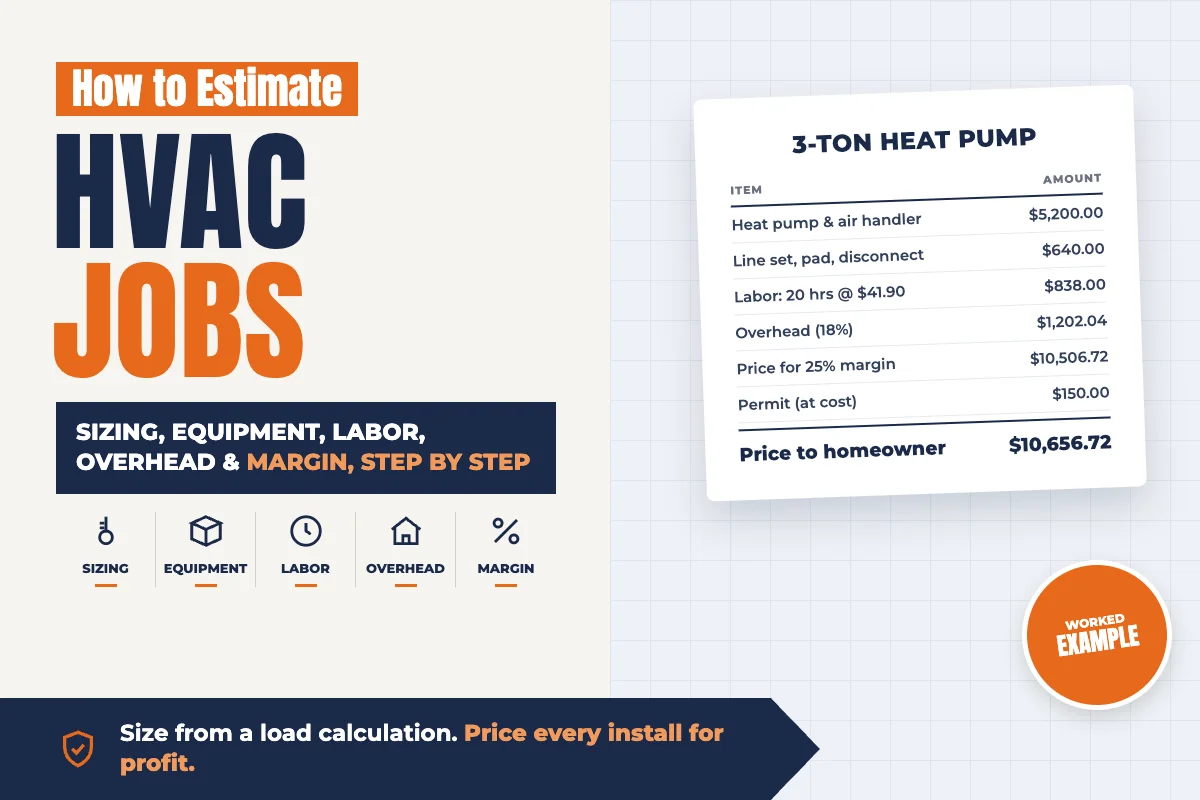
To estimate an HVAC job, size the system from a load calculation, price the equipment and materials at your cost, work out the labor hours at your true hourly cost, add overhead, then set the price for your profit margin. On replacement jobs, the equipment is usually the biggest number, but labor and overhead are where estimates go wrong.
Key takeaways
- Size the system from a load calculation, not from the old unit.
- Price equipment and install materials at your distributor’s current cost.
- Use your true cost per labor hour, including taxes, insurance and benefits.
- Add overhead, then price for your margin by dividing cost by one minus the margin.
- Offer good, better and best options so homeowners can choose.
1. Size the system from a load calculation
Don’t size the new system from the old one. Houses change: new windows, insulation or additions all change the load. An oversized system costs the homeowner more and often short-cycles. An undersized one can’t keep up.
For homes, the standard is ACCA Manual J. ACCA describes it as “the national ANSI-recognized standard for producing HVAC equipment sizing loads for single-family detached homes”, and says a proper load calculation “is required by national building codes and most state and local jurisdictions” (ACCA). Check what your local inspector requires.
2. Write down the scope
List what the job includes and excludes. For a replacement that usually means:
- Removing and disposing of the old equipment and refrigerant
- New equipment: outdoor unit, indoor unit or coil, thermostat
- Line set, pad, disconnect, electrical whip, condensate line
- Ductwork changes, if any, and whether they’re in or out of scope
- Permit, startup, and testing
Write the exclusions down too, such as electrical panel upgrades or drywall repair. If the homeowner asks for them later, you have a baseline for a change order.
3. Price equipment and materials at your cost
Use your distributor’s current price for the equipment, not last year’s. Then add the materials that come with every install: line set, pad, disconnect, whip, fittings, refrigerant, condensate parts and thermostat wire.
Keeping these in a price list saves time and stops you leaving them off.
4. Work out labor hours and your true cost per hour
Estimate the hours for removal, installation, wiring, brazing, evacuation, startup and cleanup, for every person on the crew. Then use what an hour really costs you.
According to the US Bureau of Labor Statistics, the median pay for HVAC mechanics and installers was $29.33 an hour in May 2025. Employers also pay payroll taxes, insurance and benefits, which averaged 30% of total compensation across private industry in June 2026 (BLS). That makes wages 70% of the cost of an employee:
$29.33 ÷ 0.70 = $41.90 an hour
Use your own wages and costs where you can. The free employee cost calculator works out your real figure.
5. Add overhead, then price for your margin
Add your overhead percentage to equipment, materials and labor. Overhead covers trucks, tools, insurance, your office, and the time spent on sales calls and quotes. The free overhead calculator helps you find your percentage.
Then set the price for your target margin:
Price = total cost ÷ (1 − margin)
Pass-through costs like permits can be added at cost after this step.
Worked example: replacing a system with a 3-ton heat pump
These are example figures to show how to estimate an HVAC job with this method. Use your own distributor prices and rates.
| Item | Amount |
|---|---|
| 3-ton heat pump and matched air handler | $5,200.00 |
| Line set, pad and disconnect | $640.00 |
| Equipment and materials | $5,840.00 |
| Labor: 2 technicians, 10 hours each, 20 hours at $41.90 | $838.00 |
| Materials and labor | $6,678.00 |
| Overhead at 18% | $1,202.04 |
| Total cost | $7,880.04 |
| Price for a 25% margin: $7,880.04 ÷ 0.75 | $10,506.72 |
| Permit, passed through at cost | $150.00 |
| Price to the homeowner | $10,656.72 |
Your profit is $2,626.68, which is 25% of the $10,506.72 before the permit.
Offer good, better and best options
HVAC replacements suit tiered options: for example a standard-efficiency system, a higher-efficiency one, and a top tier with a better thermostat or a longer labor warranty. Price each one with the same method. Homeowners get to choose for themselves, instead of a single yes or no.
Common HVAC estimating mistakes
- Sizing from the old unit instead of a load calculation.
- Pricing labor at the wage, without taxes, insurance and benefits.
- Forgetting install materials, like the pad, disconnect, whip and refrigerant.
- Leaving out disposal, including recovering the old refrigerant.
- Confusing markup with margin. Adding 25% to cost only gives a 20% margin. See markup vs margin.
Frequently asked questions
How do you estimate an HVAC job?
Size the system from a load calculation, list equipment and materials at your cost, estimate the crew’s hours at your true hourly cost, add overhead, then price for your margin.
How long does a residential HVAC replacement take?
It varies with the system, access and ductwork. Estimate from your own past jobs, and include removal, startup and cleanup time.
Do I need a Manual J for a replacement?
ACCA says a proper load calculation is required by national building codes and most local jurisdictions. Check what your local inspector asks for.
Is HVAC estimating the same as job costing?
No. Estimating sets the price before the job. Job costing tracks what the job actually cost afterwards, so you can compare.
Price your next HVAC job with QuickEstimate
QuickEstimate adds your overhead and margin to every estimate, lets you offer good, better and best options on paid plans, and sends a proposal the homeowner can approve and sign online. It doesn’t do load calculations, takeoffs or job costing. See how it works for HVAC, or start free.