
 QuickEstimate Team
Estimating vs job costing comes down to two different questions. Estimating asks what this job should cost and what you should charge, before you start. Job costing asks what the job actually cost once you’ve done it. You need both to know whether you’re making money, but they happen at different times and often in different tools.
Key takeaways
- Estimating sets your price before the job. Job costing tracks the real cost during and after it.
- Comparing the two shows which tasks you underestimate.
- A few extra hours can cut a 25% margin to under 19% without you noticing.
- Small contractors can start job costing with a simple spreadsheet.
- Job costing usually comes in construction management platforms, not estimating tools.
What estimating is
An estimate is your prediction of the job’s cost, plus the price you’ll charge. You list materials, labor hours, overhead and your profit margin, then send a quote or proposal to the client.
Estimating happens before the job, and its main purpose is to win the work at a price that pays. Our guides to estimating a plumbing job and estimating an HVAC job walk through the method.
What job costing is
Job costing tracks the real costs of a job as it happens: hours from timesheets, materials from receipts and invoices, subcontractor bills, and equipment. At the end, you compare the actual costs with what you estimated.
Job costing happens during and after the job. Its purpose is to show where the money really went, so the next estimate is better.
Estimating vs job costing at a glance
| Estimating | Job costing | |
|---|---|---|
| When | Before the job | During and after the job |
| Question | What should this cost, and what do I charge? | What did it actually cost? |
| Uses | Your price list, expected hours, overhead and margin | Timesheets, receipts, supplier invoices, sub bills |
| Result | A price and a proposal | Actual profit on each job |
| Main benefit | Win work at a price that pays | Learn where estimates were wrong |
How they work together
Each one makes the other better. Your estimate sets the target. Job costing shows how close you came. Over time, the gaps show you which tasks you underestimate, so you can fix your hours, your labor rate or your overhead.
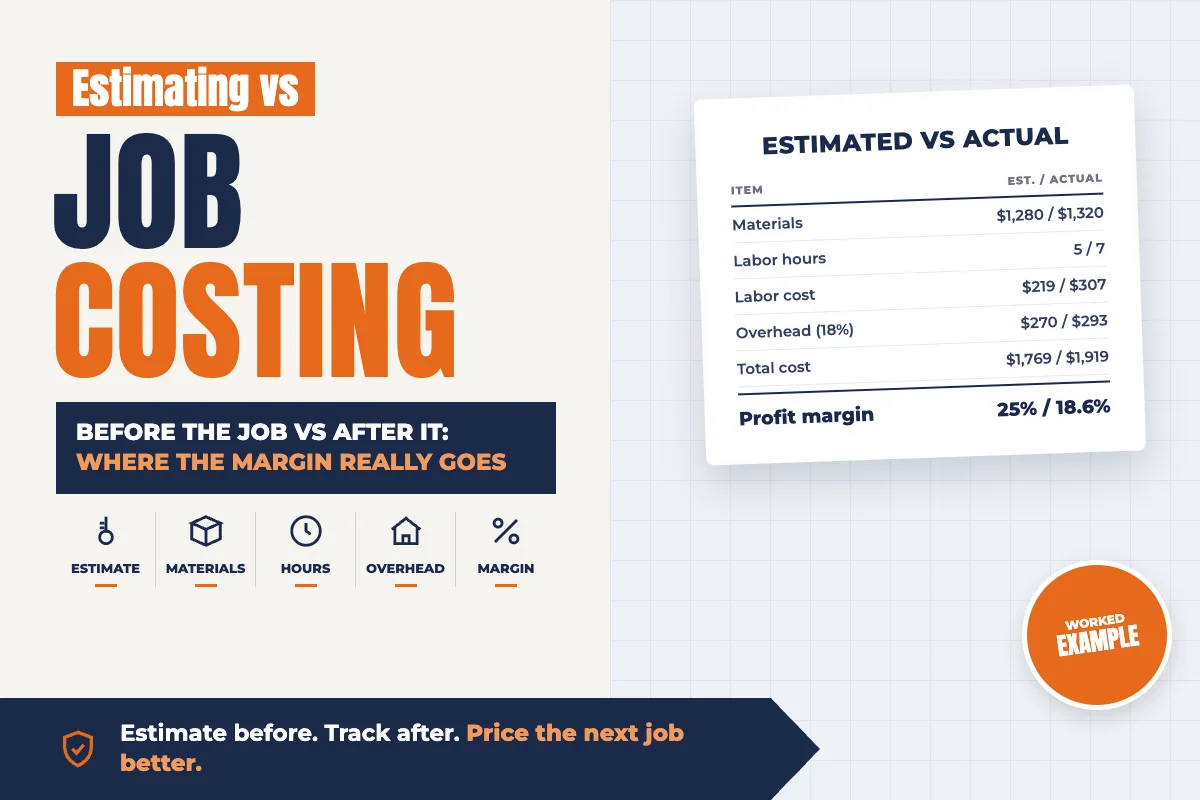
Here’s an example using the water heater job from our plumbing guide, priced at $2,358.51 before the permit for a 25% margin. These are example figures.
| Estimated | Actual | |
|---|---|---|
| Materials | $1,280.00 | $1,320.00 |
| Labor at $43.81 an hour | 5 hours, $219.05 | 7 hours, $306.67 |
| Overhead at 18% | $269.83 | $292.80 |
| Total cost | $1,768.88 | $1,919.47 |
| Profit on $2,358.51 | $589.63 (25%) | $439.04 (18.6%) |
Two extra hours and $40 more in parts cut the margin from 25% to 18.6%. Without job costing, you’d never see it, and you’d price the next one the same way.
Do small contractors need job costing?
If you do a few similar jobs a month, a simple habit can be enough: note the actual hours and material receipts for each job, and compare them with your estimate. A spreadsheet works for that.
As you grow, take on bigger jobs or run several crews, tracking costs by hand gets harder. That’s when dedicated job costing, usually part of a construction management platform, starts to pay off.
Which tools do which
- Estimating and proposal tools focus on pricing the job and sending the quote. QuickEstimate is one of these.
- Construction management platforms often include job costing alongside scheduling and invoicing. For example, Projul lists job costing among its features. Check each platform’s feature list for job costing specifically.
- Accounting software records what you spend. Some contractors use it for job costing by tagging costs to jobs.
Our comparison of construction bidding software covers several of these tools and what they cost.
Frequently asked questions
What is the difference between estimating and job costing?
Estimating predicts costs and sets your price before a job. Job costing tracks the real costs during and after the job, so you can compare them with the estimate.
Is job costing the same as accounting?
Not quite. Accounting records your business’s money overall. Job costing breaks costs down by job, so you can see which jobs made money.
What is HVAC or plumbing job costing software?
It’s software that tracks the actual labor, materials and other costs for each HVAC or plumbing job. It’s often part of a larger field service or construction management platform.
Can I do job costing in a spreadsheet?
Yes, for a small number of jobs. List each job’s estimated and actual hours and materials, and compare them when the job is done.
Where QuickEstimate fits
QuickEstimate is an estimating and proposal tool. It builds each price with your overhead and margin, and sends a proposal your client can approve and sign online. It doesn’t do job costing, so if that’s what you need, use a platform that includes it. You can still use a dedicated estimating tool alongside one. See how QuickEstimate works, or start free.