
 QuickEstimate Team
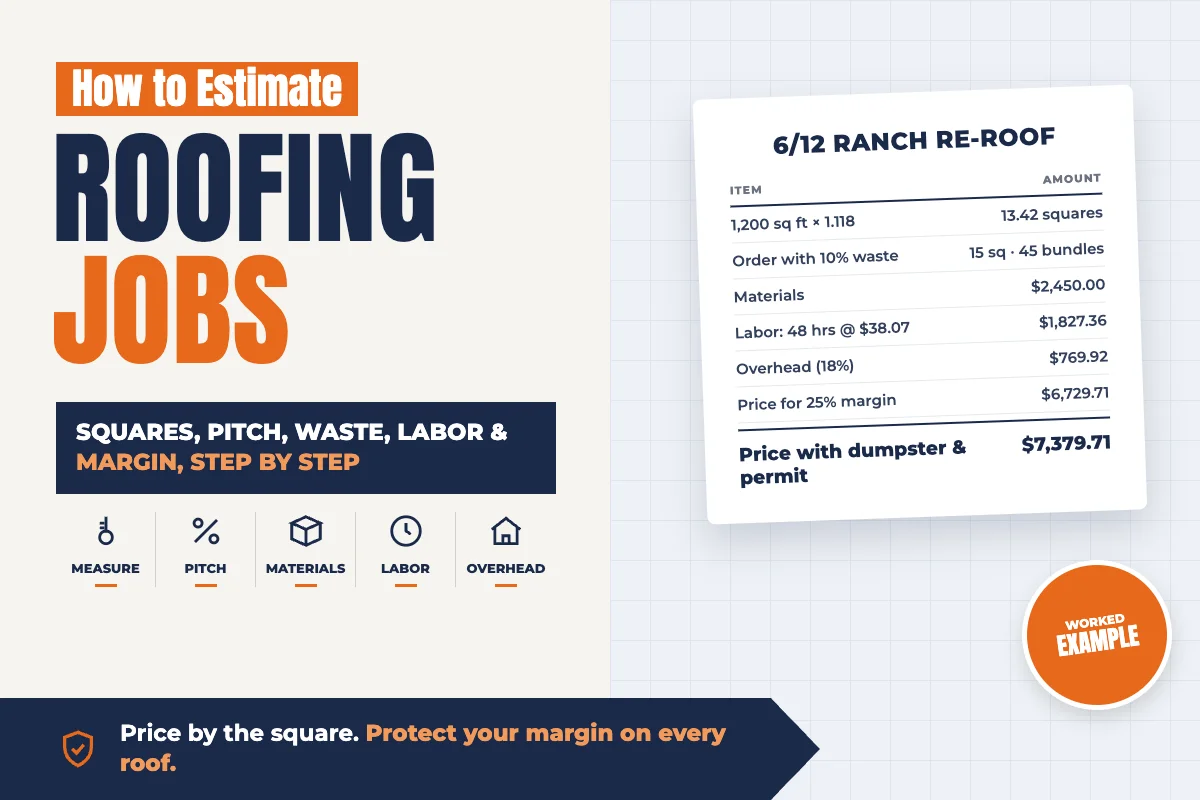
To estimate a roofing job, measure the roof’s footprint, multiply by the pitch factor to get the real roof area, convert it to squares, and add a waste allowance. Then price materials and labor, add overhead, and set the price for your margin. Roofing is priced by the square, and a roofing square is 100 square feet of roof surface.
Key takeaways
- A roofing square is 100 square feet of roof surface.
- Multiply the footprint by the pitch factor before converting to squares.
- Add waste for cuts, hips, valleys and ridges, based on your past jobs.
- Include every extra: underlayment, starter, ridge cap, drip edge, flashing and vents.
- Price labor at its true cost, then add overhead and price for your margin.
1. Measure the footprint
Measure the length and width of the area the roof covers, including the overhangs. For a simple rectangle, multiply them. For more complex roofs, split the roof into rectangles and triangles, work out each one, then add them up.
Aerial measurement reports are an alternative when you can’t safely get on the roof.
2. Adjust for the pitch
A sloped roof has more surface than its footprint. Multiply the footprint by the pitch factor to get the actual roof area.
Pitch factor = √(12² + rise²) ÷ 12
| Pitch | Pitch factor |
|---|---|
| 4/12 | 1.054 |
| 6/12 | 1.118 |
| 8/12 | 1.202 |
| 10/12 | 1.302 |
| 12/12 | 1.414 |
The free roofing calculator does this conversion for any pitch.
3. Convert to squares and add waste
Divide the roof area by 100 to get squares. Then add a waste allowance for cuts, starter rows, hips, valleys and ridges. Simple gable roofs need less waste than cut-up roofs with lots of hips and valleys. Use what your past jobs needed.
Then convert squares to bundles. For example, Owens Corning lists 3 bundles per square for its Duration shingles. Always check the coverage on the product you’re buying.
4. List all the materials
Shingles are only part of it. Include:
- Underlayment and ice and water barrier where needed
- Starter strip and ridge cap
- Drip edge and flashing
- Vents
- Nails and sealant
- Replacement decking, priced as an allowance if you can’t see it yet
5. Work out labor at your true cost
Estimate the crew hours for tear-off, deck repair, underlayment, installation and cleanup. Then use your true cost per hour.
According to the US Bureau of Labor Statistics, the median pay for roofers was $26.65 an hour in May 2025. Employers also pay payroll taxes, insurance and benefits, which averaged 30% of total compensation across private industry in June 2026 (BLS). Dividing by the 70% wage share gives:
$26.65 ÷ 0.70 = $38.07 an hour
Your own workers’ compensation rate for roofing makes a big difference here, so check your real figure. The free employee cost calculator works out your real figure.
6. Add overhead, then price for your margin
Add your overhead percentage to materials and labor, then price for your margin:
Price = total cost ÷ (1 − margin)
Pass-through costs like the dumpster and permit can be added at cost after this step.
Worked example: re-roofing a 6/12 ranch house
These are example figures to show how to estimate a roofing job with this method. Use your own measurements, supplier prices and rates.
Measuring: the footprint with overhangs is 40 ft by 30 ft, or 1,200 sq ft. At a 6/12 pitch: 1,200 × 1.118 = 1,341.6 sq ft, or 13.42 squares. With a 10% waste allowance that’s 14.76 squares, so you order 15 squares, which is 45 bundles.
| Item | Amount |
|---|---|
| Shingles: 45 bundles at $40 | $1,800.00 |
| Underlayment, starter, ridge cap, drip edge, vents and nails | $650.00 |
| Materials | $2,450.00 |
| Labor: 48 crew hours at $38.07 | $1,827.36 |
| Materials and labor | $4,277.36 |
| Overhead at 18% | $769.92 |
| Total cost | $5,047.28 |
| Price for a 25% margin: $5,047.28 ÷ 0.75 | $6,729.71 |
| Dumpster, passed through at cost | $500.00 |
| Permit, passed through at cost | $150.00 |
| Price to the homeowner | $7,379.71 |
That works out to about $550 per square of roof. Your profit is $1,682.43, which is 25% of the $6,729.71 before the pass-through costs.
Common roofing estimating mistakes
- Pricing from the footprint without the pitch factor.
- Not enough waste on roofs with hips and valleys.
- Forgetting the extras: ridge cap, starter, drip edge, flashing and vents.
- No decking allowance for rot you find after tear-off.
- Pricing labor at the wage, without taxes, insurance and workers’ comp.
Frequently asked questions
How many square feet is a roofing square?
A roofing square is 100 square feet of roof surface.
How do I calculate roofing squares?
Multiply the footprint by the pitch factor to get the roof area, divide by 100, then add your waste allowance.
How many bundles are in a square?
It depends on the shingle. Owens Corning lists 3 bundles per square for its Duration shingles, for example. Always check the coverage listed for the product you use.
What should a roofing estimate include?
The measured squares, all materials, tear-off and disposal, labor, any decking allowance, permits, and your overhead and profit. List exclusions too.
Price your next roof with QuickEstimate
QuickEstimate adds your overhead and margin to every estimate, and sends a proposal your client can approve and sign online. It doesn’t measure roofs or do takeoffs. Use the free roofing calculator for squares. See how it works for roofers, or start free.